
Roasting pan alternatives work best when you choose the cooking method before choosing the vessel. A rimmed sheet pan can suit a flattened turkey; a skillet can handle a small chicken; a casserole may fit a turkey breast. None earns a universal whole-bird capacity simply by being oven-safe.
Start with the cookware you already own. The seven options below help you judge the usable footprint, drippings, lifting weight and gravy plan before buying another bulky pan. If your bird needs more support or room than your substitute provides, change the meal format or borrow a properly sized roaster.
Affiliate disclosure: As an Amazon Associate, we earn from qualifying purchases. Product suggestions are based on published specifications, not hands-on testing. Images are AI-generated editorial illustrations, not photographs of the recommended products.
Table of Contents
Choose roasting pan alternatives by the meal
The most useful distinction is whole bird versus portions. Spatchcocking lowers a bird but spreads its legs and wings wider. A turkey breast occupies less space, yet still releases juices. Choose roasting pan alternatives by the actual food shape and recipe, rather than a guessed pounds-per-pan rule.
| Substitute | Best starting use | Main limitation |
|---|---|---|
| Rimmed sheet pan + oven-safe rack | Spatchcocked poultry or portions | Shallow liquid capacity |
| Cast iron skillet | Small chicken or compact roast | Weight and round footprint |
| Oven-safe stainless skillet or sauté pan | Small roast with pan sauce | Handle and oven ratings |
| Fixed-base metal cake pan | Turkey breast or small roast | Grip and burner restrictions |
| Two-piece broiler pan | Smaller poultry that fits its tray | Hidden drippings and rack load |
| Oven-safe casserole dish | Breast, portions or small roast | Thermal shock and tall sides |
| Supported disposable foil pan | Occasional holiday cooking | Flexible walls; no burner use |
These are selection judgments, not tested load ratings. For a dedicated pan, our roasting pan size guide explains interior measurements, outer handles and loaded height. Apply the same measurements to roasting pan alternatives; the oven does not become larger because the cookware has a different name.
For example, a couple cooking a turkey breast may already own a suitable fixed-base cake pan and saucepan. A household preparing a flattened bird needs to check width before choosing among sheet-pan roasting pan alternatives. Put the side dishes into the oven plan too: a tray that occupies the entire shelf may leave no useful space for vegetables. Compare roasting pan alternatives as part of the whole dinner, including which burner remains free for gravy and where the hot pan will rest during carving.
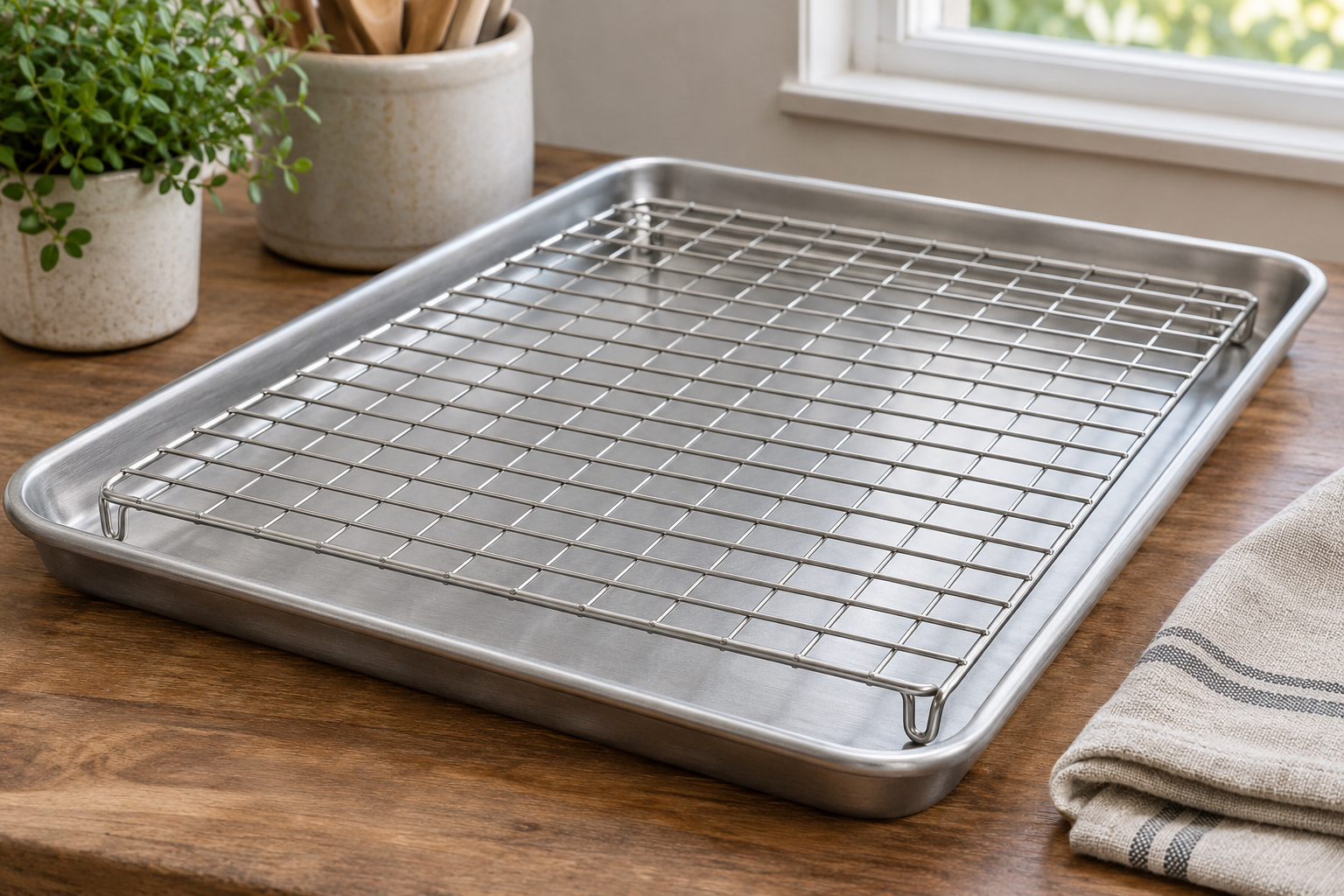
1. Rimmed sheet pan: the flexible everyday option
A sturdy rimmed sheet pan is the first cupboard to check for flattened poultry and separate pieces. The University of Maine Extension roasted turkey recipe explicitly allows a roasting pan or rimmed sheet with a rack for its 10–14-pound turkey. That supports the method, not an unlimited weight promise for every baking sheet.
Among roasting pan alternatives, this is especially useful when you also bake biscuits or roast vegetables weekly. Choose a continuous raised rim, a base that sits steadily, and an oven-approved rack that fits completely inside. A flat cookie sheet with an open edge cannot contain the same drippings.
Check roasting pan alternatives for liquid headroom
The rim is your limiting feature. Keep every part of the food over the pan, leave space for juices, and avoid recipes that add a large volume of stock. A rack occupies some of that space. Measure its feet and height rather than assuming a cooling rack is also suitable for roasting.
For a useful size reference, Nordic Ware lists its Naturals half sheet at 17.9 × 12.9 × 1 inch externally. Its separate product guidance gives a 500°F oven limit. Those figures describe that uncoated pan; a rack, coating or liner can impose a lower limit.
The Nordic Ware Naturals Half Sheet two-pack makes sense if sheet pans will earn regular use after the holiday. It supplies pans, not a roasting rack; verify a suitable rack separately and do not buy two merely to solve one dinner.
2. Cast iron skillet: keep the roast compact
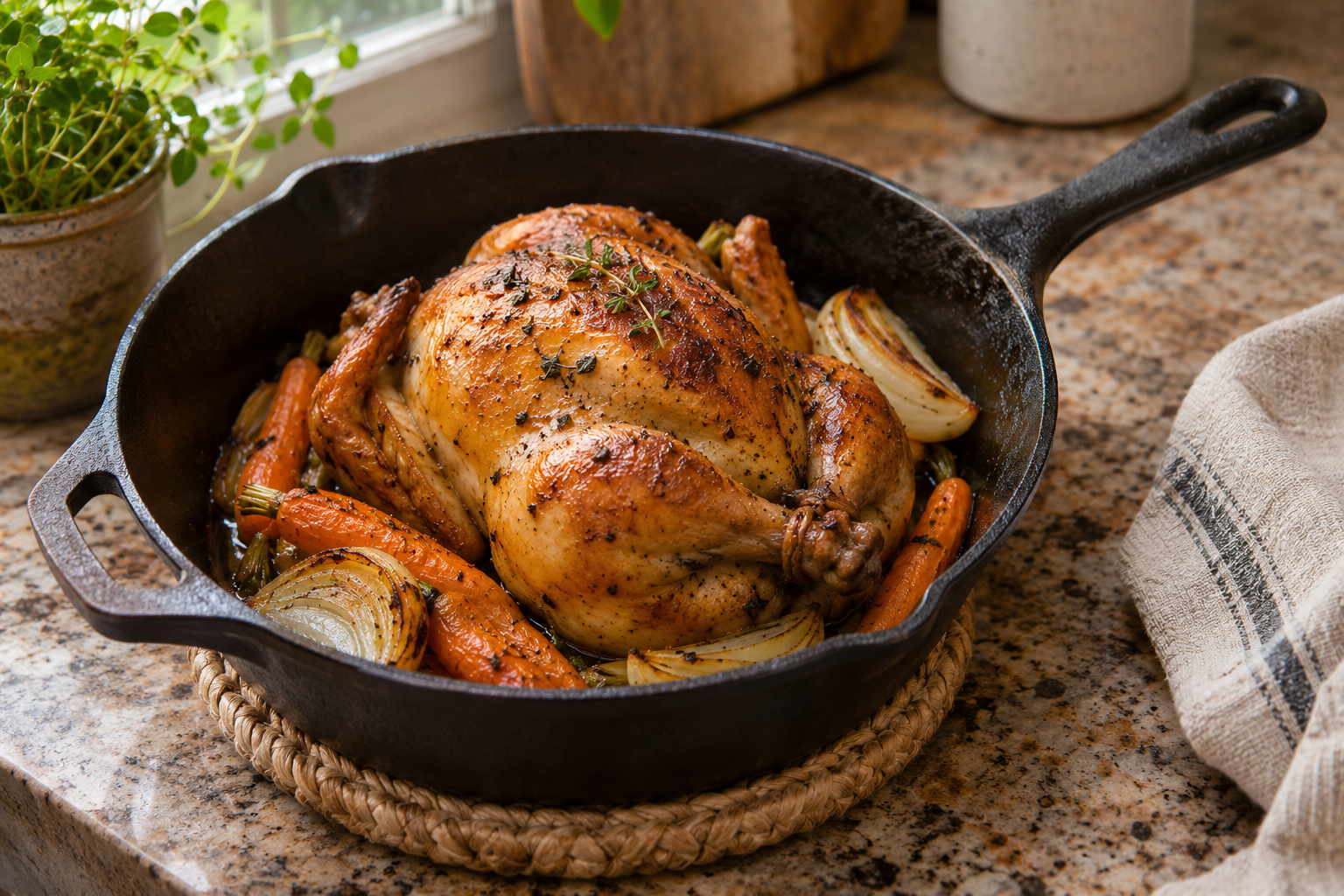
Cast iron skillets are practical roasting pan alternatives for a small chicken, a turkey breast that fits, or a compact boneless roast. Its round shape is the constraint: a long roast may crowd the sides even when the skillet looks generous. Arrange the food so the entire footprint stays above the pan.
Roasting pan alternatives should also pass a lifting rehearsal. Cast iron plus meat, vegetables and juices can be cumbersome. Test your grip on the cold, empty skillet using dry oven mitts, including the helper handle. Arrange a heatproof landing area before cooking, and choose a lighter setup if handling already feels awkward.
Consider the Lodge 12-inch seasoned cast iron skillet, L10SK3 for compact roasting plus everyday searing. The integral helper grip is useful for two-handed handling; the 12-inch label is not a turkey-capacity rating. Our Lodge cast iron review covers the ownership tradeoffs before you commit to its weight and maintenance.
Do not enlarge the meal simply because the pan is heavy. Leave room to reach the roast with utensils and remove it without spilling. If you are deciding between pans already in the cupboard, the 10-inch versus 12-inch skillet guide helps separate top diameter from usable cooking space.
3. Stainless skillet or sauté pan: plan the sauce first
Oven-safe stainless roasting pan alternatives can suit a small roast when you want to finish a sauce on the stove. A sauté pan offers straighter sides and more containment, but may leave less exposed space around the food. Compare their loaded shapes instead of treating the larger quart label as the better choice.
These roasting pan alternatives require two permissions: the exact pan must allow the oven temperature, and its base must suit your burner. Check handles, removable sleeves and lids separately. Leave a lid off only when the recipe calls for uncovered roasting; changing a covered braise into a roast changes the dish.
After roasting, set the meat aside as the recipe directs and remember that the handle stays hot. Keep a dry mitt beside it so nobody grabs it barehanded. An uncoated stainless interior also makes browned residue easier to see while preparing a pan sauce. Use suitable utensils and follow the pan’s care instructions.
4. Metal cake pan: useful if the base is fixed
Fixed-base rectangular metal cake pans are useful roasting pan alternatives for a turkey breast or smaller roast. Inspect its seams and rim, confirm the oven rating, and make sure you can grip it securely while wearing mitts. A deep rectangle may contain more liquid than a sheet, but depth alone does not establish strength.
Avoid springform and removable-bottom pans for this job: they are poor choices for containing roasting juices. Also reject a pan whose coating is flaking or whose body is visibly damaged. Roasting pan alternatives need to hold hot fat securely throughout cooking and removal, not merely keep cake batter in place.
Plan gravy in a separate saucepan unless the cake-pan manufacturer explicitly approves stovetop use. Metal bakeware is not automatically burner-safe. If buying a replacement cake pan, choose it for your regular baking needs as well; otherwise borrowing cookware may solve the holiday problem with less expense and storage.
5. Broiler pan: inspect both pieces
A two-piece broiler pan already provides a raised cooking surface over a lower tray. It can work for smaller poultry or portions when the food and load fit its design. Circulon includes broiler pans among its roasting substitutes, while noting that their smaller size limits what they can accommodate.
Check the lower tray rather than judging only the slotted top. Confirm that both pieces are oven-safe, sit securely together and provide enough room for drippings. Avoid stacking an unrelated rack on top to gain extra height; that adds an unverified support point and moves food closer to the oven’s upper element.
Of these roasting pan alternatives, a broiler pan makes the liquid hardest to see at a glance. Follow the recipe’s inspection steps and transfer drippings carefully after the cooked food is removed. If the tray is awkward to lift or the two parts shift when empty, select another vessel before starting.
6. Casserole dish: respect the material
Genuinely oven-safe casserole dishes are roasting pan alternatives that can handle a breast or small roast that fits comfortably. Read the instructions for that exact dish, including its lid. A serving bowl with a similar shape is not equivalent. Tall walls also change access to the meat, so use a recipe suited to the vessel rather than expecting identical browning.
Glass and ceramic roasting pan alternatives need particular care. Pyrex’s published instructions require a preheated oven, prohibit stovetop and broiler use, and warn against adding liquid to hot glassware or ceramicware. They also specify adding a little liquid before cooking foods that release liquid. Follow your own maker’s instructions if they differ.
That means a dry, high-heat metal-pan technique may be the wrong match even when the casserole physically fits. Never improvise a stovetop deglazing step in glass. Use an approved dry resting surface, avoid sudden temperature changes, and choose another pan if the recipe conflicts with the dish’s care requirements.
7. Disposable foil pan: support it from the start
Disposable foil pans are roasting pan alternatives that can solve an occasional hosting problem without permanent storage. It is still a pan that needs evaluation, not a strength guarantee. Choose a size that contains the food, inspect for damage, and read any weight or temperature guidance supplied with the specific product.
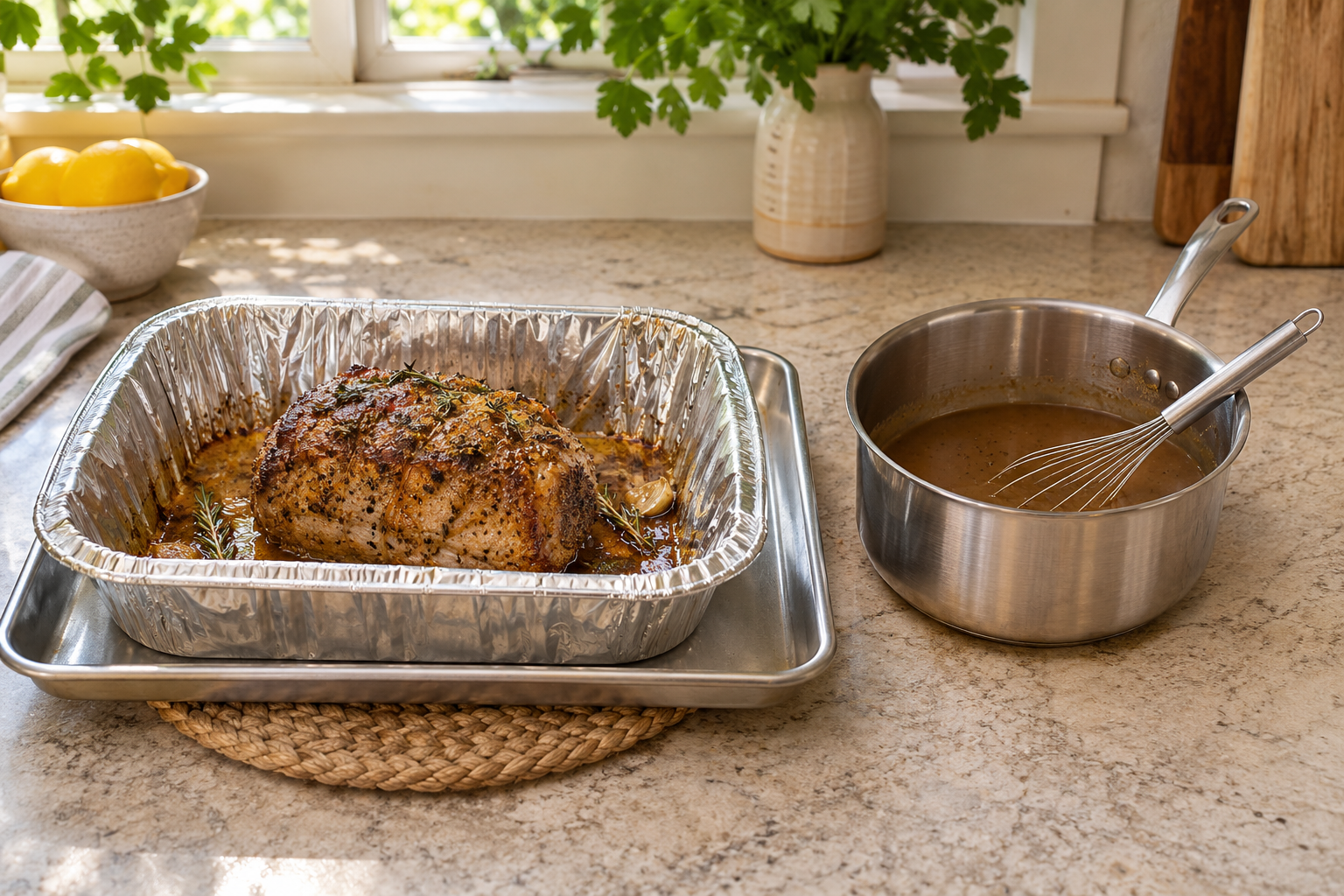
Use a sturdy, appropriately sized rimmed baking sheet underneath from the beginning. Support the base when placing the filled assembly in the oven and when removing it; thin foil rims should not be your only lifting points. If the loaded arrangement is beyond what you can comfortably handle, reduce the load or change equipment.
Supported foil pans are convenient roasting pan alternatives for cleanup, but they do not become stovetop cookware. Transfer juices to an approved saucepan for gravy. Avoid puncturing the base with sharp utensils, and keep the support sheet beneath the foil tray until the food and hot liquid have been safely removed.
Keep the gravy even when you change pans
The gravy plan often decides between roasting pan alternatives more effectively than the roast itself. If your chosen vessel cannot go on a burner, reserve the juices and make the sauce separately. You can use prepared stock for volume rather than expecting a small roast to produce enough drippings for a crowd.
The OXO Good Grips Good Gravy 4-cup fat separator is useful if separating settled fat is the awkward part of your workflow. Its strainer and bottom-release mechanism help transfer juices to a saucepan; respect the fill markings and handle hot liquids carefully.
You do not need every tool listed here. Compare the cost of the missing item with borrowing a complete setup. Our starter cookware guide prioritizes daily-use pieces, which is a better buying order than filling a cupboard for one annual meal.
Run a cold fit check before preparing the bird
Place the empty assembly on the intended oven shelf and check the closed-door clearance. Include handles, rack height and the expected food height. Remove any measuring templates before heating. Make sure you can lift the cookware out level and reach the prepared landing spot without turning around an obstacle.
For all roasting pan alternatives, doneness is a separate measurement. CDC holiday turkey guidance calls for at least 325°F oven temperature and 165°F internally, checked in the thickest breast and innermost thigh and wing. Use a food thermometer; browned skin and a pan that fits cannot establish safety.
If the original recipe specifies a pan you cannot match, choose a tested recipe for your available equipment. Changing to turkey portions may solve a space problem, but requires appropriate cooking instructions and temperature checks. Do not transfer whole-bird timing assumptions to separated pieces or a flattened bird.
Watch the sheet-pan method before choosing
Serious Eats’ “Why + How To Spatchcock A Turkey” shows why flattening changes the equipment decision. Watch the bird’s wider footprint as well as its lower height, then measure your pan. The demonstration complements these roasting pan alternatives; it does not replace your cookware’s current instructions.
Frequently asked questions
Can I roast a turkey without a roasting pan?
Yes, when an oven-safe substitute contains the bird and drippings and can be lifted safely. Match the vessel to a tested recipe. A shallow sheet pan is not a universal replacement for every whole turkey.
Can I use a baking sheet instead of a roasting pan?
A sturdy rimmed baking sheet can suit a tested sheet-pan turkey method, especially flattened poultry or portions. Check rack rating, footprint and liquid headroom. Avoid flat cookie sheets that cannot contain juices.
Can I use a glass dish for roasting turkey?
Only if the dish’s instructions and the recipe are compatible and the food fits. Follow preheating and thermal-shock precautions. Never use ordinary glass bakeware for stovetop gravy or under a broiler.
What can I use if I do not have a roasting rack?
Use a recipe-approved substitute that supports the food steadily. University of Maine Extension suggests foil coils in its turkey recipe. A cooling rack is suitable only when its manufacturer approves the oven use and load.
Are disposable foil roasting pans safe to lift alone?
Do not rely on flexible foil rims alone for a heavy hot meal. Place the foil pan on a sturdy support sheet before filling and keep it supported during handling. Follow the product’s limits.
Can a Dutch oven replace a roasting pan?
It can suit a small roast in a recipe designed for that vessel, but high walls and a lid change the result. For crisp uncovered poultry, compare lower-sided roasting pan alternatives and check the complete loaded height.
Your best next step: put the candidate pan, rack and oven mitts together on the counter. Check fit, instructions, drippings and handling in that order. The best roasting pan alternatives are the ones that solve your actual meal without creating a second equipment problem.
Leave a Reply