
This Lodge cast iron review starts with a fact: someone you know thinks Lodge is junk. Maybe that someone is you. I’m not here to argue. I just want to ask seven questions about what a $25 Lodge cast iron skillet does on your stove. Answer them honestly, and see where you land.
Disclosure: This post contains affiliate links. As an Amazon Associate, we earn from qualifying purchases at no extra cost to you.
Table of Contents
Is Lodge Cast Iron Good?
Yes. Lodge cast iron is good for most home cooks. A Lodge skillet sears, bakes, and fries as well as pans costing $100 to $200 more, because seasoning creates the nonstick surface and mass holds the heat. The real downsides are weight, a short hot handle, and a rough surface that takes weeks to break in.
That’s the short answer. You don’t have to trust it. Every claim in this review is one you can check in your own kitchen with a pan, a burner, and a steak. For how Lodge stacks up against other makers, see our guides at Top Cookware Brands.
Why Do People Say Lodge Cast Iron Is Bad?
Every product has a hardest critic. For Lodge, it’s the cast iron purist.
You know the type. They own a 1930s Griswold from an estate sale. Or they paid $180 for a hand-polished skillet from a small workshop. Their view is simple: Lodge is rough, heavy, cheap iron for beginners. Real cooks graduate to something better.
To hold that view, they need to believe several things at once:
- A smooth surface cooks better than a pebbly one.
- Heavy pans are worse pans.
- A higher price means higher quality.
- Old pans beat new pans.
- Factory seasoning doesn’t count as real seasoning.
Each belief sounds fine alone. The trouble starts when you hold them together. I’ll go through them one at a time. I’ll ask what each one means, and you fill in the answers.
What Makes a Cast Iron Skillet “Better”?
Start with the main claim: “Lodge isn’t as good.”
Good at what? Pick one. Does it sear a steak worse? Does it bake worse cornbread? Does it stick more with eggs?
Or does “better” mean something else, like nicer to hold or prettier on the stove?
Both answers are fair. But they are two very different claims.
“It cooks worse” is about the food. You can test that with a steak and a timer.
“It feels cheaper” is about you. Nobody can test that. Nobody needs to.
So which one do you mean? Say it out loud in one sentence.
Many critics start with the first claim. When you press them, they slide to the second. Watch for that slide in your own answers.
Smooth vs. Rough Cast Iron: Does a Polished Surface Cook Better?
This is the big one. Lodge cast iron skillets have a pebbly texture, and vintage and boutique pans feel like glass.
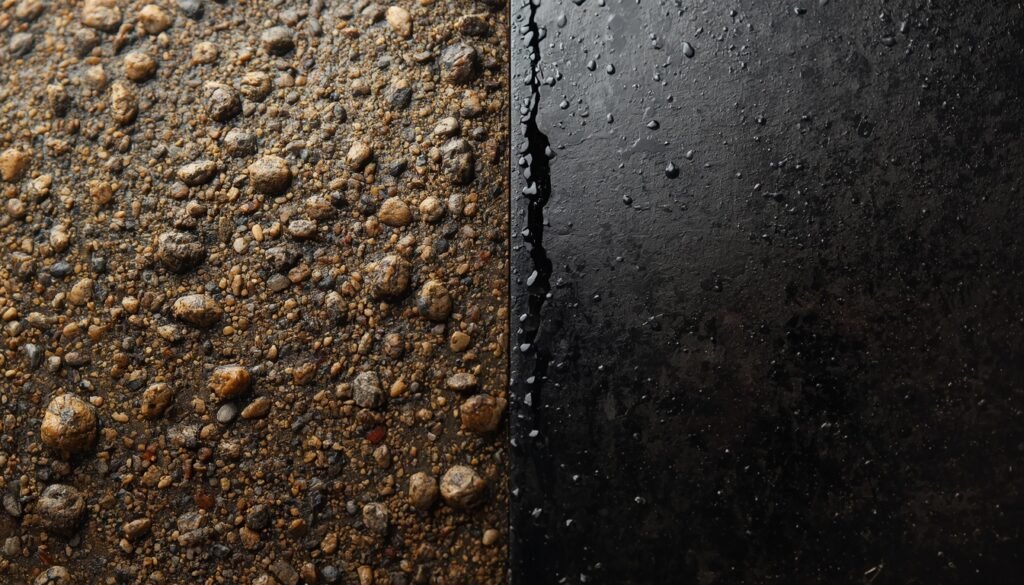
The texture is real, and so is the reason for it. Lodge pours iron into sand molds and skips the polishing step. Polishing costs money.
So the critic says, “Smooth means nonstick.” Fair enough. But what makes cast iron nonstick in the first place?
Most cooks agree it’s the seasoning. Seasoning is oil baked into a hard, slick layer. Bare iron sticks like glue, whether it’s smooth or rough.
So here’s the follow-up: if seasoning does the work, what does the smoothness add?
Maybe you’ll say it helps a little at the start. That’s reasonable. A new Lodge can grab a fried egg in week one.
But what about month six? By then, seasoning has filled in many of those tiny valleys. Plenty of Lodge owners slide eggs around just fine.
Here’s another angle. Some owners of polished pans complain that seasoning flakes off. The surface is so slick that the oil struggles to grip. If that’s true, is roughness a pure flaw, or does it sometimes help?
You don’t have to agree with me. Just answer this: how much sticking difference do you expect after a year? Is it a lot, a little, or none?
If your answer is “a little,” hold onto it. We’ll need it later.
Is Lodge Cast Iron Too Heavy? Weight vs. Heat Retention
A 10.25-inch Lodge cast iron skillet weighs roughly five pounds. Many vintage skillets weigh a pound or so less.
The critic says the Lodge is a brick. And it’s true that tossing vegetables in one takes real wrist strength.
But why do people buy cast iron at all? Ask any fan and you’ll hear the same thing: “It holds heat.” You drop a cold steak in, and the pan stays hot. That’s how you get the crust.
So where does that heat-holding come from? It comes from mass. More iron stores more heat. A thicker pan drops less in temperature when the food hits.
The physics backs this up. Cast iron moves heat only about a quarter as well as aluminum. J. Kenji López-Alt made this point in his well-known Serious Eats piece, The Truth About Cast Iron Pans: the metal is a poor conductor, and its real strength is how much heat it holds once it’s hot. That strength grows with every ounce of iron.
Now put the two beliefs side by side:
“Cast iron is great because it holds heat.”
“Lodge is bad because it has more iron.”
Can both be fully true at once?
There’s an honest way out. You could say, “I’ll trade some heat for a lighter pan.” That’s a real preference, and I respect it. Lodge even sells that trade itself: its Blacklock line has thinner, lighter walls at a higher price.
But notice what just happened. “Lodge is worse” became “Lodge makes a different trade.” Those aren’t the same sentence. Which one do you actually believe?
Lodge vs. Expensive Cast Iron: What Does the Extra $150 Buy?
A Lodge skillet costs around $20 to $30. Boutique skillets often run $100 to $200 or more.
So the question is simple. What does the extra money buy? Let’s check the usual answers.
“Better iron.” Is it, though? Cast iron is cast iron. It’s iron with some carbon, melted and poured. What would “better” iron do in your kitchen?
“It lasts longer.” Longer than what? A Lodge can outlive you, and people hand them down to their grandkids. How do you beat “forever”?
“Made by craftsmen in America.” Joseph Lodge opened his foundry in South Pittsburg, Tennessee, in 1896. The company says it still makes all of its seasoned cast iron there (Lodge product guide). Does 130 years count?
“A smoother finish and a nicer handle.” Yes, this one is true. The polish is real, and so is the comfort.
Professional testers land in the same place. When America’s Test Kitchen tested a $400 artisan skillet, they called it a lovely pan and still said you’d make perfect food in their recommended Lodge for about $30 (America’s Test Kitchen).
So be precise. Are you paying for better cooking, or for a nicer object?
There’s no shame in the second answer. People buy nice watches that tell the same time. But a watch fan doesn’t say a Timex tells the wrong time. Do you hold cookware to that same standard?
Watch the head-to-head: Eater ran this exact comparison on camera in Is This $200 Cast Iron Pan Better Than the Lodge? from The Kitchen Gadget Test Show.
Is Expensive Cast Iron Worth It? Test the Price Rule Elsewhere
Let’s test the rule outside the kitchen.
Do you believe a $200 hammer drives nails better than a $25 hammer? Do you think a $90 white T-shirt keeps you warmer?
Most people say no. They know a higher price doesn’t always buy better results. Past a certain point, you’re paying for how a thing feels.
So why would skillets be the exception?
A skillet is a simple tool. It’s one piece of metal with no moving parts. If the rule “price equals quality” fails for hammers, what saves it for pans?
Try the reverse case too. Say a friend insists their $400 knife cuts onions better than your $40 one. Would you ask for proof? If yes, what proof would you offer for your pan?
Lodge vs. Griswold: Why Was Vintage Cast Iron Good?
Many critics love vintage iron, like Griswold and Wagner. They say nobody makes pans like that anymore.
Those old pans are lovely. They’re thin, light, and smooth as a river stone.
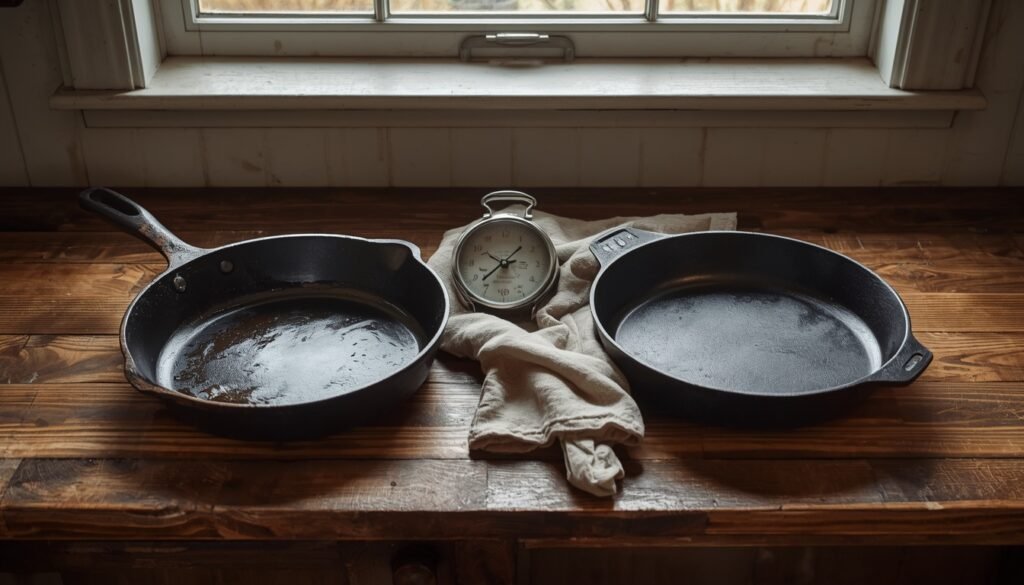
But who bought a Griswold in 1935? Regular families did. It was hardware store cookware. It was the affordable, mass-produced pan of its day.
In other words, it was the Lodge of its time.
So here’s the puzzle. Cheap, mass-made iron was great in 1935. Why is cheap, mass-made iron junk today?
You might answer, “The old ones were polished.” That’s true. But we covered polish in the smooth vs. rough question. You told me how much difference it makes after a year. Was your answer “a little”?
And one more. Those vintage pans are thinner and lighter. So they hold less heat than a Lodge. If heat-holding is the whole point of cast iron, which pan wins that round?
Is Lodge Pre-Seasoned Cast Iron Really Seasoned?
Lodge has pre-seasoned its pans since 2002. They spray on vegetable oil and bake it.
Critics often wave this off. They say it isn’t real seasoning and you have to strip it and start over.
So what is “real” seasoning? Define it.
Most people say it’s thin layers of oil, baked on until they harden. That’s exactly what Lodge does at the factory.
Is the factory layer thin? Yes. Does it need more layers on top? Yes. A few rounds of bacon or cornbread help a lot.
But every pan needs that, including the $180 one. Its maker also tells you to keep cooking and build the layers.
So what’s the difference in kind? If both pans need the same care, why does only one get blamed?
Lodge vs. a $200 Skillet: What Would Change Your Mind?
This is the most important one, so take your time.
Picture a blind test with two steaks. One is seared in a Lodge and one in a $200 skillet. Same heat, same oil, same timing. You taste both, and you can’t tell them apart.
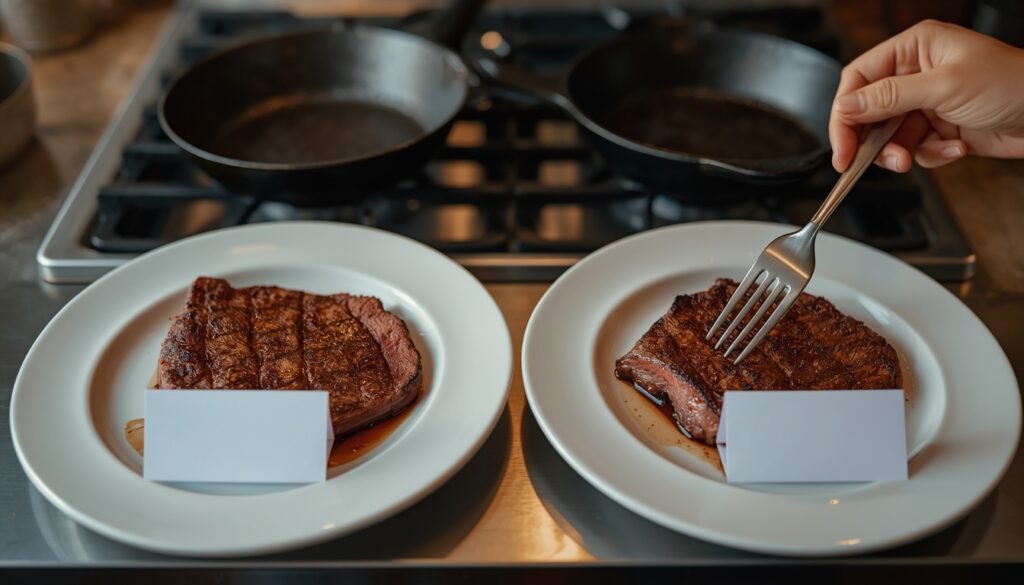
Would that change your view?
If yes, great. Your belief is a testable claim. Run the test this weekend. Borrow a friend’s Lodge if you need to.
If no, ask yourself why not. What would change your mind, if not the food?
If nothing would, then it isn’t a belief about cooking. It’s a taste. Tastes are fine, but they aren’t reviews.
Lodge Cast Iron Pros and Cons: Where the Questions Leave Us
Let’s gather up your own answers.
- You said seasoning creates the nonstick surface.
- You said mass is why cast iron holds heat.
- You said price and performance split apart for simple tools.
- You said old mass-market pans were excellent.
- You said every pan needs seasoning built up at home.
Put those together. What do they say about a thick, affordable, pre-seasoned American skillet?
Lodge Cast Iron Skillet Downsides
I didn’t say Lodge is perfect, and I won’t. An honest Lodge cast iron review includes real downsides:
- It’s heavy. Small or sore wrists will notice.
- The handle is short and gets very hot.
- The surface starts rough and takes weeks to break in.
- It heats unevenly on a small burner, because cast iron spreads heat slowly. Preheat it for several minutes before you cook.
Those are fair complaints. A lighter, smoother pan fixes some of them. If you cook daily and love the feel, buy the fancy one and enjoy it.
But “I enjoy this more” and “that one is bad” are different claims. The questions above pull them apart.
Is a Lodge Cast Iron Skillet Worth It?
Here’s my actual review, in plain words. A Lodge cast iron skillet sears, bakes, and fries as well as almost anything. It costs about what a pizza dinner costs. It will likely outlast your stove.
For most home cooks, that’s the whole story.
Lodge Cast Iron Skillets and Gear to Run the Test
- Lodge 10.25-Inch Pre-Seasoned Cast Iron Skillet: the pan this whole review is about, and the one to buy for the one-month test.
- Lodge 12-Inch Cast Iron Skillet: the same iron with more room, for families or two steaks at once.
- Lodge Blacklock 10.25-Inch Skillet: the lighter option if weight is your real objection.
- Lodge Silicone Hot Handle Holder: fixes the short, hot handle for a few dollars.
- Chainmail Cast Iron Scrubber: cleans stuck-on food from a pebbly surface without stripping the seasoning.
Lodge Cast Iron FAQ
Is Lodge cast iron good quality?
Yes. It is thick, durable iron that sears and bakes as well as far pricier pans. What you give up is finish and comfort, with a rougher surface and a shorter handle.
Why is Lodge cast iron so cheap?
Lodge casts its pans in sand molds and skips the polishing step that boutique makers pay for. It also makes them at huge scale. The low price comes from the process, and the iron is the same kind of metal.
Is Lodge cast iron made in the USA?
Lodge says all of its seasoned cast iron is made in its South Pittsburg, Tennessee foundries. Check the label on enameled pieces, since Lodge has more than one enameled collection.
Do I need to season a pre-seasoned Lodge skillet?
No, you can cook in it right away. The factory layer is thin, so the pan gets better as you cook fatty foods like bacon and build more layers.
Why is my Lodge skillet rough, and should I sand it?
The pebbly texture comes from the sand mold. You don’t need to sand it. Regular cooking fills in the surface over a few months.
Is Lodge as good as vintage Griswold?
For searing and baking, yes, and its extra mass holds more heat. Griswold pans are lighter and smoother, which is a matter of feel more than food.
Can I use soap on Lodge cast iron?
Yes. Kenji López-Alt explains that seasoning is polymerized oil bonded to the metal, so dish soap won’t remove it. Dry the pan right away and wipe on a thin coat of oil.
Should You Buy a Lodge Cast Iron Skillet?
I asked the questions. The answers were yours, and they don’t add up to “Lodge is junk.”
So stop reading Lodge cast iron reviews, this one included. The pan costs $25. Being wrong about it costs $150.
Buy or borrow a 10.25-inch Lodge and cook in it three times a week for one month. Bacon, cornbread, smash burgers, fried eggs. Then tell me which of the seven questions the food got wrong.
Leave a Reply