
Dishwasher safe cookware sounds like a simple label, but it hides a lot of fine print. To legally carry that stamp, a pan only has to survive one test cycle with mild detergent and a low-temperature rinse — not the 200-plus loads you’ll actually run it through over a few years. Some materials shrug off real-world dishwasher abuse for a decade. Others start failing by the third real cycle, whether the label admits it or not. Here’s what the testing, the manufacturers, and the material science actually say about each type of cookware, plus a quick checklist to run before you load the rack.
Table of Contents
- The Short Answer: What Survives the Dishwasher
- Stainless Steel: The Safest Bet
- Ceramic and Modern Non-Stick: Safe, But Not Forever
- Cast Iron and Carbon Steel: Never These
- Copper and Hard-Anodized Aluminum: Handle With Care
- Why “Dishwasher Safe” Labels Don’t Tell the Whole Story
- Your 5-Point Dishwasher-Safe Checklist
- FAQ
The Short Answer: What Survives the Dishwasher
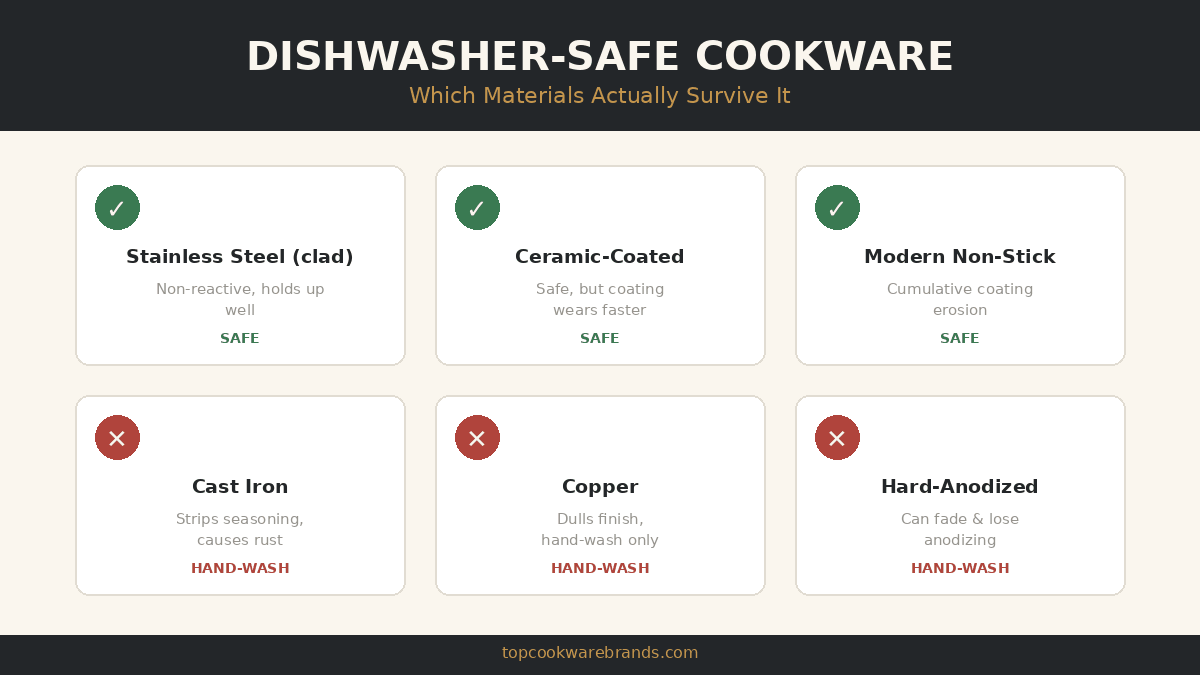
Multi-ply or clad stainless steel is the closest thing to a genuine yes — the steel surface is non-reactive and the clad construction (steel bonded to an aluminum or copper core) holds up to years of cycles. Ceramic-coated and modern non-stick pans are technically dishwasher safe too, but the coating wears down faster than the pan itself. Cast iron, carbon steel, and copper should never go in, and hard-anodized aluminum is a case-by-case call depending on the manufacturer’s finish.
Stainless Steel: The Safest Bet for the Dishwasher
A tri-ply or 5-ply stainless steel cookware set is the best all-around choice for dishwasher use in 2026. The clad construction fixes stainless’s historical weak point — uneven heating — while keeping the cooking surface non-reactive and genuinely tolerant of repeat cycles.
That said, “dishwasher safe” doesn’t mean “dishwasher immune.” Hard water leaves calcium and magnesium deposits that create a dull, whitish film, and pitting — a real form of corrosion — can develop from prolonged contact with chlorides like table salt or chlorine bleach in some detergent pods. Consumer Reports’ cookware care guidance recommends drying stainless surfaces immediately rather than letting them air-dry in the machine, which is the single biggest thing you can do to prevent spotting and pitting over time.
Ceramic and Modern Non-Stick: Safe, But Not Forever
Ceramic-coated pans are marketed as dishwasher-safe and heat-resistant, and for the most part that holds up — the coating is more chemically stable than traditional non-stick. But it still wears faster in a dishwasher than it would with hand-washing, and once the coating thins, food starts sticking even though the pan looks fine.
Modern non-stick coatings have the same story, just faster. Current FTC labeling rules and the ASTM F2878-22 standard only require a pan to retain its non-stick function after one simulated dishwasher cycle with mild detergent to legally carry the “dishwasher safe” label — there’s no requirement to test cumulative wear, thermal cycling, or chemical leaching over hundreds of real cycles.
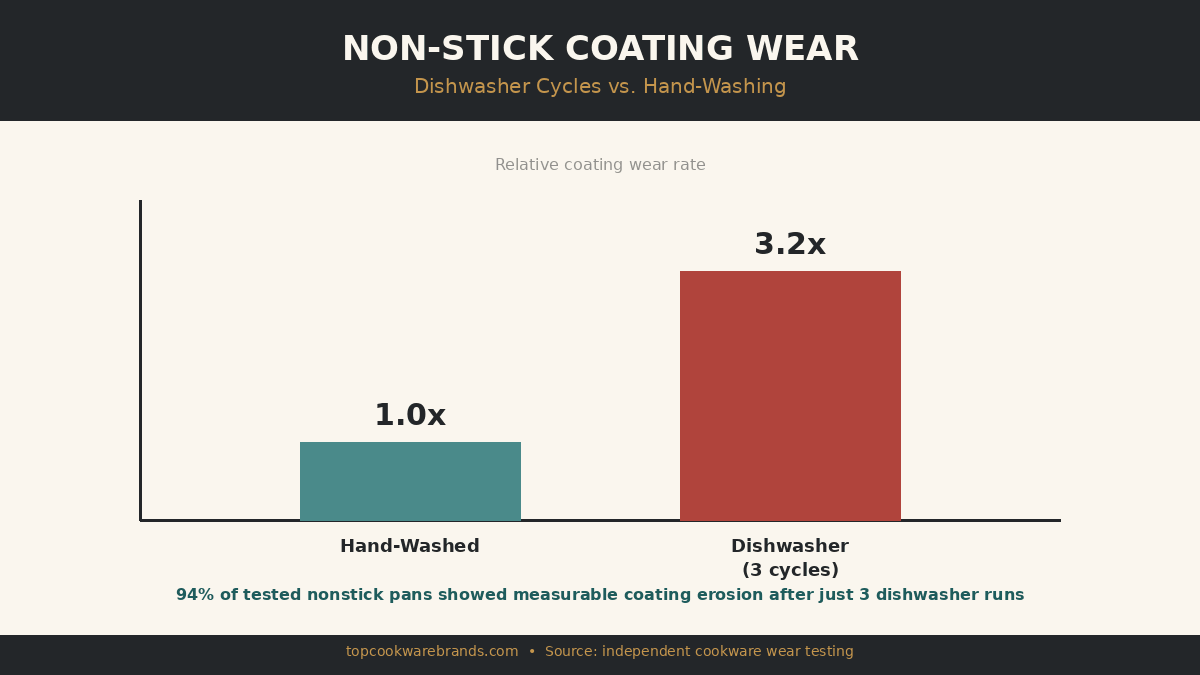
Independent testing across 42 popular non-stick lines found that 94% showed measurable coating erosion after just three real-world dishwasher runs, with wear rates roughly 3.2x higher than hand-washing — the suspended silicate particles in powder detergents combined with high-pressure spray arms act like liquid sandpaper on the coating. The damage is cumulative and invisible until it’s suddenly not, which is usually the day eggs start sticking despite a fresh coat of butter. If you’re shopping for a coating that’s built to last longer between replacements, our guide to the best PFAS-free cookware brands covers the newer ceramic formulations worth a look.
Cast Iron and Carbon Steel: Never Put These In
Cast iron is never truly dishwasher safe, regardless of what a listing claims. The high pH of dishwasher detergent acts as a solvent on the fatty acids that make up your pan’s seasoning, slowly dissolving the protective layer, while the forceful spray jets and the pan clanging against other dishes can chip fragile new seasoning outright.
Carolyn Forté, executive director of the Good Housekeeping Institute’s Home Care & Cleaning Lab, puts it plainly: a cast iron skillet should never be soaked in the sink or run through the dishwasher. Even a single full cycle can strip enough seasoning to start surface rust. If yours has already been through one, our guide to removing rust and restoring a cast iron skillet walks through the recovery process, and our carbon steel seasoning guide covers the identical logic for carbon steel pans, which rely on the same fragile seasoning layer.
Copper and Hard-Anodized Aluminum: Handle With Care
Copper cookware should stay out of the dishwasher — the detergent dulls the signature finish and the appliance’s heat and moisture accelerate tarnishing, so hand-washing is really the only option if you want it to stay presentable.
Hard-anodized aluminum is more nuanced. Some manufacturers, like Viking, add a patented clear coating specifically so their hard-anodized lines can handle the dishwasher, and brands including Cuisinart and Anolon back their hard-anodized sets with lifetime warranties that assume normal dishwasher use. But standard or colored anodized aluminum without that protective layer can have its anodizing reversed by the alkalinity in dishwasher detergent, which lightens the surface color over time — Calphalon’s own support documentation addresses this exact discoloration on their hard-anodized line. We put one popular option through its paces in our Anolon Accolade hard-anodized cookware review if you’re deciding whether a set like this is worth it.
Why “Dishwasher Safe” Labels Don’t Tell the Whole Story
The label tells you a pan passed a single lab cycle, not that it will look and perform the same after 300 loads. It also doesn’t tell you whether running it through the dishwasher voids your warranty — several manufacturers exclude damage to a coating or anodized surface from coverage, even on cookware they market as dishwasher safe. Before you assume you’re covered either way, it’s worth checking our cookware warranty guide to see which brands are actually transparent about what voids the policy. For general dishwasher loading and detergent guidance that applies across materials, the American Cleaning Institute’s dishwashing guide is a solid, brand-neutral reference.
Your 5-Point Dishwasher-Safe Checklist
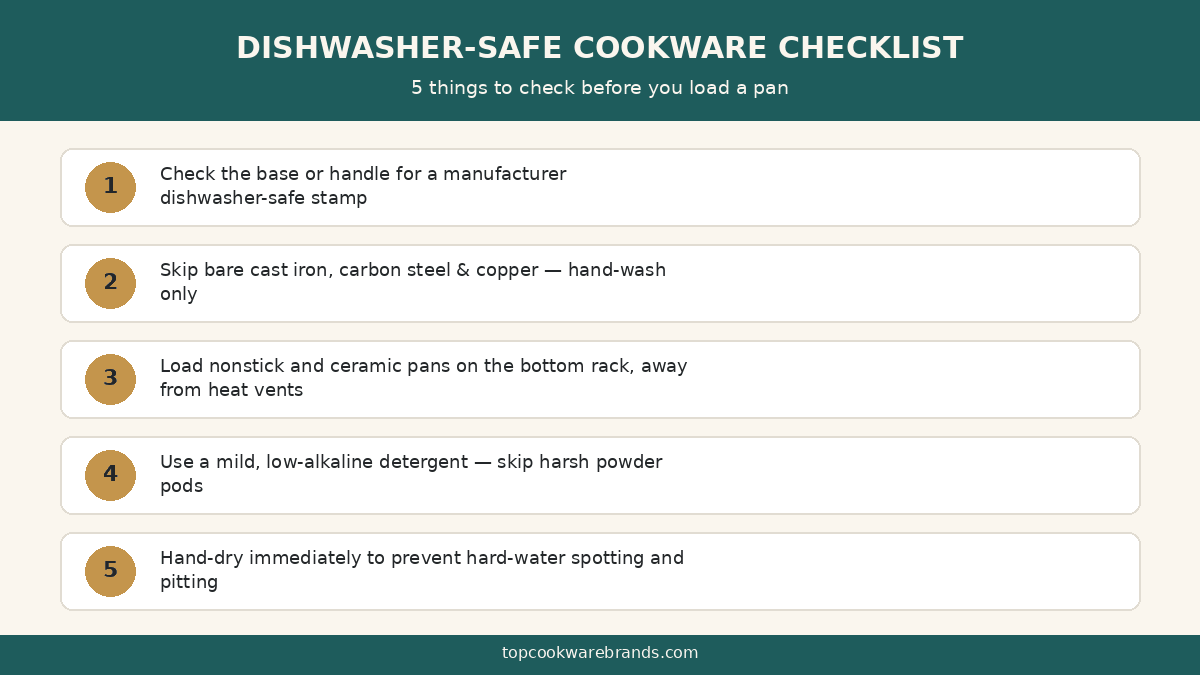
- Check the base or handle for a manufacturer dishwasher-safe stamp before you assume anything.
- Skip bare cast iron, carbon steel, and copper entirely — hand-wash only, no exceptions.
- Load nonstick and ceramic pans on the bottom rack, away from the heating element and spray arm.
- Use a mild, low-alkaline detergent and skip harsh powder pods that accelerate coating wear.
- Hand-dry stainless and hard-anodized pieces immediately to prevent hard-water spotting and pitting.
FAQ
Is stainless steel cookware really dishwasher safe?
Clad or tri-ply stainless holds up well to repeat dishwasher cycles, but hand-drying it immediately still prevents the hard-water spotting and pitting that build up over years of air-drying in the machine.
Why did my “dishwasher safe” non-stick pan start sticking?
It passed the one-cycle test required for the label, but coating wear is cumulative. Independent testing shows measurable erosion after just three real dishwasher runs, so performance quietly declines long before it becomes obvious.
Can I put cast iron in the dishwasher just once?
One cycle won’t destroy the pan, but it will strip seasoning and can trigger surface rust. If it happens, clean off the rust and re-season rather than writing the pan off.
Does running cookware through the dishwasher void the warranty?
It depends on the brand. Several manufacturers exclude coating or anodizing damage from warranty coverage even on pieces labeled dishwasher safe, so it’s worth checking the specific policy before you rely on it.
Leave a Reply