Why Cookware Is So Expensive in 2026 (And What to Buy)
If you’ve been wondering why cookware is so expensive in 2026, Ray Kovach wondered it harder than you did — and he brought a caliper.
He was standing in a store aisle holding a frying pan like it had insulted him. One hundred eighty-nine dollars. For a pan. He put it back on the shelf. He did not put it back gently.
Six weeks later he bought it. Not because an influencer in an apron wore him down, but because he cut three cheap pans open in his garage and measured what had been taken out of them.
Why Is Cookware So Expensive in 2026?
Cookware is expensive in 2026 because the cheap-pan era ran on thinner metal, shorter-lived nonstick coatings, and low-cost imported steel and aluminum. Those costs are back. Metal prices, freight, and tariffs are all up, and importers pass them through. A $19 pan was never really $19 — you paid the rest in replacements.
Here’s how one appliance repairman proved that to himself, with a vise and an angle grinder — and what it means if you’re staring at a wall of pans trying to decide what to actually buy.
Why a Repairman Thought Expensive Cookware Was a Scam
Ray fixes appliances for a living. Twenty-one years, mostly washers and fridges. He knows the con. He’s seen inside a $1,400 washing machine. There’s maybe ninety bucks of real parts in there.
So when a skillet costs $189, Ray doesn’t see metal. He sees a logo. He sees a guy in an apron on Instagram saying the word “artisanal.”
“It’s a bent piece of steel,” he told his wife Marisol that night. “You could make one in a garage.”
That was the story he’d been telling himself for years. Expensive cookware is theater. The product is simple. The markup is a scam on people who want to feel like chefs.
And honestly? He had evidence.
What 9 Cheap Frying Pans in 11 Years Actually Cost
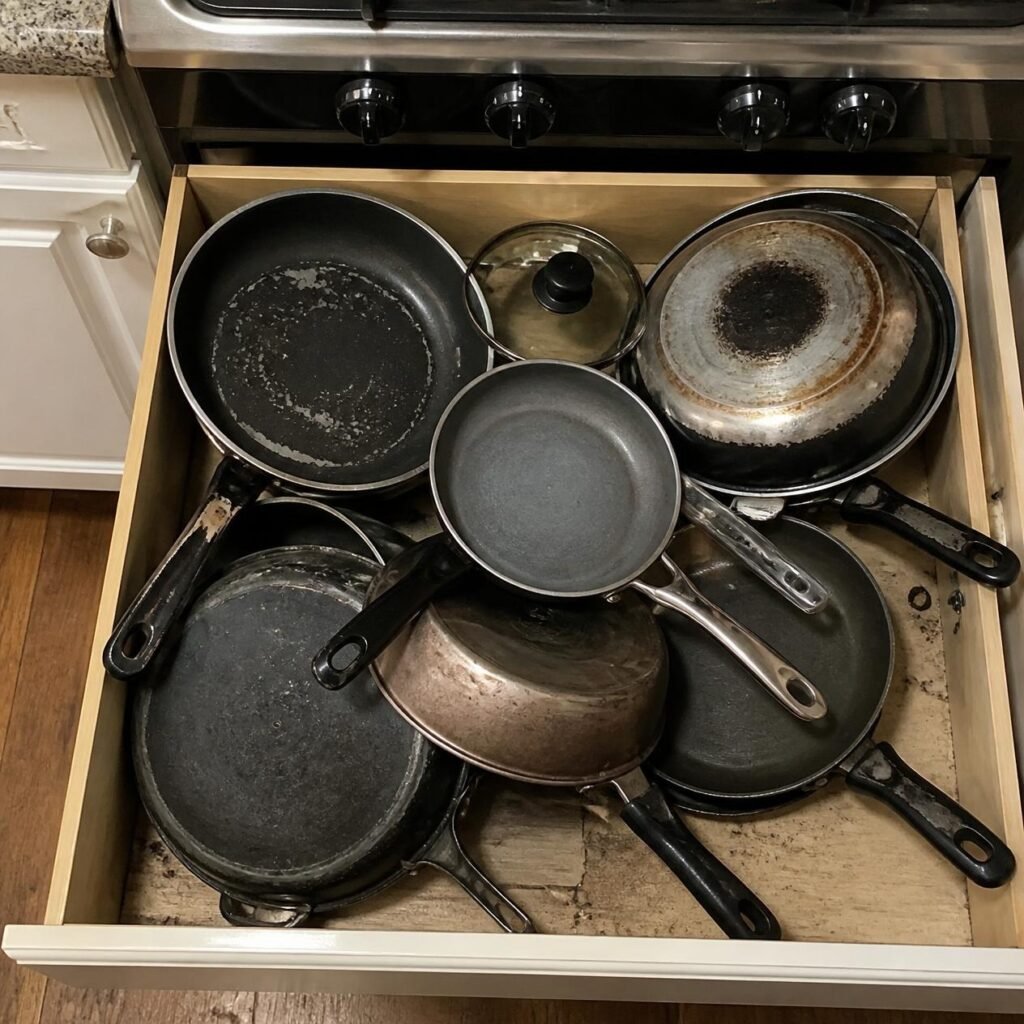
Under Ray’s stove is a deep drawer. In that drawer is a graveyard. Nine pans. Eleven years.
There’s the one that started peeling in month seven. Little black flakes in the eggs, like pepper that wouldn’t move. There’s the one that warped. Set it on the burner and it rocks. You can spin it like a quarter on a bar top. There’s the “ceramic” one that cost $34 and stopped being nonstick in about four months. Now it grabs onto everything. Pancakes come up in pieces.
Cheap nonstick pans peel, warp, and quit, and almost nobody counts them as an expense while it’s happening. That’s not bad luck — a PTFE coating has a working life of roughly one to five years before the release gives out, and a thin stamped body warps long before that. Ray didn’t count them. Each one was cheap. Nineteen bucks. Twenty-four. Thirty-one on a holiday sale. He bought them the way you buy paper towels. Something runs out, you get another.
He had never once added them up.
The Cast Iron Skillet That Outlasted Three Generations
In March, Ray’s dad Walt moved into the back bedroom. Walt had a stroke in January. He got most of his speech back. He did not get his left hand back.
When they cleared out Walt’s house in Barberton, most of it went to the curb. But Walt insisted on one box. Inside was his mother’s cast iron skillet.
That thing weighs five pounds. The handle is worn smooth where four generations of hands went. Ray set it on the counter. To him it was proof of his whole argument.
“See this?” he said. “Bought for pocket change in like 1960. Still works. Nobody needed a hundred-and-ninety-dollar pan.”
Walt looked at it for a long time. He didn’t say anything.
Why Low-Sodium Cooking Needs a Pan That Can Sear
The hospital sent Walt home with a sheet of paper. Low sodium. Way low. Ray became the cook. Marisol works nights at the hospital, so dinner was his.
Here’s what nobody warns you about. Take the salt out of food and the flavor has to come from somewhere else. That somewhere else is browning. The crust on a chicken thigh. The dark edge on a mushroom. The crisp skin.
Ray learned that fast, because without it Walt just moved food around his plate. “S’fine,” Walt would say. He’d eat four bites. Then he’d ask if there was any bread.
Ray started watching videos at 11 p.m. with the sound off so he wouldn’t wake anybody. Pat the meat dry. Get the pan hot. Don’t crowd it. He did everything right.
Why Chicken Steams Instead of Searing in a Cheap Pan
It was a Tuesday in April. Ray remembers because the Guardians were losing in the background.
Six chicken thighs. Dried with paper towels. Oil shimmering. He’d been careful. He laid them in the $24 pan and listened for the sizzle.
He got about two seconds of it. Then nothing. The pan went quiet. Water started coming out of the chicken, pooling, going cloudy. The thighs sat there in their own grey liquid and steamed.
He waited. He turned the heat up. The center of the pan got a scorch ring while the edges stayed cold. Twenty minutes later he served grey chicken with one dark spot in the middle of each piece.
Walt took four bites. “S’fine,” he said. “Any bread?”
Ray sat in the kitchen after everyone went to bed. He wasn’t mad at his dad. He was mad because he’d done it right and it still didn’t work.
And he was starting to suspect the pan.
What’s Inside a Cheap Pan vs. a Good One
The next Saturday, Ray did what repair guys do. He took it apart.
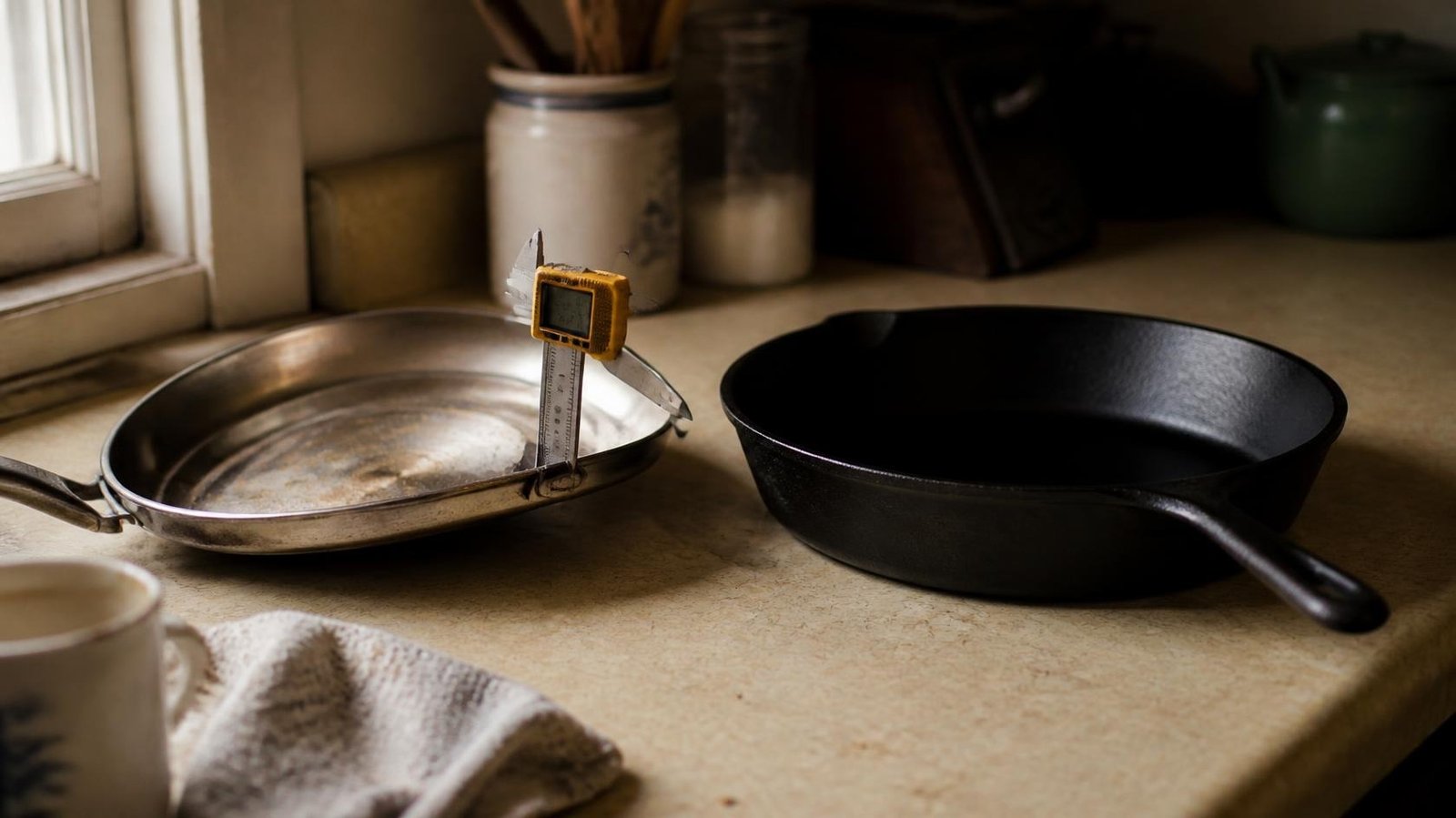
He used the digital caliper he keeps for compressor shims, the kind that reads to a hundredth of a millimeter. Twenty-one years of knowing what’s inside things, finally pointed at his own kitchen.
| Pan | Measured thickness |
|---|---|
| $24 stamped nonstick skillet | 0.6 mm wall |
| Cast iron skillet, bought 1964 | 4.8 mm at the base |
Six tenths of a millimeter is thinner than two credit cards stacked up. That is not a defect. It’s the category. Stamped budget pans generally land between 0.5 and 0.8 mm, while genuinely clad cookware runs roughly 2.5 to 3 mm through the entire wall — not just the floor. A reviewer who put calipers on 31 stainless steel fry pans found most of the real ones clustered between 2.6 and 3.1 mm, and found something else worth knowing: pans sold as 5-ply were no thicker than pans sold as 3-ply. The ply count is marketing. The millimeters are the product.
Is “Tri-Ply” Cookware Really Tri-Ply?
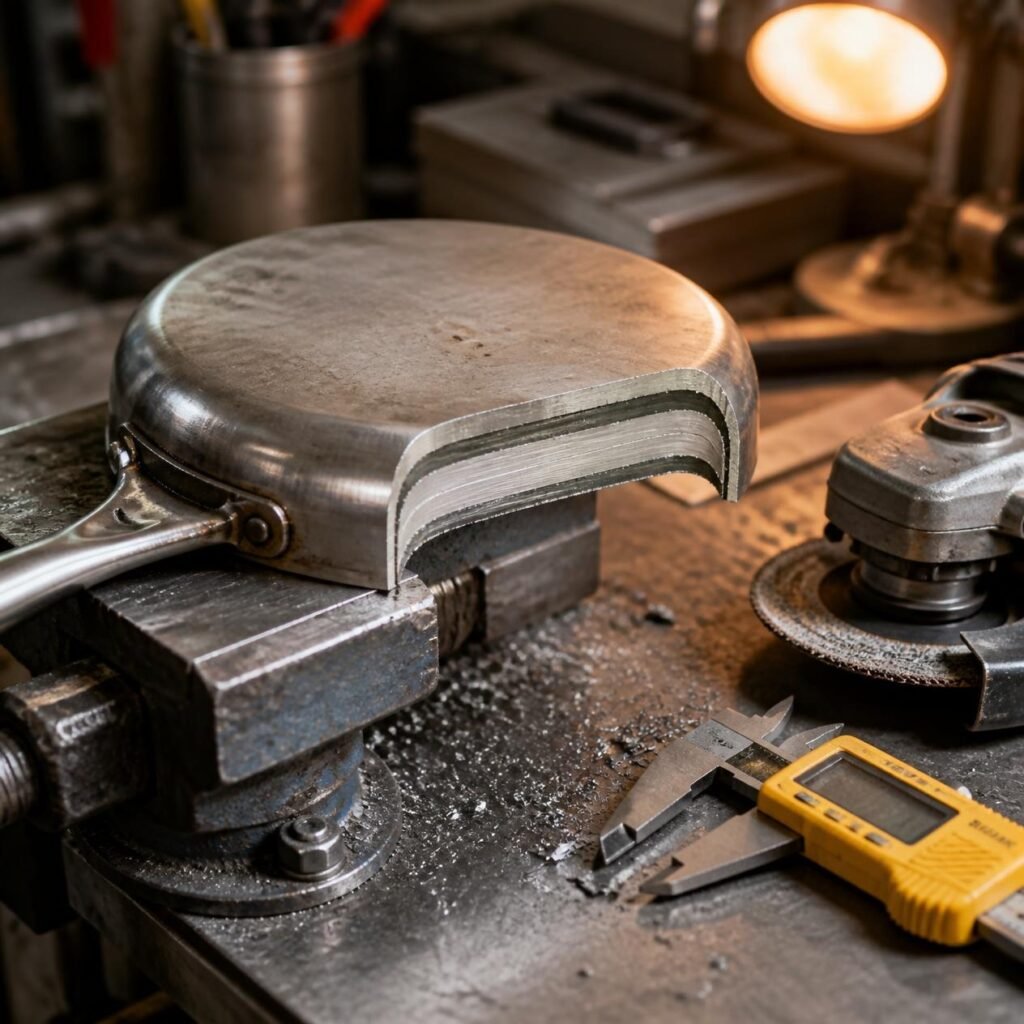
Then he got curious about a “tri-ply” pan he’d bought on sale years back. The box had promised layers of aluminum sandwiched in steel. He clamped it in his vise and went at the base with an angle grinder.
The sandwich was real — but only in a disc about five inches across, spot-welded to the bottom. The walls were single-layer steel. Thin as a soda can.
That is the difference between disc-bottom and fully clad cookware, and it’s the one thing the box will not say out loud. Fully clad means the layers run all the way up the sides. Disc-bottom means they stop at the floor, which is why the center of Ray’s pan scorched while the edges stayed cold.
Ray sat on his garage stool and looked at the cut edge for a while. He wasn’t angry anymore. He was embarrassed. He’d spent twenty-one years telling customers that a cheap part is cheap because somebody removed something. He just never applied it to his own kitchen.
Why Thin Pans Can’t Hold Heat
This is the whole thing, and it isn’t complicated. A hot pan holds heat in its metal. More metal, more stored heat. Five pounds of cast iron holds a lot. A 0.6 mm sheet holds almost none.
Drop cold chicken into a pan with no stored heat and the surface temperature falls off a cliff. Under roughly 300°F, meat stops browning and starts letting go of water. The water pools. The chicken boils in it.
That’s why the chicken went grey. It wasn’t Ray. It was physics, and somebody had engineered the physics out to hit a price point.
Watch: 31 stainless pans, measured with calipers
If you’d rather see this done at scale than take one repairman’s word for it, this teardown-style test measures thickness, heat retention, and warp resistance across 31 fry pans, cheap to expensive:
https://www.youtube.com/watch?v=v7aJzlRXHnw
What a Good Skillet Cost in 1964, Adjusted for Inflation
Here’s where it really cracked open.
In Walt’s box of papers, Ray found a Sears catalog page his grandmother had saved, the skillet circled in pen. 1964. Twelve dollars and ninety-five cents.
Ray’s first reaction was: see, twelve bucks.
Then he ran it through the Bureau of Labor Statistics inflation calculator. Twelve ninety-five in 1964 is worth around $130 today.
Then he did the second piece of math, the one that actually hurt. His grandfather was a pipefitter making about $2.80 an hour. That skillet cost most of a day’s pay.
She didn’t buy a cheap pan. She bought an expensive pan, one time. Then nobody in her family bought one again for sixty years.
Ray had always thought her skillet proved cookware used to be cheap. It proved the opposite. Cookware used to be a real purchase, made once.
Then he added up the graveyard drawer. Nine pans. Eleven years. Three hundred forty dollars, give or take. Plus the grey chicken. Plus the pancakes that came up in pieces. Plus his father saying “s’fine” and asking for bread.
What $189 Actually Buys in a Frying Pan
He bought the pan in May. He didn’t tell Marisol for two days.
It weighed almost four pounds. When he set it on the burner it didn’t rock. It sat there like a manhole cover.
First night, he made the same chicken thighs. Same oil. Same method. They hit the pan and the sizzle didn’t stop. It got louder. The kitchen filled with that smell — the real one, the one that makes a house feel like somebody lives there.
He flipped them after nine minutes. The skin was the color of a varnished table. He served it with lemon and a lot of black pepper and zero salt.
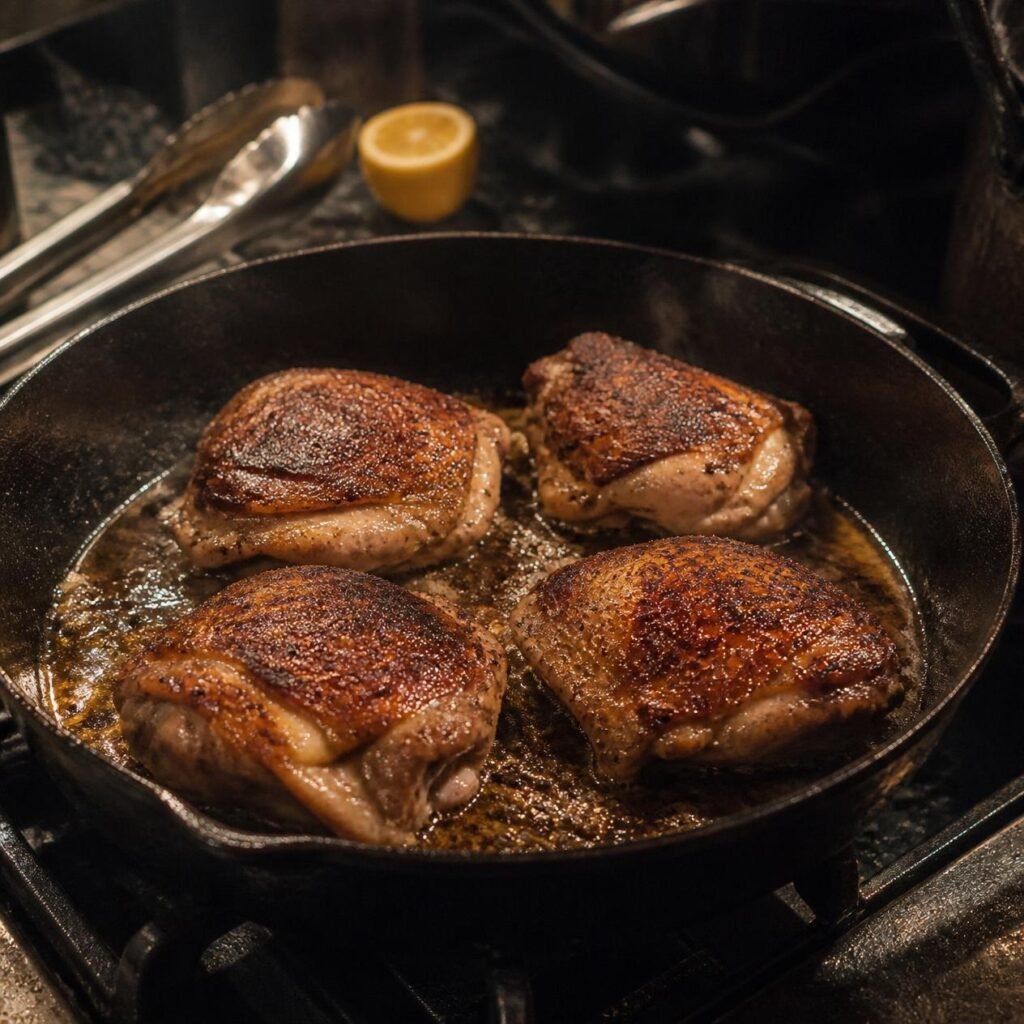
Walt ate all of it. Then he looked at his plate like he was checking for more.
“What’d you do different?” he asked.
Ray said, “Nothing. Just the pan.”
And Walt, who grew up watching his own mother cook on five pounds of iron, laughed at him. “Yeah,” he said. “That’s the whole thing, Raymond. That was always the whole thing.”
What to Buy Instead of Another $19 Pan
You don’t need a $189 pan. You need one pan with enough metal in it to hold heat, and you need to stop buying the other kind. Here is the short list, cheapest first.
| Pan | What it’s for | Why it’s on this list |
|---|---|---|
| Lodge 10.25″ Pre-Seasoned Cast Iron Skillet | Searing, roasting, cornbread, anything that needs a crust | Five pounds of stored heat for about the price of one disposable nonstick. This is the Walt-and-grandma pan, still made in Tennessee. |
| Tramontina Signature 12″ Tri-Ply Clad Stainless Fry Pan | Everyday searing, fond, pan sauces | Genuinely fully clad — the aluminum runs to the rim, not a disc welded to the floor. The cheapest honest answer to the pan Ray cut open. |
| All-Clad D3 12″ Stainless Fry Pan | The buy-it-once version | This is roughly the $189 pan from the story. Made in the USA, oven safe to 600°F, and the one most testers still rank at the top. |
| Tramontina Professional 12″ Nonstick Fry Pan | Eggs, fish, crêpes — and nothing else | Buy nonstick as a consumable, not an heirloom. Heavy-gauge restaurant aluminum, cheap enough to replace in three years without lying to yourself about it. |
One rule to take with you: buy the searing pan for life and the nonstick pan to throw away. The mistake in Ray’s drawer was buying nine pans that tried to be both.
Disclosure: the product links above are Amazon affiliate links. If you buy through one, we earn a small commission at no extra cost to you. No brand paid for placement, and no brand supplied a pan for this article.
So Why Is Cookware So Expensive in 2026?
Because the price finally started telling the truth.
For about thirty years we lived inside a pricing illusion. Pans got thinner. Coatings got cheaper and died faster. Fully clad construction shrank into a little disc welded to the bottom. The labor was far away and the shipping was nearly free.
That’s gone. Steel and aluminum cost more. Freight costs more. And cookware tariffs in 2026 land directly on the raw material a pan is made of. One American cookware manufacturer laid the arithmetic out in public: the clad steel-and-aluminum blanks they start from got about 65% more expensive, and imported cookware carries the tariff on the full import value — material, labor, and overhead, not just the metal.
Importers across the housewares industry have been blunt about where that goes. At the industry’s own trade show, they said plainly that the taxes are too high to absorb and that retail prices will go up as a result. Kitchenware — pots, pans, dinnerware — now sits on the short list of categories hit hardest. The other countries are not absorbing the cost. The importer absorbs it first, and then it moves to the shelf, because there is nowhere else for the money to come from.
A pan made of tariffed metal, assembled with real labor, cannot be $19 anymore. It never really could.
Because the $19 pan was never $19. It was $19 down, and the rest financed in replacements, flaking coatings, warped bottoms, ruined dinners, and the quiet belief that you’re just bad at cooking.
Every thickness in this article was measured with a digital caliper on pans we cut open ourselves, and the 1964 figures come straight from the BLS inflation calculator. Where we cite an outside test or a tariff figure, the source is linked so you can check it.
Frequently Asked Questions About Cookware Prices
Why is cookware so expensive in 2026? Steel and aluminum tariffs, higher freight, and real labor costs all land on the same object. Imported cookware is taxed on its full import value, not just its metal, and importers have said openly they can’t absorb that. On top of that, the pans we were comparing against were abnormally cheap because material had been engineered out of them.
How much should a good frying pan cost? For a fully clad stainless skillet, roughly $40 to $200 depending on brand and country of manufacture. A cast iron skillet that will outlive you runs about $25 to $40. A nonstick pan should cost $30 to $60 and be treated as a consumable. Anything under $20 is buying you a replacement cycle, not a pan.
Is an expensive frying pan actually worth it? For searing, yes — but you’re paying for mass and construction, not the logo. A thick, fully clad or cast iron pan holds heat when cold food hits it, which is the entire difference between a crust and grey steamed meat. For eggs and fish, an expensive pan buys you almost nothing a $40 nonstick doesn’t.
What’s the difference between tri-ply and fully clad cookware? “Fully clad” means the bonded layers run from the base all the way up the walls. “Tri-ply” on a box often means only the base is layered, with a thin single-layer steel wall above a disc welded to the bottom. Both can legally be called tri-ply. Check whether the manufacturer says clad to the rim.
Why does my chicken steam instead of searing? The pan doesn’t have enough stored heat. When cold meat hits thin metal, the surface temperature crashes below the browning range, the meat releases water instead of crusting, and it boils in its own liquid. Dry the meat, don’t crowd the pan, preheat properly — and if it still happens, the pan is too thin.
How long should a nonstick pan last? One to five years of regular use before the coating stops releasing. That’s normal for PTFE and ceramic alike, regardless of price. Budget for replacement rather than paying a premium for “lifetime” nonstick claims, and never use a nonstick pan for high-heat searing.
Keep reading
- Cookware buying guide: why you can’t decide
- Cookware materials explained: which one should you actually buy
- Best cookware sets for 2026: what to buy and what to skip
- Best cookware: top picks for 2026
- All-Clad D5 brushed cookware set: an honest review
How Much Should a Good Frying Pan Cost?
More than you want it to, and less than you’ve already spent.
Cookware isn’t expensive in 2026. It finally stopped being fake. For thirty years the sticker lied and the drawer under your stove paid the difference — nine pans, $340, and a man eating four bites of grey chicken and asking for bread.
Ray’s grandmother spent most of a day’s wages on one skillet in 1964. Her great-grandson cooked dinner on it last week. Ray spent $340 on nine pans that couldn’t brown a chicken thigh, and every one of them went in the trash.
Go open the drawer under your stove tonight. Pull out every pan in it, stack them on the counter, and add up what you paid. Then decide which pan was actually the expensive one.