Nonstick Pan Safety: 9,100 Particles From One Scratch
Nonstick pan safety has been argued badly for thirty years, and if you’re skeptical, you have every right to be. You’ve heard the Teflon scare since the 90s. You know PFOA was phased out years ago. You know PTFE is chemically inert — swallow a flake and it passes straight through you. You’ve watched wellness influencers sell $200 ceramic pans using cherry-picked studies. You’ve been burned by fearmongering before, and you’re tired of it. You’re right about almost all of it. That’s exactly why this argument works.
Disclosure: This article contains Amazon affiliate links. If you buy through them, we may earn a small commission at no extra cost to you. It doesn’t change what we recommend.
Table of Contents
Is Teflon toxic? Let’s kill the weak argument first
The “Teflon gives you cancer” claim is weak. I’m not making it.
PFOA was the genuinely nasty chemical, and it was a manufacturing aid — not the coating itself. US producers phased it out by 2015. If your pan was made after about 2013, PFOA isn’t in it.
PTFE itself is one of the most chemically stable substances humans make. It doesn’t react with your eggs. At normal cooking temperatures, it sits there and does its job.
So when someone tells you a nonstick pan is “poisoning your family,” they’re overselling. You were right to roll your eyes.
Here’s the problem. That argument has been so loud, and so wrong, that it drowned out the real one.
What nonstick coating actually is — and why it wears off
The real issue isn’t toxicity. It’s that the coating leaves.
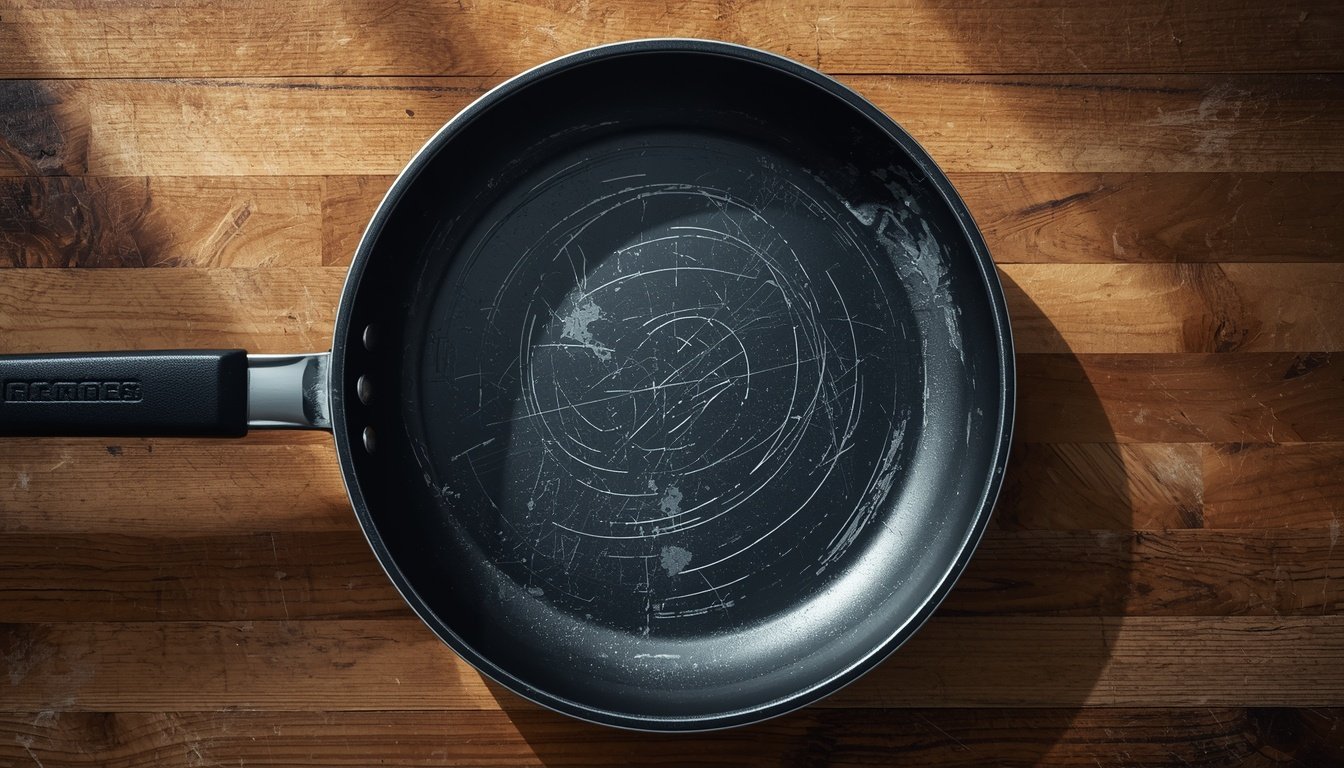
A nonstick pan is not a pan. It’s a pan with a thin plastic film glued to it. That film is maybe 20 to 40 microns thick. Thinner than a human hair. It’s the only thing doing the work you bought the pan for.
And it is designed to wear out. Every spatula scrape, every heat cycle, every trip through the dishwasher takes a little off. Not “maybe.” Always. That’s physics, not marketing. It’s the single structural difference between a coated pan and an uncoated one — the reason a nonstick vs stainless steel cookware comparison isn’t really a comparison of two pans at all. It’s a comparison of a pan and a subscription.
Which raises the question nobody asks: is it safe to use a scratched nonstick pan, and where does the missing coating actually go?
Is it safe to use a scratched nonstick pan? A scratched nonstick pan is not proven to be toxic, but it is actively shedding. Researchers found a single crack in a Teflon coating can release about 9,100 plastic particles. If the coating is flaking or bare metal shows, stop using the pan. If it’s only lightly scratched, keep it for low-heat jobs and plan a replacement.
It doesn’t evaporate into another dimension. It goes into your food, your sink, and your water supply. Gram by gram, meal by meal, over three years.
You can be completely right that PTFE is inert and still be eating your cookware.
How many microplastics does a scratched nonstick pan release?
In 2022, researchers at the University of Newcastle and Flinders University did something obvious that almost nobody had done. They counted.
They used Raman imaging to scan nonstick pan surfaces. Raman imaging works like a fingerprint reader for materials. Shine a laser at a surface, and each material scatters the light in its own pattern. Match the pattern, and you know exactly what you’re looking at — even at particle sizes far too small to see.
What they found, published in Science of The Total Environment, is the number that should stop you.
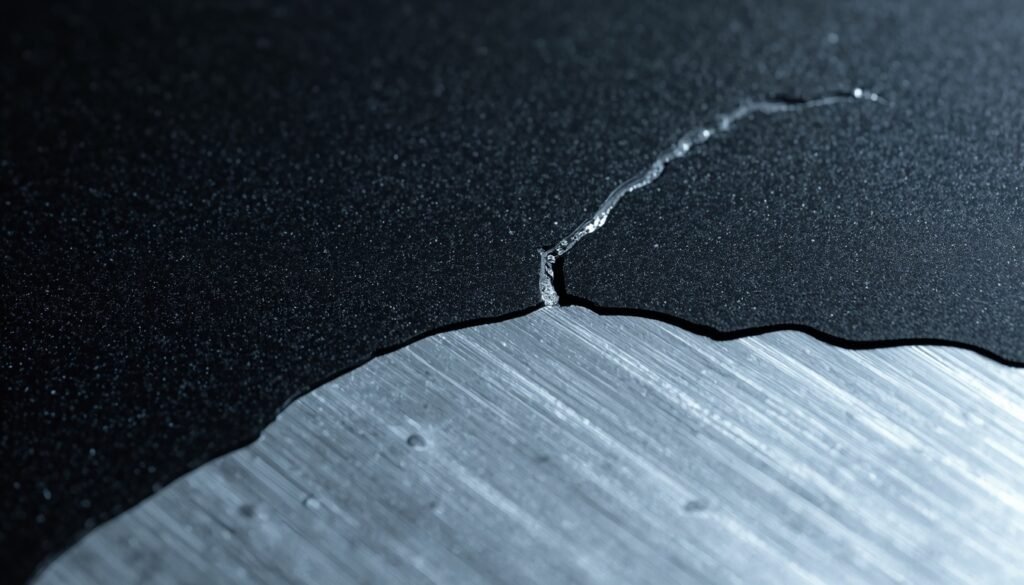
Just one surface crack on a Teflon-coated pan can release about 9,100 plastic particles. From a broken-down coating, their Raman imaging and algorithm modeling identified the release of 2.3 million microplastics and nanoplastics. You can read the full write-up of the findings in Phys.org’s coverage of the study and in Flinders University’s own summary. Phys.org
One crack. Nine thousand particles.
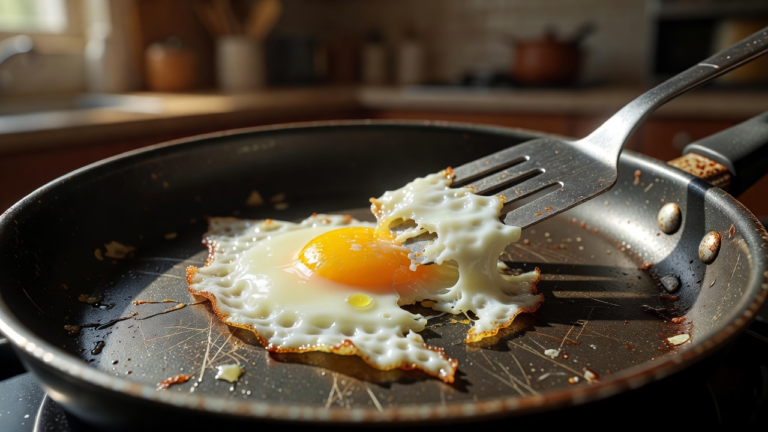
Now go look at your pan. Not the shiny part. The part where the spatula always lands. Count the scratches.
What the Teflon microplastics study does and doesn’t prove
I’m going to do something the wellness blogs won’t: tell you the limits of that study.
Those are lab estimates from imaging and modeling. They are not a measurement of how much ends up in your stomach. The researchers said so themselves. Dr. Cheng Fang of the University of Newcastle pointed out that Teflon belongs to the PFAS family, and that because these are emerging contaminants, we simply don’t know much about them yet. Flinders University’s Professor Youhong Tang called specifically for more work on risk assessment. Mirage NewsPhys.org
Nobody has proven that eating PTFE particles harms you.
But notice what just happened. The question changed. It used to be “is this poison?” Now it’s something harder to shrug off: we are all eating a material nobody has studied, in amounts nobody has measured, and nobody is checking.
That’s not a scare story. That’s an information gap. And you’re the one absorbing the risk while it stays open.
You’d never accept this from a pharmaceutical company. “It’s probably fine, we haven’t looked” is not a safety standard.
Nonstick pan fumes: the 500°F problem is not theoretical
Here’s the part even hardened skeptics concede, because it’s documented and old.
PTFE begins degrading around 500°F. Above that, it releases fumes. In humans, this causes polymer fume fever — flu-like symptoms that usually clear in a day or two. Unpleasant, rarely serious.
In birds, it’s fatal. When PTFE is heated to high temperatures it releases particles and acidic gases that are toxic to inhale, and because those gases are colorless and odorless, owners usually have no idea their bird was exposed — that’s VCA Animal Hospitals, not a forum post. The veterinary literature is blunter still: Cornell’s Animal Health Diagnostic Center cites a budgerigar study in which nine minutes or more of exposure to PTFE pyrolysis products produced clinical signs and death in 97% of the birds. VCA Animal Hospitalscornell
Not a rumor. A known veterinary phenomenon with a body count.
Now, the defense: “Just don’t overheat your pan.” Fine. Except an empty pan on a hot burner can pass 500°F in a few minutes. Searing steak, preheating for stir-fry, walking away to answer the door — these aren’t exotic scenarios. They’re Tuesday.
Why a worn nonstick pan makes overheating more likely
A worn coating sticks more. So you crank the heat higher to compensate. You use the pan harder precisely as it becomes less able to take it.
Wear doesn’t just degrade the coating. It pushes you toward the exact behavior that breaks it faster.
Nonstick pan alternatives: what cast iron, carbon steel and stainless really cost
Forget health for a second. Let’s talk about being ripped off.
Do the math on what nonstick actually costs you:
- A decent nonstick pan: $40–$80
- Realistic useful lifespan: 3–5 years, less with heavy use
- Over 20 years: 4 to 6 replacements
- Total: $200 to $450
Now the alternatives:
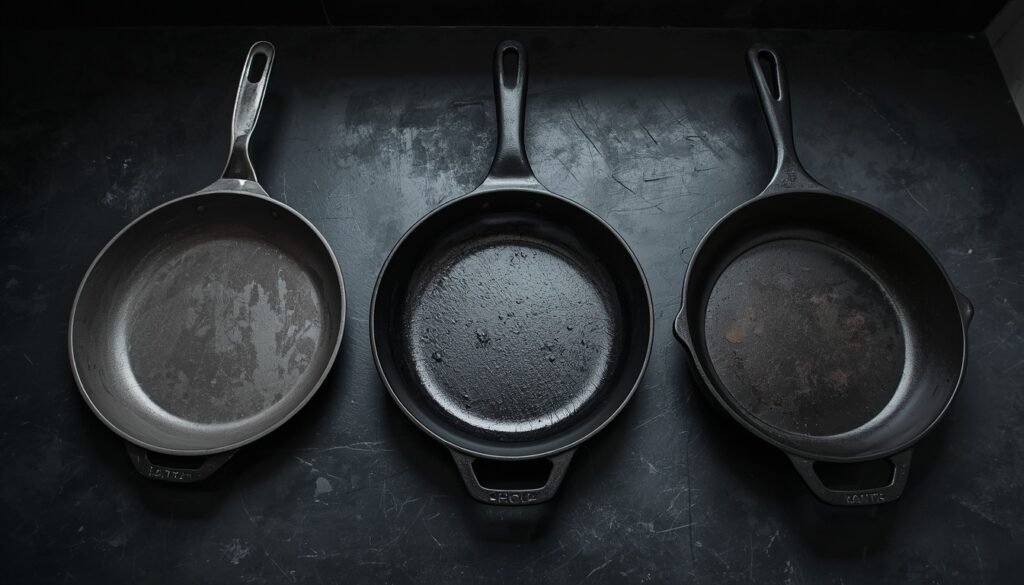
- Cast iron skillet: $25–$40. Lasts a century. People inherit these. (Care and seasoning basics are in this cast iron cookware guide.)
- Carbon steel: $40–$70. Same deal, about half the weight. A carbon steel pan is roughly half as heavy as a comparable cast iron piece, which makes flipping and manoeuvring far easier, and it responds faster when you change the burner. The full breakdown is in this carbon steel cookware guide. Topcookwarebrands
- Stainless steel: $60–$100. Effectively permanent.
You are on a subscription plan and nobody told you.
And it’s worse than the sticker price. A degraded nonstick pan makes you a worse cook. Eggs tear. Fish shreds. You add more oil to compensate. You get patchy browning because you’re afraid to get it hot enough for a real sear. You paid for convenience and you’re getting frustration.
I know because I ran the same scratched $60 skillet for four years past its expiry date, adding a second glug of oil every morning to stop eggs welding to it, and told myself that was normal. It wasn’t normal. It was a pan quietly failing while I paid the difference in butter and patience.
The four pans that end the replacement cycle
These are the pieces that do the work a worn nonstick pan can no longer do, plus the two cheap items that make a nonstick pan last twice as long. More options are in our top cookware picks.
Lodge 10.25″ Pre-Seasoned Cast Iron Skillet — Around $25. The cheapest permanent pan in the kitchen. Sears better than any nonstick ever will, goes stovetop to oven to grill, and gets slicker every year instead of worse. Heavy, and that’s the only real objection.
Lodge 12″ Seasoned Carbon Steel Skillet — Around $45. The one pan I’d tell most people to buy first. Half the weight of cast iron, heats and cools fast enough for eggs, and handles a 700°F sear that would destroy a coated pan. It becomes genuinely nonstick with use.
Tri-Ply Stainless Steel 10″ Fry Pan — $60–$100. For sauces, pan sauces, deglazing and anything acidic. Dishwasher-safe, oven-safe, effectively immortal. You will never replace it.
Tramontina Professional 10″ Nonstick Fry Pan — Around $35. Buy your one nonstick here, not at $120. The restaurant-grade aluminum pans hold up as well as premium consumer ones and cost a third as much — which matters enormously when you’ve accepted the pan is a consumable.
Wooden and Silicone Utensil Set — Under $20. The single highest-return purchase on this page. Metal utensils are the main cause of the cracks the Newcastle team was counting. Stop using them and your coating lifespan roughly doubles.
Felt Pan Protectors — Under $15. Stacked pans grind against each other in the cupboard. These stop it. Nobody thinks about storage damage, and storage damage is real.
When to replace a nonstick pan: nobody does it on time
Here’s the emotional truth underneath all of this.
Nobody replaces a nonstick pan on schedule. Nobody. We use them until they’re genuinely awful. Until the coating is grey and patchy and flaking at the edges. Until eggs weld themselves to the surface.
Why? Because throwing away a pan that still looks like a pan feels wasteful. It has a handle. It holds food. It seems fine.
So the last third of a nonstick pan’s life is the worst part of it. That’s when it sheds the most and cooks the worst. And that’s exactly when we keep using it — because binning it feels like admitting we wasted the money.
That’s the trap. The product is designed to degrade. We’re wired to hold on.
Here’s the industry’s own number, which is more generous than mine and still nowhere near what people actually do. America’s Test Kitchen reports that a decade ago a nonstick pan was expected to last two to three years, and that with today’s coatings you can expect five to seven years from a quality pan, according to Fran Groesbeck, managing director of the Cookware and Bakeware Alliance. Five to seven years, under good treatment. Ask yourself honestly how long your current pan has been in rotation. americastestkitchen
ATK put the same question on camera, and it’s worth four minutes of your time before you decide whether yours is done:
Video: How Often Should You Replace Nonstick Pans? — America’s Test Kitchen
What nonstick pan warranties don’t cover
Manufacturers know this. Their warranties carefully exclude “normal wear of the coating.” Read the fine print on your next pan.
They will replace a warped base. They will not replace the only part that matters.
They sold you a consumable and priced it like a tool.
What critics of the nonstick pan safety argument get right
Let me be straight with you, because credibility is the whole point. The critics of this argument have real points, and you should hear them:
- No study has shown that ingesting PTFE particles causes disease in humans. That’s true. The health risk is unquantified, not proven.
- Modern coatings are better. Reinforced and multi-layer nonstick genuinely lasts longer than 1990s Teflon.
- “Nonstick-free” alternatives aren’t automatically cleaner. Ceramic coatings often wear out faster — they just wear out into something different. GreenPan told Consumer Reports that its ceramic coatings are expected to last two to five years, possibly longer with good care. Two to five. That’s the “safer” option’s lifespan, and it’s shorter than PTFE’s. Consumer Reports’ full nonstick testing is worth reading before you pay a premium for ceramic. Consumer Reports
- Nonstick solves a real problem. For low-fat cooking, for people with grip or strength limitations, for anyone who can’t wrestle a 10-pound cast iron skillet, it’s genuinely useful.
Anyone who tells you to throw out every nonstick pan tonight is selling something. I’m not. I own a nonstick pan. I’ll buy another one. I just stopped pretending it’s permanent.
The real nonstick pan safety argument, in three sentences
It’s narrower than the scare stories, and much harder to dismiss.
Nonstick coating wear is a real, measurable, ongoing process with unknown health consequences, guaranteed performance consequences, and certain financial consequences — and almost nobody accounts for it.
You don’t have to believe PTFE is dangerous to act on that. You just have to believe three things:
- The coating is leaving the pan. (Measured. Not disputed.)
- It’s going somewhere. (Into food, water, and landfill.)
- Nobody has checked whether that matters. (The researchers say so themselves.)
That’s it. That’s the whole case. No conspiracy required.
How to check your nonstick pan for wear tonight
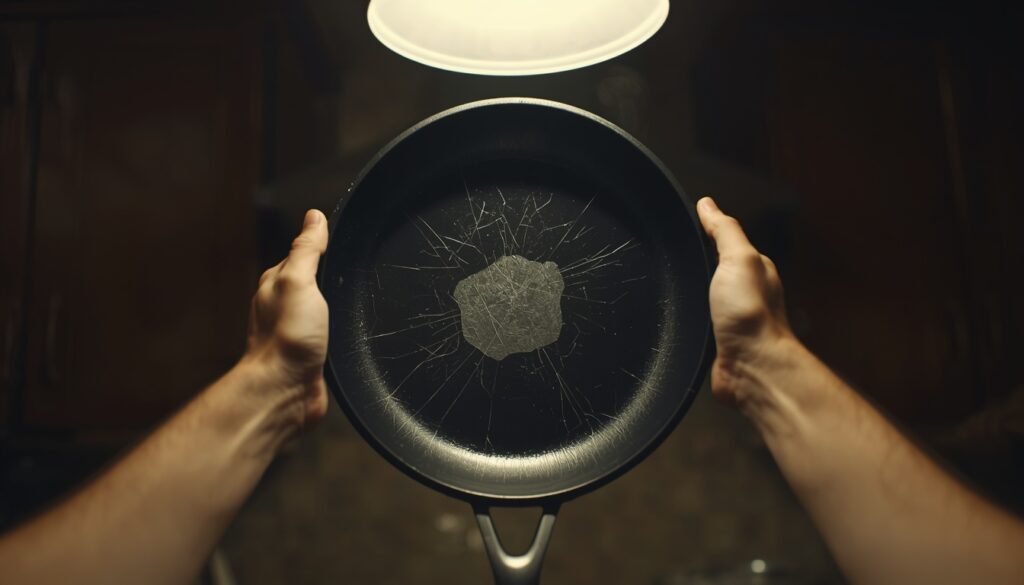
Go to your kitchen. Pick up your most-used nonstick pan. Tilt it under a light. Look for:
- Scratches, especially where the spatula lands
- Dull or grey patches where it used to be black and glossy
- Any chipping or lifting at the edges
- Food that now sticks where it never used to
If you see flaking or exposed metal, that pan is done. Today. Not next month.
If it’s scratched but intact, you’ve got a decision to make. Keep it for gentle, low-heat jobs. But start planning its replacement now, on your schedule — not when it finally becomes unusable.
Which of your pans actually needs to be nonstick?
When you do replace it, ask a different question than “which nonstick is best?”
Ask: which of my pans actually needs to be nonstick?
For most people the honest answer is one. Eggs and delicate fish. That’s it. Everything else — searing, browning, roasting, frying, sauce — works better in carbon steel or stainless, and those pans will outlive you.
Buy one good nonstick, treat it like a consumable, replace it every three years without guilt. Buy one carbon steel pan for everything else and never buy a pan again.
Nonstick pan safety FAQ
Is it safe to cook in a scratched nonstick pan?
A scratched pan isn’t proven toxic, but it is shedding coating into your food. Light surface scratches are low risk for occasional low-heat cooking. Visible flaking, lifting edges or exposed bare metal means the pan is finished — stop using it and replace it now.
How often should you replace a nonstick pan?
Plan on three to five years with regular home use. The Cookware and Bakeware Alliance puts a quality coating at five to seven years, but that assumes careful treatment: no metal utensils, no dishwasher, no high heat. Replace sooner if the surface dulls, greys or starts sticking. americastestkitchen
Does Teflon still contain PFOA?
No. PFOA was a manufacturing aid, not part of the coating itself, and US producers phased it out by 2015. Any nonstick pan made after roughly 2013 is PFOA-free. PFOA is a genuine historical concern, but it is not what’s in your current pan.
How many microplastics does a scratched nonstick pan release?
Researchers estimated that a single surface crack could leave behind approximately 9,100 plastic particles, and that broken coating may release around 2,300,000 microplastics and nanoplastics. These are Raman imaging and modeling estimates, not direct measurements of what reaches your stomach. ScienceDirect
At what temperature does a nonstick pan become dangerous?
PTFE starts breaking down near 500°F and releases fumes above that. An empty pan on high heat can reach that in a few minutes. Those fumes cause temporary flu-like polymer fume fever in people and are rapidly lethal to pet birds.
Are ceramic pans a safer alternative to Teflon?
Ceramic coatings are PFAS-free, which matters to some buyers, but they are not more durable. GreenPan itself told Consumer Reports its ceramic coatings are expected to last two to five years. You’re swapping one consumable for another that often wears out faster. Consumer Reports
Can you repair or re-coat a scratched nonstick pan?
Not meaningfully at home. Nonstick repair sprays exist, but they wear through quickly and can chip into food themselves. Once the coating is compromised, the honest options are demotion to low-heat duty or replacement.
What’s the best long-term alternative to nonstick?
Carbon steel for most jobs — light enough to handle, hot enough to sear, and naturally slick once seasoned. Cast iron for heat retention, stainless for sauces and acidic food. All three outlive every coated pan you’ll ever buy.