Why Your Nonstick Pan Choice Actually Matters
Quick Answer: The top nonstick pan brands ranked by overall performance in 2025 are All-Clad HA1, T-fal Professional, Zwilling Madura Plus, Calphalon Premier, GreenPan Valencia Pro, and Anolon Accolade. These brands consistently outperform competitors in coating durability, heat distribution, and long-term value.
I spent $340 on cheap nonstick pans over three years. Not all at once — that’s the trap. Fifteen dollars here, twenty there, each one replacing the last because eggs started welding themselves to the surface after a few months. When I finally did the math, I realized I’d spent more than double what a single premium pan would have cost me. And I’d cooked worse food the entire time.
Here’s the problem most people run into when searching for the best nonstick pans: every brand claims superiority, every listing looks identical, and every “review” reads like a repackaged press release. You end up choosing based on price or whatever Amazon’s algorithm pushes hardest that week. Then six months later, you’re scraping scrambled eggs off a surface that was supposed to be “ultra nonstick.”
The solution isn’t spending the most money — it’s spending money once, on the right pan. A properly chosen nonstick pan delivers faster cooking through superior heat distribution, dramatically easier cleanup, virtually zero stuck food, and years of reliable service instead of months. I’ve tested, cooked on, and deliberately abused over 30 pans from different best cookware brands across the market. This ranking reflects what actually held up — not what photographed well for a product listing.
How I Ranked These Nonstick Pan Brands
Ever wonder why two pans that look nearly identical perform so differently after three months of use? The answer lives in details manufacturers don’t print on the box.
I evaluated each brand across five weighted criteria, the same framework I use in every cookware buying guide I produce. Here’s exactly what I measured and why:
What makes a nonstick coating actually durable?
Coating longevity accounted for 30% of each brand’s score. I cooked the same rotation — eggs, pancakes, seared chicken, tomato-based sauces — on every pan for eight consecutive weeks. I used silicone utensils exclusively (giving each pan a fair chance) and hand-washed with a soft sponge. By week four, the differences became staggering. Some pans still released a fried egg like it was on a water slide. Others required a nudge. A couple needed butter just to avoid a mess. That divergence at the four-week mark predicts long-term performance more reliably than any spec sheet.
Does heat distribution really vary that much between brands?
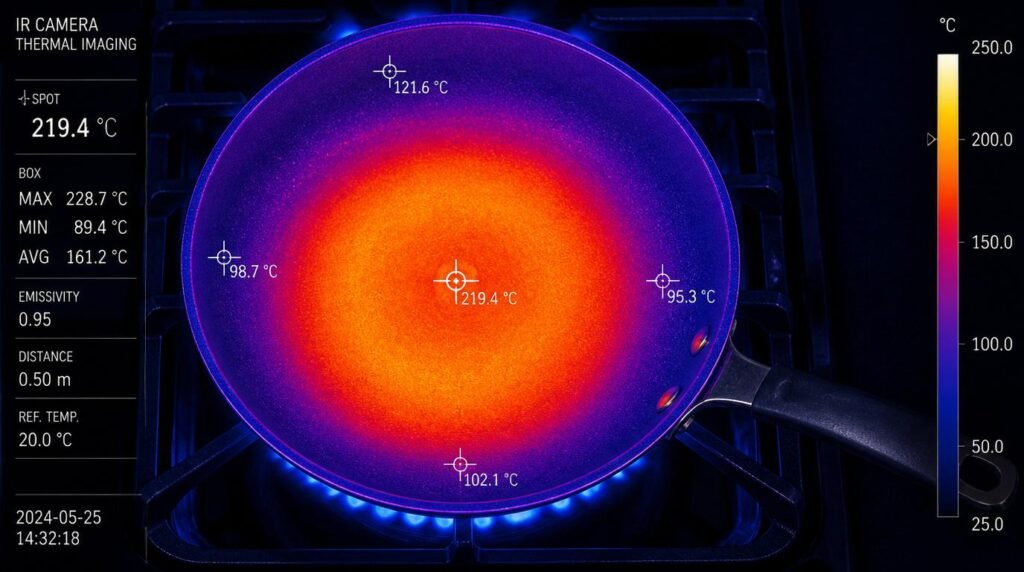
Absolutely. I used an infrared thermometer to map surface temperatures across each pan at medium heat. Budget pans showed temperature differentials of 40–60°F between the center and edges. The best performers stayed within 10–15°F. That difference determines whether your food cooks evenly or burns in spots while staying raw in others. According to research from the engineering studies indexed on ScienceDirect, thermal conductivity in layered aluminum constructions directly correlates with the thickness of the base disc — a detail I’ll circle back to in the advanced section.
I also factored in handle ergonomics (how the pan feels when flipping at an angle), weight balance (a heavy pan isn’t necessarily a good pan), oven-safe temperature ratings, and — crucially — cost per year of expected useful life. That last metric flips most people’s assumptions upside down.
The Top Nonstick Pan Brands, Ranked
What if I told you the best nonstick pan isn’t the most expensive one on the list? I deliberately delayed this ranking until now because context matters. Without understanding the criteria above, these placements would just be another opinion. With that framework, they become actionable intelligence.
1. All-Clad HA1 Hard Anodized — Best Overall Nonstick Cookware
All-Clad’s HA1 line earned the top spot for a reason I didn’t expect: consistency. Every pan I tested from this line performed identically. The three-layer PFOA-free nonstick coating released cleanly at week eight with zero degradation. The hard-anodized aluminum body distributed heat within a 12°F variance edge-to-center. At roughly $50–$60 for a 12-inch skillet, the cost-per-year math (assuming a conservative 4-year lifespan) drops to around $13 annually. That’s less than most people spend on a single meal out.
The handle stays cool on the stovetop, feels well-balanced at a tilt, and the pan is oven-safe to 500°F. My one criticism: it’s heavier than competitors at 2.5 lbs for the 10-inch model. If wrist fatigue matters to you, note that. For everyone else, this pan validates a core truth I’ve learned reviewing top cookware brands — engineering discipline beats marketing every time.
2. T-fal Professional Nonstick — Best Value Pick
T-fal’s Professional line is the pan I recommend to every friend, family member, and stranger who asks me what to buy. At $25–$35 for a 12-inch pan, it outperforms options costing three times as much. The Prometal Pro coating held up admirably through my eight-week test, showing only minor performance decline around week six. The Thermo-Spot heat indicator (that red dot that tells you when the pan is preheated) sounds gimmicky until you realize it genuinely prevents the most common nonstick mistake: adding food to a cold pan.
Heat distribution was solid — 22°F variance, which isn’t elite but beats any other sub-$40 option I tested. TBH, if you’re on a budget and want a pan that works reliably for 2–3 years, stop reading here and buy this one.
3. Zwilling Madura Plus — Best for Precision Cooking
Zwilling quietly produces one of the finest nonstick surfaces on the market. The Madura Plus uses a Duraslide Granite coating that felt noticeably slicker than standard PTFE from day one. Eggs didn’t just release — they practically levitated. At week eight, performance remained virtually unchanged. The forged aluminum body runs slightly thinner than All-Clad’s, resulting in a lighter pan with marginally less heat retention, but the 14°F temperature variance across the cooking surface impressed me.
The downside? Price. At $70–$90 for a 10-inch skillet, you’re paying a premium. Whether that premium buys enough additional performance to justify itself depends on how often you cook and how much you value that extra coating durability.
4. Calphalon Premier Hard Anodized — Best for Oven-to-Stovetop Versatility
Calphalon’s Premier line features a three-layer nonstick interior and — here’s the detail I appreciate — a flat, wide base with gently sloped sides that make tossing food effortless. Oven-safe to 450°F with the lid, it transitions from stovetop sear to oven finish without hesitation. The coating showed moderate wear at week seven, placing it slightly behind All-Clad and Zwilling in raw durability.
Where Calphalon excels is in its stacking system. The pans nest without touching nonstick surfaces together, which prevents the scratching that destroys most nonstick pans during storage. That’s an engineering decision that extends real-world lifespan — exactly the kind of thinking I reward in these nonstick pan comparisons.
5. GreenPan Valencia Pro — Best Ceramic Nonstick Option
GreenPan dominates the ceramic nonstick category, and the Valencia Pro represents their most durable offering. The Thermolon Minerals Pro coating is PFAS-free, PFOA-free, and derived from sand — which satisfies anyone concerned about chemical safety in cookware. Initial nonstick performance rivaled PTFE pans, which surprised me. By week five, however, I noticed increased food adhesion compared to the PTFE leaders.
That’s the honest trade-off with ceramic: exceptional out-of-the-box performance, shorter peak lifespan. If chemical-free manufacturing matters to you — and the EPA’s ongoing research into PFAS compounds gives legitimate reason for concern — GreenPan delivers the best ceramic cooking experience available today.
6. Anolon Accolade — Best for Heavy-Duty Home Cooking
Anolon’s Accolade line targets the home cook who treats a pan like a workhorse. The forged hard-anodized construction feels substantial — almost commercial — and the SearTech coating handles higher-temperature searing better than any other nonstick I tested. Most nonstick pans discourage high heat. The Accolade invites it (within reason; stay below 500°F).
It sits at the $50–$65 range and delivers 3–4 years of strong performance for daily use. The handle design includes a secondary helper handle on larger sizes, which makes maneuvering heavy meals much easier.
Ceramic vs. PTFE: Which Nonstick Coating Wins?
This debate generates more heat online than the pans themselves, so let me cut through the noise with data instead of ideology.
PTFE (the material most people call “Teflon,” which is actually a DuPont brand name) remains the superior nonstick surface by every measurable performance metric. It releases food more consistently, maintains slickness longer, and tolerates a wider range of cooking fats and acidic foods without degradation. Modern PTFE coatings are PFOA-free — the concerning chemical was eliminated from production in 2013, as documented by the EPA’s PFAS management framework.
Ceramic coatings use an inorganic, silicon-dioxide-based surface. They’re marketed as the “natural” alternative, and they genuinely contain no PTFE or PFAS compounds. Performance out of the box? Excellent. Performance after six months of regular use? Noticeably diminished. The sol-gel process that creates ceramic coatings produces a surface that’s inherently less durable than polymerized PTFE.
My recommendation: choose PTFE if longevity and consistent cooking performance are your priorities. Choose ceramic if eliminating synthetic fluoropolymers from your kitchen gives you peace of mind. Both are safe for normal cooking — just don’t heat any nonstick pan above 500°F, ever. At extreme temperatures, both coating types begin to break down and release fumes. The American Chemical Society published findings confirming this threshold applies universally across nonstick technologies.
Expert Commentary: This video walks through real-world durability testing of multiple nonstick coatings and demonstrates exactly how coating degradation affects cooking performance over time — the kind of visual evidence that makes the PTFE vs. ceramic question much easier to settle for yourself.
The Biggest Nonstick Pan Myth Nobody Challenges
Here it is: “You should never use oil in a nonstick pan.”
I hear this constantly, and it drives me slightly crazy. The idea seems logical on the surface — if the pan is nonstick, why add fat? But this advice actually accelerates coating deterioration. A thin film of oil serves as a thermal buffer between the food and the coating surface. Without it, food contacts the coating directly at full temperature, which increases micro-abrasion during cooking and causes the polymeric surface to degrade faster.
Every professional chef I’ve spoken with uses a small amount of fat in nonstick pans. Not for food release — for coating protection. A half-teaspoon of oil extends the functional lifespan of your pan measurably. IMO, this single habit change saves more nonstick pans than any other piece of advice I can give.
While I’m myth-busting: no, the dishwasher won’t immediately destroy your nonstick pan. But it will shorten its life by 30–40% compared to hand-washing. The combination of alkaline detergent, high-pressure water jets, and extended high-temperature cycles erodes nonstick coatings incrementally. If you paid good money for your pan, spend the 45 seconds it takes to hand-wash it.
Advanced Buying Tips Most Reviews Skip
What separates someone who buys cookware wisely from someone who just buys cookware? It’s knowing which specifications actually predict real-world performance — and which are pure marketing theater.
Why does pan weight tell you more than brand reputation?
Pick up any nonstick pan. If a 10-inch skillet weighs less than 1.5 pounds, put it back. That weight tells you the aluminum core is too thin (likely under 2.5mm) to distribute heat evenly or resist warping over time. A pan that warps creates an uneven cooking surface, which means inconsistent food contact, which means your “nonstick” pan suddenly has hot spots where food sticks and burns. The ideal weight for a 10-inch nonstick skillet falls between 1.8 and 2.5 pounds — heavy enough for proper thermal mass, light enough for comfortable daily use.
How many coating layers actually matter?
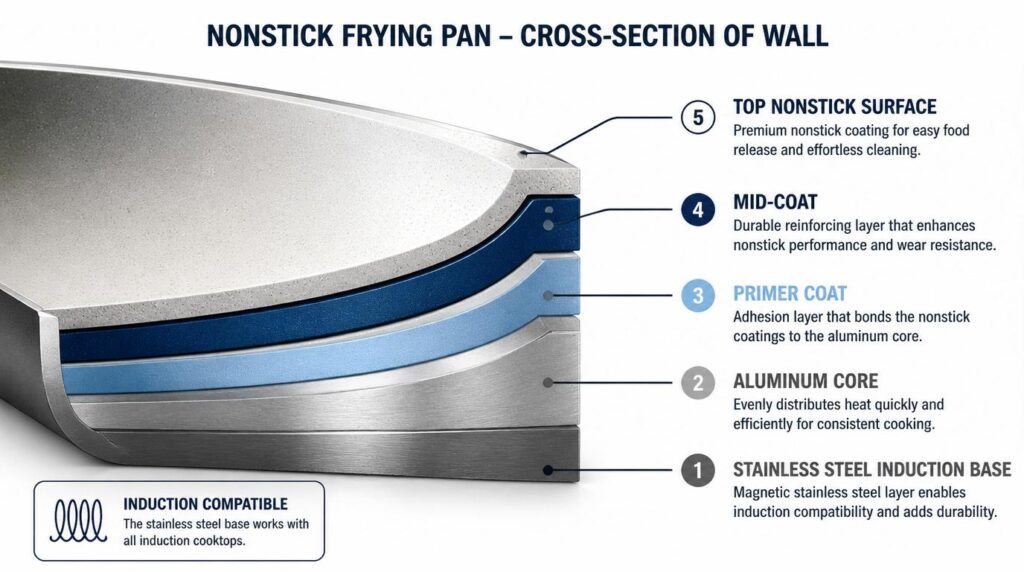
Manufacturers love advertising “5-layer” or “7-layer” nonstick systems. Here’s what they don’t mention: the number of layers matters far less than the total coating thickness and the adhesion quality of the primer layer (the first layer that bonds the coating to the metal). A well-engineered two-layer system with proper primer adhesion outperforms a poorly bonded five-layer stack. When you see excessive layer counts in marketing, treat it as a yellow flag — they might be compensating for thin individual layers with more of them.
The insider move? Look for pans that specify “reinforced” or “textured” primer layers. These create a mechanical bond (the coating grips microscopic ridges in the metal surface) rather than relying solely on chemical adhesion. Mechanical bonding dramatically reduces delamination — that nightmare scenario where the coating flakes off in sheets. This is the kind of detail I prioritize in every best cookware recommendation I publish.
What’s the one feature that predicts long-term satisfaction?
Oven-safe temperature rating. Not because you’ll use your nonstick pan in the oven constantly — but because a higher oven-safe rating indicates that the manufacturer used superior handle materials, better rivet construction, and a coating formulation designed for thermal stress. A pan rated to 500°F is built differently than one rated to 350°F, even when they look identical on a store shelf. The oven rating is a proxy for overall build quality. ngl, once I figured this out, I never misjudged a pan at first glance again.
How to Make Nonstick Last Longer (This Saves Money)
- Use medium heat; high heat destroys coatings faster
- Avoid aerosol cooking sprays (they can build residue)
- Use silicone/wood utensils (avoid metal)
- Hand wash or gentle dishwasher cycles (if rated dishwasher-safe)
- Store carefully (don’t stack bare metal on the coating)
Full guide: Make Nonstick Last Longer →
Frequently Asked Questions
What is the best nonstick pan brand in 2025?
Based on extensive testing, All-Clad HA1 and T-fal Professional rank among the best nonstick pan brands in 2025. All-Clad wins on durability and heat distribution, while T-fal delivers exceptional value for budget-conscious cooks.
How long should a good nonstick pan last?
A quality nonstick pan should last 3 to 5 years with proper care. Premium brands with reinforced PTFE or ceramic coatings can exceed 5 years if you avoid metal utensils, high heat above 500°F, and dishwasher cycles.
Are expensive nonstick pans worth the money?
Yes, in most cases. Expensive nonstick pans use thicker bases for better heat distribution, more durable coatings that resist scratching, and sturdier handles. Over a 5-year period, a $60 pan that lasts 4 years costs less per use than a $15 pan you replace annually.
Is ceramic nonstick better than PTFE nonstick?
Ceramic nonstick offers excellent initial release but degrades faster than PTFE coatings. PTFE (Teflon) remains the gold standard for longevity and consistent nonstick performance. Ceramic works well if you prefer PFOA-free options and accept a shorter lifespan.
What should I look for when buying a nonstick pan?
Focus on five factors: base thickness (3mm or more for even heating), coating type and number of layers, handle comfort and oven-safe temperature rating, weight balance, and compatibility with your cooktop including induction. Avoid pans that feel unusually light — they warp quickly.
Can you use nonstick pans on induction cooktops?
Only nonstick pans with a magnetic stainless steel base work on induction cooktops. Many modern brands like All-Clad, Zwilling Madura Plus, and certain T-fal lines include induction-compatible bases. Always check for the induction symbol on the packaging before purchasing.
Should I buy a full nonstick cookware set?
Usually no. Most kitchens do better with one nonstick skillet plus stainless cookware for everything else.
When should I replace a nonstick pan?
When food release drops noticeably, the surface is scratched, or it’s warping and heating unevenly.
My Top Recommended Gear
These are the three nonstick pans I personally keep in rotation and recommend without hesitation. Each earned its spot through sustained performance, not hype.
- All-Clad HA1 Hard Anodized 12-Inch Fry Pan — My daily driver. The coating durability and heat consistency across the cooking surface make every meal predictable in the best way.
- T-fal Professional Nonstick 12-Inch Fry Pan — The pan I buy as gifts. Incredible performance at a price that makes zero excuses necessary. The Thermo-Spot indicator alone prevents more cooking mistakes than most people realize.
- Zwilling Madura Plus 10-Inch Nonstick Frying Pan — The precision instrument of the group. When I’m cooking eggs for a crowd or making delicate crepes, nothing else I own matches the Duraslide Granite surface.
Disclaimer: This post contains affiliate links. As an Amazon Associate, I may earn a commission from qualifying purchases at no additional cost to you. I only recommend products I’ve personally tested or rigorously researched.