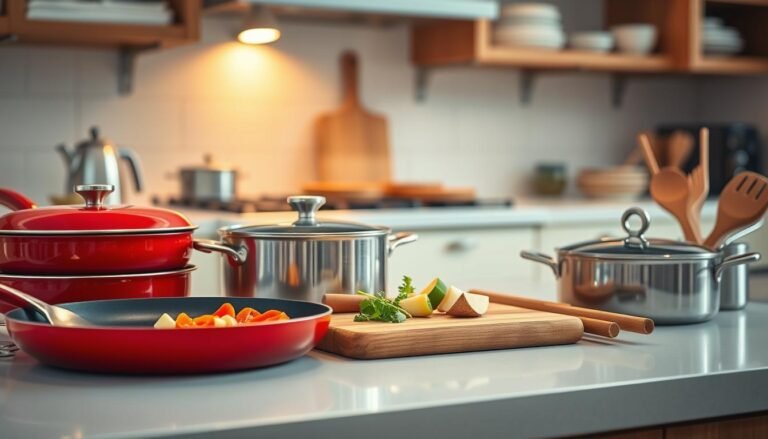
Nonstick: What Matters (and what’s marketing)
Did you know the average home chef replaces their favorite slippery-surface pan every 18 to 24 months? This frequent turnover is often due to confusing claims and failed coatings.
Today’s market is flooded with options. Brands promise revolutionary materials and lifelong durability. It’s hard to know what’s real.
This guide cuts through the noise. We separate genuine innovation from clever marketing. You’ll learn what features actually improve your cooking experience.
Modern nonstick technology has evolved. New coatings and construction methods offer better safety and performance. Understanding these differences is key to a smart purchase.
We evaluate products across price points. Our focus is on construction quality, heat distribution, and long-term value. This helps you choose the right tools for your kitchen.
Whether buying a single item or a full set, knowledge is power. Invest in cookware that performs reliably for years. Let’s find what truly matters.
Key Takeaways
- Not all nonstick coatings are created equal; durability varies widely by brand and technology.
- The pan’s base material (like aluminum or stainless steel) critically impacts how evenly it heats.
- Marketing terms like “granite” or “ceramic” often describe the coating’s look, not its core composition.
- A higher price tag does not automatically guarantee a longer-lasting or better-performing pan.
- Proper care, like using wooden utensils and avoiding high heat, can significantly extend any coating’s life.
- For daily use, seek out pans with reinforced or multi-layer coatings for added resilience.
- Your specific cooking habits should guide your choice between different nonstick options.
Overview of Nonstick Cookware Trends
The landscape for easy-release kitchen tools has transformed significantly in recent years. Shoppers now prioritize safer materials and clear manufacturing details. This shift has reshaped the entire market.
Old coatings raised health concerns for many families. Manufacturers responded with new surfaces. Ceramic and advanced metallic treatments now offer similar food release.
Every brand promotes its own special technology. This makes comparing different options tough. A key trend is the rise of hybrid pans. They mix nonstick convenience with the sturdy feel of classic kitchenware.
| Coating Type | Key Market Claim | Consumer Consideration |
|---|---|---|
| Traditional PTFE | Tried-and-true performance | Potential long-term wear and heat limitations |
| Ceramic | Natural, PFAS-free material | Durability can vary widely between brands |
| Advanced Metallic | Superior scratch resistance | Often commands a higher price point |
New direct-to-consumer companies add more choices. Their bold claims need careful checking. Understanding these trends helps you spot real innovation. It guides you past clever marketing to find lasting value for your money and your meals.
What Defines Quality in Modern Cookware
Forget flashy marketing—real quality in your kitchen starts with the fundamental choice of metals and how they’re bonded together. This foundation dictates both immediate performance and how long a pan will last.
Materials and Construction Explained
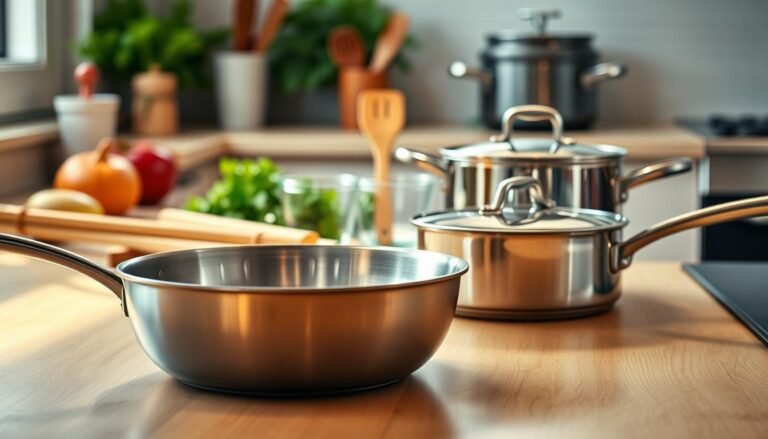
Superior pieces use a combination of materials. A common high-quality build is Fully-Clad Tri-Ply Construction.
This method sandwiches an ultra-conductive aluminum core between a durable stainless steel exterior and a specialized interior surface. The result is exceptional heat spread.
It eliminates hot spots for perfectly even cooking. The interior layer is crucial for food release. Understanding options like ceramic vs. nonstick helps you choose the right cookware.
The Role of Durability in Everyday Cooking
Long-term value comes from resilience. High-quality materials resist warping under high heat.
They also handle repeated cooking cycles and cleaning. A robust steel exterior prevents dents and corrosion.
This everyday toughness is what separates great cookware from items that fail quickly. Your investment pays off for years.
Top Nonstick cookware Options: A Product Roundup
Our product roundup cuts through the clutter to highlight the top-performing options available today. We compare items across budget, mid-range, and premium tiers.
Each product undergoes real-world testing. We check for even heating and food release. Scratch resistance and ease of cleaning are also key factors.
You can buy a single pan or a full cookware set. Individual pieces are great for replacements. A complete set offers better value for a kitchen overhaul.
Price varies widely. A high cost doesn’t always mean better performance. Our table below breaks down the main categories.
| Product Type | Average Price Range | Key Strength | Primary Consideration |
|---|---|---|---|
| Traditional Coated | $20 – $50 | Excellent initial food release | Coating may wear faster over time |
| Ceramic | $40 – $80 | PFAS-free and eco-friendly | Durability depends heavily on brand |
| Advanced Metallic | $60 – $150 | Superior scratch resistance | Higher upfront investment |
| Coating-Free | $80 – $200+ | Extreme durability and heat tolerance | Requires different cooking technique |
Look for products where the performance justifies the price. Some brands rely on reputation over real results. Focus on construction and verified user reviews.
Your cooking habits should guide your final choice. Consider how often you cook and what foods you make most. This ensures you pick the right pan for your needs.
Exploring NoCo® Nonstick Technology
Imagine a pan where the food slides off not because of a coating, but because of the metal’s own engineered surface. NoCo® Technology represents this fundamental shift.
It is the first coating-free solution for easy release. This patented innovation mimics the Lotus Effect found in nature.
How the Technology Works
Instead of applying a separate layer, the nonstick property is engineered directly into the pan’s surface. Microscopic structures cause liquids to bead and roll away.
This process eliminates traditional coating applications. Food release happens through physical characteristics, not chemical layers.
Benefits Over Traditional Coatings
The cooking performance stays consistent for years. The integrated properties cannot peel or flake like a standard coating.
It also withstands much higher heat. This expands your cooking techniques safely.
| Feature | NoCo® Technology | Traditional Nonstick Coating |
|---|---|---|
| Construction | Properties integrated into metal | Separate layer applied on top |
| Durability | High; cannot peel or flake | Prone to wear and scratching |
| Heat Tolerance | Very high (up to 1000°F) | Often limited (around 500°F) |
| Utensil Compatibility | Metal utensils are safe | Requires soft utensils |
| Safety Profile | PFAS and PTFE-free | May contain PFAS chemicals |
This approach offers enhanced safety and long-term value. It is a clear step forward in kitchen tool innovation.
The Advantages of Fully-Clad Tri-Ply Construction
Engineered with three distinct metal layers, fully-clad tri-ply pans deliver unmatched thermal performance. This method bonds a durable stainless steel exterior to a highly conductive aluminum core and a specialized interior surface. The layers extend throughout the entire pan, including the sides, for consistent results.
Enhanced Heat Distribution
The aluminum core is key. It rapidly conducts heat laterally across the cooking surface and up the sides. This even heat transfer eliminates hot spots that cause uneven cooking.
Your food prepares more uniformly. You won’t need constant stirring or repositioning. The stainless steel exterior adds durability and works on all cooktops.
This steel and aluminum sandwich responds quickly to temperature changes. It maintains stable heat during delicate tasks. That control improves your cooking outcomes.
Tri-ply design represents a premium build. It distinguishes high-quality pans from budget disc-base options. The investment pays off in every meal.
Stainless Steel vs. Nonstick Surfaces: Choosing the Right Pan
The debate between stainless steel and nonstick isn’t about which is better, but which is right for the task at hand. Each surface excels in specific cooking applications.
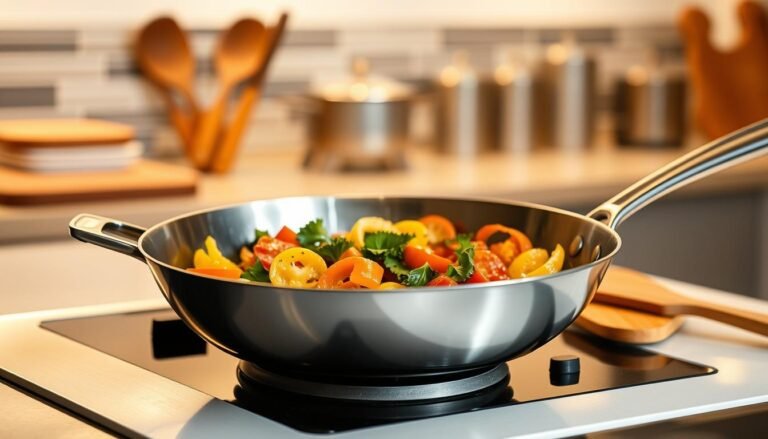
Stainless steel pans are champions of high-heat searing. They develop fond—those flavorful browned bits—essential for rich sauces. This makes them ideal for meats and pan sauces.
In contrast, a nonstick surface prioritizes easy food release. It’s perfect for delicate items like eggs, fish, or pancakes. Cleanup is often simpler with these pans.
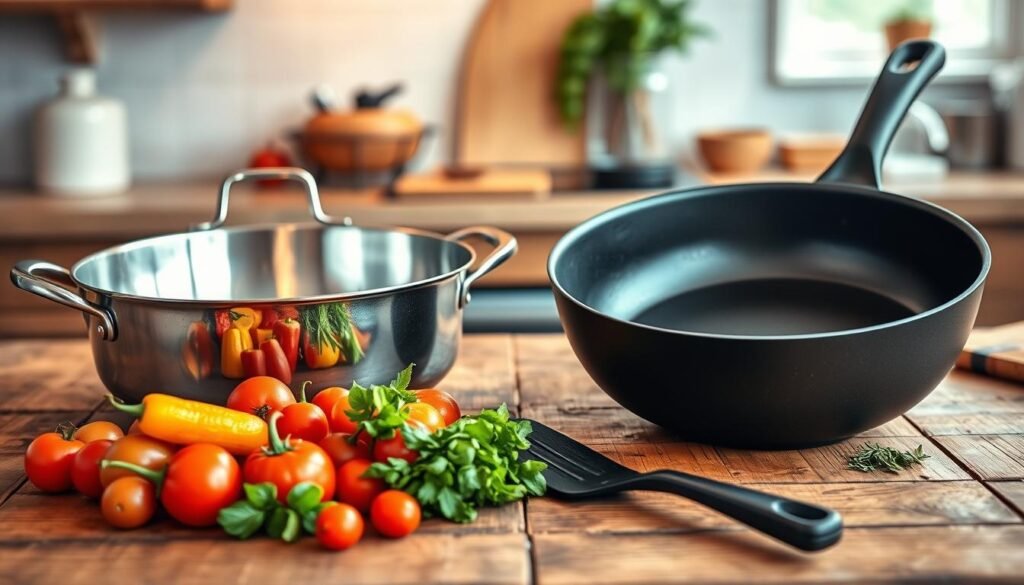
Your oil needs change too. Stainless steel typically requires more fat for good release. A nonstick pan can often work with just a light spray.
The most versatile kitchen owns both types. Use stainless steel for searing and sauce-making. Reserve your slippery-surface pans for delicate foods.
Hybrid designs try to combine both worlds. They may involve a steel body with a specialized coating. For a detailed comparison of stainless steel vs, explore our dedicated guide.
| Feature | Stainless Steel Pan | Nonstick Pan |
|---|---|---|
| Best For | Searing, browning, making sauces | Eggs, fish, pancakes, low-fat cooking |
| Utensil Use | Metal utensils are safe | Use wood or silicone to protect coating |
| Heat Tolerance | Extremely high (oven-safe) | Often limited to medium heat |
| Cleaning | Can handle abrasive scrubbing | Requires gentle hand-washing |
| Durability | Lasts for decades | Surface may wear over time |
Understanding these core differences prevents disappointment. Don’t expect a steel pan to release an egg easily. Don’t try to sear a steak on high heat in a standard coated pan. Match the tool to the job.
Safety First: Cooking Free from PFAS and Forever Chemicals
The term ‘forever chemicals’ has moved from scientific journals to mainstream kitchen conversations for a critical reason. These persistent substances, known as PFAS, were once standard in many kitchen items for their slipperiness.
Health research now shows these chemicals accumulate in our bodies and environment. This has shifted consumer demand toward pans made without these risks.
What Consumers Need to Know
PFAS, including PTFE, are synthetic chemicals that do not break down naturally. Traditional nonstick coatings relied heavily on them for easy food release.
Concerns about forever chemicals leaching into food or air during cooking have grown. Choosing products made without any PFAS eliminates this exposure.
Some brands have always prioritized chemicals-free design. Others have reformulated recently. It’s vital to look beyond claims like “PFOA-free” which might still use other PFAS compounds.
True PFAS-free options provide the highest safety assurance. They prove that safety and performance can coexist in modern kitchenware.
High-Heat Performance: Cooking at Temperatures Up to 1000°F
Unlock restaurant-quality searing at home with pans that handle extreme temperatures up to 1000°F. This capability transforms your kitchen into a professional workspace. You can achieve deep browning and complex flavors typically reserved for traditional materials.
Such high heat tolerance expands your technique possibilities. It allows for perfect searing and safe transitions from stovetop to oven. The durable construction behind this performance prevents warping and damage.
How Heat Safety Impacts Cooking Results
Heat safety ratings are critical for both outcomes and well-being. They indicate when materials may degrade or release compounds. A stable pan ensures consistent cooking without hot spots.
This stability is vital for methods like stir-frying or searing proteins. You no longer compromise between convenience and optimal browning. Your cooking results improve dramatically with the right tools.
Check if your typical oven and stovetop cooking requires such extreme ratings. For many, this high heat performance offers practical value and longevity.
Oven & Dishwasher Safe: Versatility in Performance
The hallmark of a premium kitchen tool is its ability to withstand both the intense heat of your oven and the rigorous spray of your dishwasher. This dual resilience defines true versatility.
An oven-safe pan streamlines cooking. You can start a sauce on the stove and finish it under the broiler. This eliminates messy transfers between different pieces of cookware.
Dishwasher compatibility is a major convenience. It simplifies cleanup after big meals. Fully-sealed rims are critical here. They prevent water from seeping into the layers of the pan during a cycle.
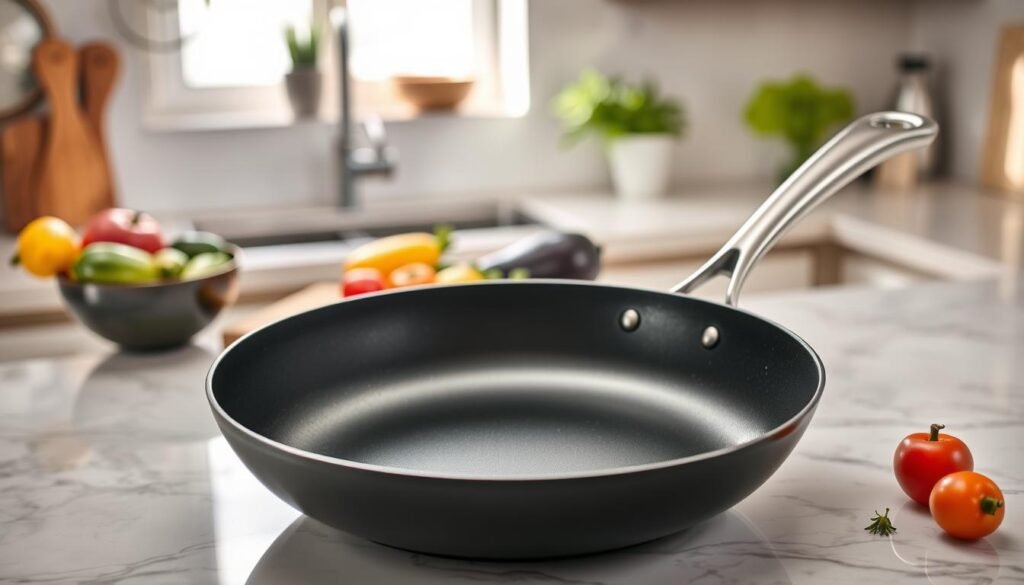
Metal utensil compatibility is the final piece. It allows for confident stirring and flipping. You aren’t limited to soft tools that can slip or melt.
| Versatile Pan Features | Limited Pan Features |
|---|---|
| Safe for high oven temperatures | Stovetop use only |
| Built for dishwasher cleaning cycles | Hand-wash only requirement |
| Compatible with metal utensils | Restricted to wood/silicone tools |
| Fully-sealed, waterproof rim construction | Exposed edges that can trap moisture |
This combination of features means one well-made pan replaces several specialized pans. For a complete versatile cookware set designed for this performance, explore options that prioritize this engineered durability.
Included Accessories and Their Impact on Cooking Efficiency
The true value of a kitchen set often reveals itself not in the main pieces, but in the quality of the included tools. Thoughtfully designed accessories streamline your workflow from start to finish.
They turn a simple collection of pots into a complete, efficient system. Cheap, flimsy utensils and ill-fitting covers create frustration and slow you down.
Premium Spatulas and Lids
A premium spatula uses materials like stainless steel and silicone. This construction is safe for all surfaces and built to last. Some feature a patented rest system.
This clever design keeps the tool securely on the pan’s edge. It eliminates messy drips on your countertop during active cooking.
The right lid is equally crucial. A tight seal locks in moisture for perfect steaming. Good visibility lets you monitor food without losing heat.
Multiple lid sizes in a set ensure every pan has proper coverage. This maximizes the versatility of your entire cookware collection.
| Premium Included Accessories | Basic Included Accessories |
|---|---|
| Stainless steel & silicone spatula | Flimsy plastic utensils |
| Innovations like spatula rest systems | No thoughtful design features |
| Glass lid with tight-sealing rim | Thin, ill-fitting metal cover |
| Dishwasher-safe, heat-resistant materials | May warp or degrade quickly |
| Adds significant value to the cookware purchase | Feels like a throwaway marketing add-on |
These details show a manufacturer’s commitment to your complete cooking experience. High-quality accessories are designed as essential tools, not afterthoughts.
User Experiences: Durability and Everyday Use
The real measure of a pan’s worth isn’t found on a store shelf, but in the hands of home cooks over time. Real-world use reveals how nonstick pans perform beyond their shiny first impressions.
Durability emerges only after months of regular cooking and cleaning. User feedback shows which pans maintain easy food release and which degrade quickly.
The time needed for cleanup varies widely. Some pans stay simple to wash for years. Others gradually require more scrubbing effort.
Experienced cooks report how different pans handle tough use. This includes exposure to acidic food, metal utensils, and high heat.
| High-Performing Pans (User Reports) | Quick-to-Degrade Pans (User Reports) |
|---|---|
| Food release stays consistent for years | Nonstick properties fade within months |
| Easy cleaning even after heavy use | Water spotting and stubborn stains appear |
| Handle diverse recipes without sticking | Struggle with delicate items like eggs |
| Justify their price through long service | Require replacement despite premium cost |
Long-term experiences are the best guide. They show which nonstick pans deliver reliable cooking across many meals. This turns a simple purchase into a lasting kitchen investment.
Pricing and Value: Understanding Cookware Investments
Smart shoppers look beyond the sticker price to gauge a kitchen tool’s true worth over time. The cost for these items varies wildly. Promotions like free shipping over $60 or bundled gifts can change the real value.
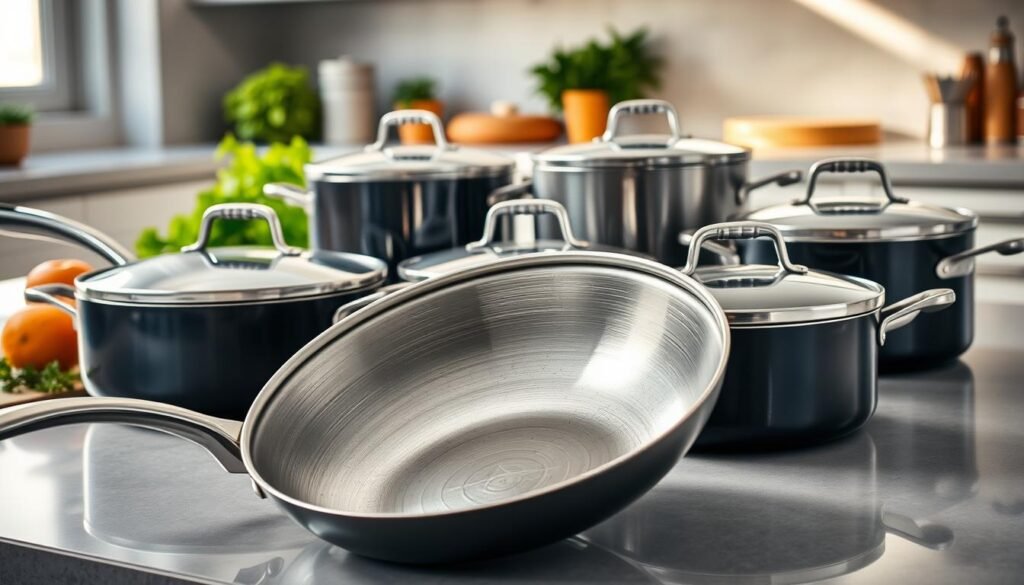
Comparative Price Analyses
A single pan can cost under $30 or over $200. This depends on materials and brand reputation. Established names often charge more, even for similar quality.
Buying a cookware set usually offers better per-piece value. But some sets include sizes you won’t use. This reduces the practical savings.
For clear detailed comparisons, look at piece count and accessories. Direct price checks are tricky without this full view.
Long-Term Value Considerations
Think about lifespan, not just upfront cost. A $150 pan lasting ten years beats a $50 one replaced every two. This cost-per-use metric shows real value.
Your cooking frequency and style matter too. The set must match your needs to justify its price. A good buying guide helps balance investment against expected performance and durability.
Effective Care and Maintenance for Longevity
Your pan’s lifespan depends more on daily habits than on its initial price tag. Proper care can extend its service for years beyond typical replacement cycles.
While many premium items are dishwasher safe, hand washing often preserves the surface longer. Use warm water and mild detergent for best results.
Your choice of sponge matters greatly. Abrasive scrubbers can damage even scratch-resistant surfaces. Always follow the manufacturer’s instructions for cleaning.
Remove food residue immediately after cooking. This prevents stubborn buildup. Avoid aerosol cooking sprays, as they leave a sticky film.
Proper storage with protectors prevents scratches. Also, manage heat by preheating your pan gradually.
| Recommended Care | Harmful Practice | Reason |
|---|---|---|
| Hand wash with soft sponge | Using abrasive scouring pads | Preserves the nonstick coating |
| Clean with warm, soapy water | Soaking in hot water for hours | Prevents surface degradation |
| Dry thoroughly after washing | Air-drying while stacked | Avoids moisture damage and scratches |
| Use wooden or silicone utensils | Scraping with metal tools | Prevents scratches on the pan |
| Store with protective layers | Nesting without separators | Maintains surface integrity |
Always review the specific manufacturer’s care instructions. This ensures your pan delivers lasting performance.
Warranties, Return Policies, and What They Mean for Shoppers
The length and terms of a warranty reveal much about a company’s confidence in its own products. A limited lifetime guarantee suggests an expectation of many years of reliable service.
Always review the full terms before you buy. This clarifies what defects are covered versus normal wear. It also defines your remedies—repair, replacement, or refund.
Return policy windows vary significantly. Some brands offer a short 30-day trial. Others provide extended evaluation periods, giving you more time to test the product thoroughly.
The implied life expectancy helps set realistic performance expectations. A two-year warranty indicates different durability than lifetime coverage on similar cookware.
A brand’s reputation for honoring claims matters as much as the written policy. Generous terms mean little if the claim process is obstructed.
Pay close attention to specific procedures. Many warranties require product registration and proof of purchase. There are often time limits for reporting issues that emerge over the years.
Common exclusions eliminate coverage for damage from misuse or improper cleaning. Reading the complete terms of sale is essential. It may reveal details about dispute resolution, like mandatory arbitration.
Robust warranty coverage reduces your purchase risk. It effectively lets the manufacturer share confidence in their cookware’s quality and craftsmanship for the long term.
Smart Shopping Tips: Evaluating Marketing Claims Versus Reality
Navigating the crowded marketplace for kitchen essentials requires a sharp eye. You must separate genuine innovation from persuasive advertising. Glossy packaging and bold promises can be misleading.
Every brand promotes exclusive technologies. Yet, many features offer minimal real-world benefit. Focus on construction and verified performance instead.
How to Decipher Product Roundup Reviews
Independent testing methods vary widely. Some reviews simply echo manufacturer claims. Look for transparent methodology and long-term assessments.
Ceramic nonstick surfaces are marketed as natural and safe. However, their performance often degrades faster than traditional coatings. Consider your cooking habits before choosing this type of pan.
Price does not always reflect quality. Mid-range pans can outperform expensive options. Evaluate the cost per use over time for true value.
Ceramic nonstick technologies have improved. Still, they may not match the durability of other surfaces. Read detailed product reviews carefully.
| Marketing Claim | Practical Reality |
|---|---|
| “Revolutionary nonstick coating” | May perform similarly to standard options |
| “Premium ceramic finish” | Requires careful maintenance; may scratch easily |
| “Lifetime durability guarantee” | Often excludes normal wear from coverage |
| “Professional-grade performance” | May not suit average home cooking needs |
Always check user feedback over time. A product’s true value reveals itself after months of regular use. Prioritize features that match your daily routine.
Smart shopping involves identifying useful features. Ignore appealing but impractical benefits. Your investment should align with your actual cooking style.
Conclusion
Armed with knowledge of materials and marketing, you can now select kitchen tools that truly align with your culinary life. Look past glossy claims to the pan’s core construction and safety profile.
Prioritize performance features you’ll use. This includes even heat from an aluminum core, a durable stainless steel body, and a surface free from PFAS chemicals. This focus ensures easy food release and lasting value.
The best choice fits your specific cooking habits. For detailed reviews of top-performing pans, explore our curated guides. Make an informed choice you’ll enjoy for years.