
Is Le Creuset worth it? You’ve already decided it isn’t. You think a Le Creuset Dutch oven is a scam, a $400 pot for people who like showing off.
Good. You’re exactly who I wrote this for.
Disclosure: This article contains affiliate links. As an Amazon Associate, we earn from qualifying purchases, at no extra cost to you.
Is Le Creuset worth it? Le Creuset is worth it if you cook in it at least once a week. At about $400, a pot used weekly for 30 years costs roughly 26 cents per meal, carries a lifetime limited warranty, and holds resale value. If you cook a braise twice a winter, an $80 enameled Dutch oven is the better buy.
Table of Contents
Key takeaways
- Weekly cooks win. One meal a week for 30 years is 1,560 meals, or about 26 cents per meal on a $400 pot.
- The budget pot cooks well. An $80 enameled Dutch oven makes a great stew, and independent testers agree.
- The gap is durability, not flavor. Weight, enamel, interior color, and handles are what separate the two over decades.
- The cheap pot saves little. In the best case for the budget pot, you save about $8 a year.
- The warranty has limits. It covers defects in materials and workmanship, not drops, overheating, or normal wear.
- Rare cooks should skip it. A pot used twice a year is expensive at any price.
That’s the short answer. You shouldn’t take it on my word, so I’m not going to tell you what to think. I’m going to ask you ten questions. You answer each one in your head, honestly. Then you tell me where you landed.
One ground rule first. Every number below is either public or an assumption I label as an assumption. You can check all of them yourself, and at the end I’ll show you how.
Let me guess what you believe right now:
- A pot is a pot, and heat doesn’t care about the logo.
- You’re paying for a French name and a pretty color.
- An $80 Dutch oven cooks the same stew.
- People buy Le Creuset to display it, not to use it.
Some of that is partly true, and I’ll admit where. Let’s start.
1. What are you really paying for when you buy a Dutch oven?
Think about the last pan you bought. Did you want the pan itself?
You didn’t. You wanted dinners. You wanted hundreds of meals out of that pan.
So the pot is not the product. The meals are the product. The pot is just the tool that delivers them.
Hold on to that answer. Everything else builds on it.
2. Price tag or cost per use: which number matters for cookware?
Here’s a simple example. A $30 pair of shoes lasts six months. A $120 pair lasts five years. Which pair is cheaper?
You already know. The $30 pair costs $60 a year, and the $120 pair costs $24.
The price tag tells you what leaves your wallet today. It tells you nothing about what each use costs.
If meals are the product, cost per meal is the real price. You can’t answer that one any other way.
3. How much have you already spent on cheap cookware?
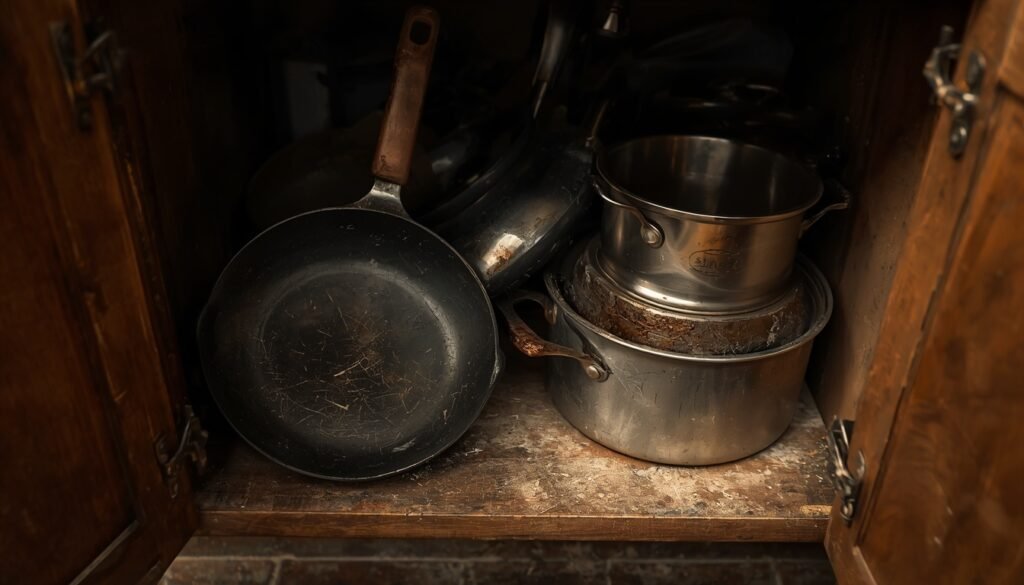
Count the pots you’ve thrown away. The nonstick pan that started flaking. The thin pot with the scorched bottom. The one with the wobbly handle.
Most people have a small graveyard of dead cookware behind them. Each one felt like a smart buy at the register. It’s the same story across every cookware category we cover, from aluminum to stainless steel.
Now add up what you spent on all of them. Be honest about the total.
That number is your real cookware budget. You just paid it in small pieces, so you never noticed.
4. What makes an enameled cast iron Dutch oven last a lifetime?
Let’s build the list together. To stay out of that graveyard, a pot would need to:
- Hold up to decades of high heat without warping
- Have no coating that flakes off into your food
- Go from stovetop to oven without a second thought
- Still look good enough that you want to use it
That’s a short list, but it’s a hard one to meet. Thin steel warps and nonstick coatings wear out.
Thick cast iron with a glass enamel coating meets every item. That’s just what the material does. It’s the same fired-glass idea behind the porcelain cookware we review.
Le Creuset has made that exact thing since 1925, at the same foundry in Fresnoy-le-Grand in northern France. Each pot is cast in its own sand mold, and the mold is used only once, as Tasting Table’s comparison of Le Creuset and Lodge explains. They’ve had about a century to get it right.
5. Le Creuset vs. a cheap Dutch oven: does the $80 pot do the same job?
This is your strongest objection, so I’ll take it seriously.
The honest answer is yes, mostly. A budget enameled Dutch oven makes a great stew. Independent testers have said so for years. CNN Underscored’s side-by-side test found the Lodge stood toe to toe with the Le Creuset. Prudent Reviews’ heat and moisture tests put the two within a degree or two of each other.
If you cook a braise twice a winter, buy the $80 pot and be happy. I mean that.
So ask a sharper question. Where do the two pots actually differ?
The four differences you only notice after years of cooking
- Weight. Le Creuset pots run lighter than many rivals of the same size. CNN Underscored weighed its pot at 11.5 pounds, among the lightest it tested. Your wrists notice that on use number 500.
- Enamel. Cheaper enamel tends to chip sooner, mostly at the rim.
- Interior. The light sand-colored inside lets you see your food browning. You can tell golden from burnt at a glance.
- Handles. The wide loops fit a hand wearing a thick oven mitt.
None of these make tonight’s dinner taste better. I won’t pretend they do.
They decide whether the pot is still in your kitchen in 2050. Which brings us to the next question.
Watch: Le Creuset vs. Lodge Dutch ovens, side by side
Seeing the two pots next to each other makes the enamel and handle differences obvious. Watch Le Creuset vs. Lodge Dutch oven comparisons on YouTube, then come back and run the math.
6. What does a Le Creuset Dutch oven cost per meal over 30 years?
Let’s run it with round numbers. Say the Le Creuset Dutch oven costs about $400 and the budget pot costs $80. Prices move, so check today’s before you do your own math.
Say you cook in it once a week. That’s 52 meals a year, or 1,560 meals in 30 years.
Now divide:
$400 ÷ 1,560 meals = about 26 cents per meal
That’s 26 cents for the tool that cooks dinner for your whole table.
Now the budget pot. Here I have to guess, so I’ll say so. Say the enamel chips badly every five or six years. Your pot may do better. If my guess is right, you buy five or six pots in 30 years. That adds up to $400 to $480.
So in that scenario, you spend the same money. You just spend it slowly, on six pots instead of one.
And if your cheap pot lasts 15 years, you save roughly $240 over three decades. That’s $8 a year.
So here’s the real question. Is $8 a year the thing standing between you and the better tool?
7. What does the Le Creuset lifetime warranty actually cover?
Every pot can fail. Le Creuset enamel can chip too, especially if you drop it or overheat it empty.
So ask what each company does about it.
Le Creuset puts a lifetime limited warranty on its enameled cast iron. It covers defects in materials and workmanship. It does not cover drops, abuse, overheating, or normal wear, and you have to follow the care instructions for it to apply. Read the terms.
Still, think about what a lifetime promise means. Every claim costs the company money. So a company only makes that promise when it expects very few claims.
Would you bet your own money on a product lasting for life? They did. That tells you what they know about their pots.
8. Does a used Le Creuset hold its resale value?
Here’s a test you can run in two minutes. Open any resale site and search for a used Le Creuset Dutch oven. Look at what 20-year-old pots sell for.
Then search for a used budget Dutch oven and compare.
One of those holds real value secondhand. The other mostly doesn’t.
That changes the math. Say you sell your $400 pot years from now and get a good part of that money back. Your real cost just dropped. A used pot that nobody wants can’t do that for you.
So which purchase is actually the risky one? Is it the pot you can sell, or the one you can only throw away?
9. Is the Le Creuset color just for show, or does it get you cooking?
Be honest about your own habits here. Do you use the things you like, or the things you tolerate?
Think about your favorite knife, your favorite mug, your favorite jacket. You reach for them constantly. The ones you merely put up with sit in the back of a drawer.
This is where the “it’s just a pretty color” objection flips.
You said people buy Le Creuset for the looks. Fine. But a pot that lives on your stovetop gets used. A pot hidden in a low cabinet behind the blender does not.
Go back to Question 1. The product is the meals. Anything that gets you cooking more often lowers your cost per meal.
So is the color really a waste? Or is it part of why the pot earns its keep?
And one more thing. What does a home-cooked braise cost compared to takeout for four? If the pot swaps out even one delivery order a month, it pays for itself fast.
10. How long does a Le Creuset last, and who cooks in it after you?
Ask around about old Le Creuset pots. You’ll find people cooking in their grandmother’s, with the orange gone a little dull and the pot still working fine. The writer of Taste of Home’s Le Creuset Dutch oven review describes using hers for about 40 years.
Now ask yourself what you own that could do the same. Not your phone, your laptop, or your nonstick pans.
Very few things you buy today will outlive you and still do their job. A heavy enameled cast iron pot is one of them.
So the last question is simple. Divide $400 by your lifetime of meals, then add someone else’s lifetime after yours. What’s the cost per meal now?
So, is Le Creuset worth the money? Here’s where you landed
Look back at what you just told yourself.
- You said meals are the product, not the pot.
- You said cost per use beats the price tag.
- You admitted your cookware graveyard cost real money.
- You saw that the cheap pot saves you maybe $8 a year at best.
- You saw that one company backs its pot for life.
- You saw which pot still has value in 20 years.
I didn’t say any of that. You did.
There’s one fair exit, and I’ll name it. If you rarely cook, the math doesn’t work, and you should skip it. A pot used twice a year is expensive at any price.
The Dutch ovens from this article, and where to check prices
These are the pots the math above is built on. Check today’s price before you run your numbers.
| Pot | Who it’s for | Check price |
|---|---|---|
| Le Creuset Signature 5.5-Quart Round Dutch Oven | Weekly cooks who want one pot for decades | See it on Amazon |
| Lodge 6-Quart Enameled Cast Iron Dutch Oven | Occasional cooks, and the budget pot in the tests above | See it on Amazon |
| Cuisinart Chef’s Classic Enameled Cast Iron Casserole | A second budget option at a similar price | See it on Amazon |
| Staub 5.5-Quart Round Cocotte | Cooks who want French-made with a dark interior | See it on Amazon |
Two cheap things protect the enamel on any of them:
- Wooden and silicone utensils, so metal never bangs the rim.
- Felt pot protectors, if you stack the pot in a cabinet.
Frequently asked questions about Le Creuset
Why is Le Creuset so expensive?
The enameled cast iron is still made at one foundry in France, each pot in its own single-use sand mold. You’re paying for that labor, the enamel work, and a lifetime limited warranty. You’re also paying for the name, and I won’t pretend otherwise.
Is Le Creuset really better than Lodge?
For tonight’s dinner, barely. Independent tests put the two close on heat and moisture retention. The Le Creuset pulls ahead on weight, handle size, and how the enamel holds up over years.
What size Le Creuset Dutch oven should I buy first?
The 5.5-quart round. It handles a braise or soup for four with leftovers, and it fits a standard burner and oven rack.
Does Le Creuset enamel chip?
It can. Dropping the pot, knocking it on a hard surface, or heating it empty can all damage the enamel. The warranty doesn’t cover that kind of damage.
Does the Le Creuset lifetime warranty pass to my kids?
No. The warranty covers the original buyer, or someone who received the pot new as a gift, for as long as they own it. The pot can be handed down. The warranty can’t.
Can a Le Creuset Dutch oven go in the dishwasher?
It’s rated dishwasher-safe, but hand-washing is the usual advice and keeps the enamel looking better. Let the pot cool first, then use hot soapy water.
Does Le Creuset work on induction, and how hot can it go in the oven?
Enameled cast iron works on induction, gas, electric, and ceramic cooktops. The Signature Dutch oven is oven-safe to 500°F.
Is a Le Creuset worth it if I only cook now and then?
No. If you’d use it a few times a year, buy the budget pot. The cost-per-meal math only works when the pot gets used.
How to decide if a Le Creuset Dutch oven is worth it for you
Don’t buy anything today. Grab a pen and check my math against your own life.
- Count how often you’d really use a Dutch oven each month.
- Multiply by 12, then by 30.
- Divide the price by that number.
- Check resale prices for the size you want.
Then walk into a store and lift one. Feel the weight and the handles. Look at the enamel up close.
If your number comes out in dollars per meal, keep your $400 and buy the $80 pot. I won’t argue.
But if it comes out in cents, you’ve stopped asking whether Le Creuset is worth it. You’re asking which color. Start with the 5.5-quart round, and put it on the stove tonight.
More cookware reviews and buying guides at Top Cookware Brands.