
Best Stainless Steel Cookware Brands: Smart Buyer Guide
Finding the best stainless steel cookware brands shouldn’t require a PhD in metallurgy or a second mortgage. Yet here we are—you’re drowning in marketing jargon about “revolutionary heat distribution” while staring at price tags ranging from $50 to $2,000. I’ve spent over a decade testing, reviewing, and frankly destroying cookware in professional and home kitchens. Let me cut through the noise and tell you exactly what’s worth your money in 2024.
Table of Contents
- Why Stainless Steel Cookware Dominates Professional Kitchens
- Top 7 Best Stainless Steel Cookware Brands Ranked
- Construction Matters: Understanding Ply and Core Materials
- 5 Stainless Steel Cookware Myths I’m Tired of Hearing
- The Smart Buyer’s Checklist
- Frequently Asked Questions
- My Top Recommended Gear
Why Stainless Steel Cookware Dominates Professional Kitchens
Stainless steel cookware dominates professional kitchens because it offers unmatched durability, non-reactive cooking surfaces, superior heat distribution when properly constructed, and the ability to develop fond (those flavorful browned bits) essential for pan sauces and professional cooking techniques.
Walk into any serious restaurant kitchen, and you’ll find stainless steel everywhere. It’s not because chefs lack options—it’s because stainless steel pots and pans deliver consistent, predictable results shift after shift. I’ve watched the same All-Clad saucier survive 15 years of restaurant abuse. Try that with a non-stick pan.
The real magic happens at the molecular level. According to research published by the National Institute of Standards and Technology, the chromium oxide layer in stainless steel creates a self-healing protective barrier. Scratch it, and it reforms within hours when exposed to oxygen. That’s why your grandmother’s Revere Ware still works perfectly.
But here’s what the marketing departments won’t tell you: not all stainless steel cookware performs equally. The best cookware brands understand that stainless steel alone is a terrible heat conductor. The solution? Sandwich aluminum or copper cores between stainless layers. This is where the real engineering—and the real price differences—come into play.
For a deeper exploration of what separates good from great, check out our comprehensive cookware buying guides.
Top 7 Best Stainless Steel Cookware Brands Ranked
After testing dozens of brands across every price point, here’s my honest ranking of durable cookware that actually delivers on its promises.
1. All-Clad (USA) – The Industry Standard
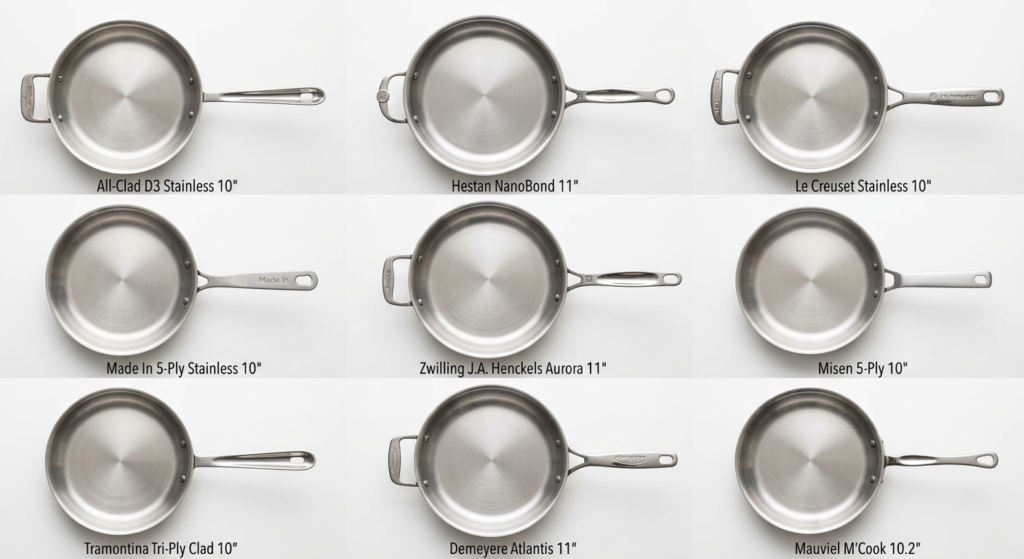
All-Clad invented bonded cookware in 1971, and they’re still the benchmark. Their D3 tri-ply line offers the best value-to-performance ratio I’ve encountered. Yes, the prices sting, but I’ve used the same D3 skillet for eight years without degradation. The Pennsylvania-made construction features fully clad aluminum cores extending through the handles, providing consistent heat distribution even on the sidewalls.
Best for: Serious home cooks who want “buy it for life” quality.
2. Demeyere (Belgium) – The Engineer’s Choice
If All-Clad is a reliable sedan, Demeyere is a precision-engineered sports car. Their Proline and Industry 5 collections feature proprietary Silvinox surface treatment that enhances stain resistance and makes seasoning unnecessary. The 7-ply Atlantis line is genuinely overkill for most home cooks, but the Industry 5 hits the sweet spot. 🙂
Best for: Technique-focused cooks who geek out over thermal conductivity.
3. Made In Cookware (USA) – The Disruptor
Made In crashed the premium market by cutting out retail middlemen. Their 5-ply stainless steel competes directly with All-Clad at roughly 60% of the price. I particularly appreciate their transparent manufacturing—they’ll tell you exactly which American mills supply their steel. For more details on this brand and others, browse our complete brand directory.
Best for: Value-conscious buyers who refuse to compromise on quality.
4. Cuisinart MultiClad Pro – The Budget King
Here’s my controversial take: the Cuisinart MultiClad Pro performs at 85% of All-Clad’s level for about 30% of the price. The tri-ply construction is solid, heat distribution is respectable, and the handles stay cool. IMO, this is the smartest entry point for anyone building their first serious kitchen cookware set.
Best for: Budget-conscious buyers and beginners.
5. Heritage Steel (USA) – The Titanium Upgrade
Heritage Steel’s titanium-strengthened stainless steel cooking surface offers enhanced durability without sacrificing heat response. Their 5-ply construction with a titanium-infused interior layer resists scratching better than standard 18/10 stainless. It’s a premium product, but the lifetime warranty backs up their confidence.
Best for: Buyers prioritizing American manufacturing and extreme durability.
6. Hestan NanoBond – The Technology Forward Pick
Hestan applies molecular titanium bonding to create an incredibly hard cooking surface. This isn’t marketing fluff—the NanoBond surface genuinely releases food more easily than traditional stainless while maintaining all the benefits of metal utensil compatibility. The science is legit, though the price reflects the R&D investment.
Best for: Tech-forward cooks willing to pay for innovation.
7. Tramontina Tri-Ply Clad – The Value Dark Horse
The Brazilian-made Tramontina Tri-Ply Clad consistently punches above its weight in blind testing. Consumer Reports and America’s Test Kitchen have both given it high marks against competitors costing three times more. The construction mimics All-Clad’s approach at a fraction of the investment.
Best for: Anyone wanting solid performance without premium pricing.
Construction Matters: Understanding Ply and Core Materials
Let me demystify the terminology that cookware marketers love to throw around. Understanding these concepts will prevent you from overpaying for features you don’t need.
Fully Clad vs. Impact Bonded: The Critical Difference
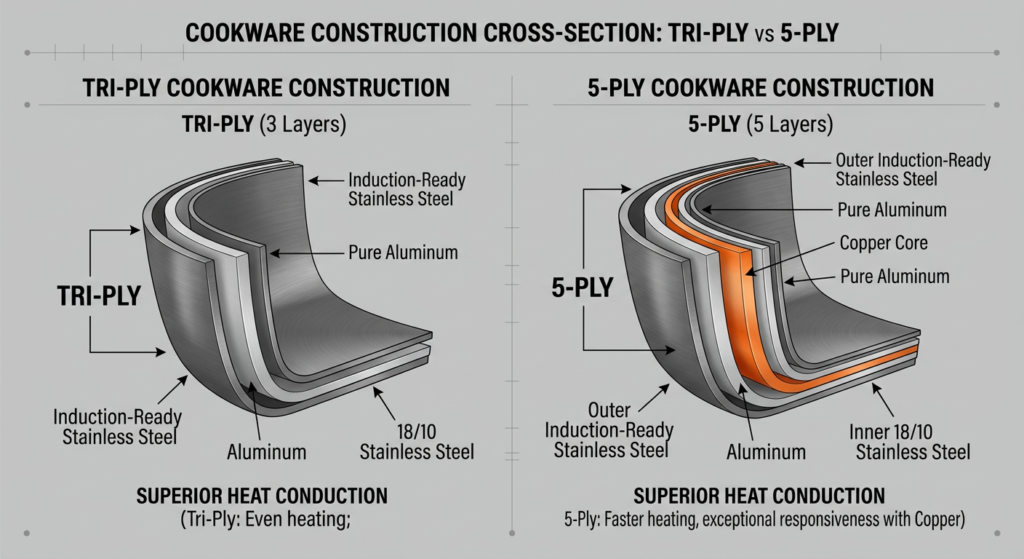
Fully clad cookware bonds layers from the base through the sidewalls. Heat distribution remains consistent whether you’re cooking in the center or near the edges. This matters enormously for techniques like reducing sauces.
Impact bonded (or encapsulated bottom) cookware attaches a heat-distributing disc only to the base. The sidewalls are thin, single-layer stainless that conducts heat poorly. These pans cost less but deliver inconsistent results. I generally steer people away from impact bonded designs unless budget absolutely demands it.
The Ply Numbers Game
Here’s the truth about ply counts that manufacturers don’t advertise: beyond 5-ply, you’re experiencing diminishing returns. The Department of Energy notes that heat distribution efficiency plateaus once core thickness reaches optimal levels. That 7-ply pan? It’s heavier, not necessarily better.
My recommendation: 3-ply for responsive cooking (sautéing, searing), 5-ply for heat retention tasks (braising, sauce-making). Skip anything marketed as 7-ply or higher unless you’ve got money to burn.
Aluminum vs. Copper Cores
Aluminum cores offer excellent heat distribution at reasonable weight and cost. Copper cores conduct heat approximately 40% better but add significant weight and expense. For 95% of home cooks, aluminum-core tri-ply provides everything you need. Copper-core makes sense if you’re doing extremely precise temperature work—chocolate tempering, delicate reductions—where every degree matters.
Our detailed cookware comparisons break down specific head-to-head matchups if you’re deciding between particular models.
5 Stainless Steel Cookware Myths I’m Tired of Hearing
After years of answering reader questions and arguing with self-proclaimed experts online, these myths need to die.
Myth #1: “You Need to Season Stainless Steel”
No, you don’t. Stainless steel is non-reactive and non-porous. The whole point is that it doesn’t develop a patina like cast iron. People confuse proper preheating technique with seasoning. Learn to preheat correctly, and food releases beautifully without any seasoning ritual.
Myth #2: “Expensive Brands Are Always Better”
I’ve tested $800 cookware sets that performed worse than $200 alternatives. Brand prestige doesn’t guarantee quality construction. Look at materials, warranty terms, and independent testing results—not price tags or celebrity endorsements.
Myth #3: “Stainless Steel Heats Evenly”
Pure stainless steel is actually a terrible heat conductor. Only stainless steel cookware with aluminum or copper cores heats evenly. Check that your potential purchase specifies a conductive core material. Single-layer stainless steel will give you massive hot spots.
Myth #4: “Higher Ply Counts Equal Better Performance”
Marketing departments love bigger numbers. In reality, a well-engineered 3-ply pan outperforms a poorly designed 7-ply pan every time. Focus on core material quality and manufacturing reputation, not ply count bragging rights.
Myth #5: “Stainless Steel Is Completely Non-Reactive”
Mostly true, with caveats. Extended exposure to highly acidic foods can cause minimal metal leaching. It’s generally considered safe according to the FDA’s food contact materials guidelines, but if you’re simmering tomato sauce for hours, consider using an enameled alternative.
Expert Commentary: This video from America’s Test Kitchen demonstrates proper stainless steel technique that transforms how food releases from the pan—essential viewing before your first cook with quality stainless cookware.
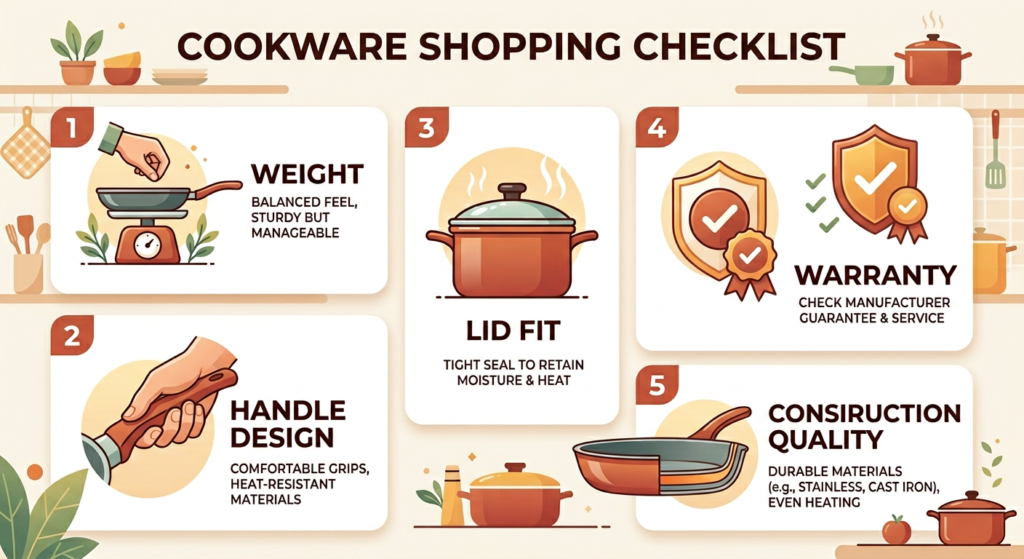
The Smart Buyer’s Checklist
Before spending a dime on stainless steel cookware, run through this checklist I’ve developed over hundreds of product evaluations.
Construction Verification
- Confirm fully-clad construction (not just encapsulated bottom)
- Verify core material is aluminum or copper
- Check that cladding extends through handles on premium pieces
- Look for 18/10 or 18/8 stainless steel designation
Practical Handling Assessment
- Lift the filled pan—can you comfortably manage the weight?
- Test handle ergonomics and stay-cool performance
- Check lid fit for tight seal and steam retention
- Verify compatibility with your cooktop (especially induction)
Value Indicators
- Warranty length and terms (lifetime warranties signal confidence)
- Country of manufacture (USA, Belgium, France indicate quality control)
- Independent testing results from Cook’s Illustrated or Consumer Reports
- Availability of replacement parts (handles, lids) for long-term maintenance
For our top cookware picks across all categories, explore our curated best of collections and in-depth product reviews.
What to Actually Buy: My Practical Recommendations
Start with these essential pieces rather than bloated 15-piece sets full of items you’ll never use:
- 10-12″ Skillet: Your daily workhorse for searing, sautéing, and pan sauces
- 3-4 Quart Saucier: Curved sides make stirring and whisking easier than straight-sided saucepans
- 6-8 Quart Stock Pot: For pasta, stocks, and batch cooking
- 8″ Skillet: Eggs, small portions, and quick tasks
This focused collection handles 90% of cooking tasks. Add specialty pieces as your skills and needs evolve.
Frequently Asked Questions
What is the best stainless steel cookware brand for home cooks?
All-Clad remains the gold standard for home cooks seeking professional-grade performance. However, brands like Demeyere, Made In, and Cuisinart offer excellent alternatives at various price points depending on your cooking style and budget.
Is 18/10 stainless steel better than 18/8?
The difference is minimal for cooking purposes. 18/10 contains slightly more nickel (10% vs 8%), providing marginally better corrosion resistance and a shinier finish. Both are excellent choices for cookware, and you shouldn’t pay significantly more just for the 18/10 designation.
How many ply should stainless steel cookware have?
3-ply (tri-ply) cookware offers the best balance of heat distribution, weight, and value for most home cooks. 5-ply provides slightly better heat retention but adds weight and cost. Beyond 5-ply is largely marketing with diminishing returns.
Why does food stick to my stainless steel pan?
Food sticks primarily due to improper preheating or incorrect temperature. Always preheat your pan for 2-3 minutes over medium heat, add oil when the pan is hot, and wait until the oil shimmers before adding food. The pan should pass the water droplet test—water should bead and dance across the surface.
Can stainless steel cookware go in the dishwasher?
Technically yes, most stainless steel cookware is dishwasher-safe. However, I recommend hand washing to preserve the finish and prevent water spots. Harsh dishwasher detergents can cause discoloration over time, and the high heat can damage handles on cheaper sets.
My Top Recommended Gear
Based on my testing and real-world use, these products represent the best value at different price points:
- Premium Pick: All-Clad D3 Stainless Steel 10-Piece Cookware Set – The benchmark for professional-grade home cookware with lifetime durability.
- Best Value: Cuisinart MultiClad Pro 12-Piece Cookware Set – Exceptional performance-to-price ratio that rivals cookware costing three times more.
- Budget Champion: Tramontina Tri-Ply Clad Cookware Set – Consistently outperforms expectations and earns recommendations from major testing publications.
Disclaimer: This post contains affiliate links. As an Amazon Associate, I may earn a commission from qualifying purchases at no additional cost to you.