
Roasting pan size should be settled with an oven measurement before you order the turkey. A pan described as 16 inches can occupy considerably more shelf space once its handles are counted, while a tall rack can lift the breast closer to the upper element than you expected.
For many whole turkeys up to roughly 20 pounds, a pan around 16 × 13 inches is a useful starting point—not a universal capacity promise. This guide turns that starting point into seven checks for your actual bird, oven, gravy plans, and storage space. Buy only after those checks agree.
Affiliate disclosure: As an Amazon Associate, we earn from qualifying purchases. Recommendations below are based on published specifications, not our own hands-on testing. Images are AI-generated editorial illustrations and do not depict specific recommended products.
Table of Contents
Roasting pan size chart: start with the bird
Use the following turkey roasting pan size chart to narrow the shelf, then verify the individual pan. Williams Sonoma’s roasting guidance gives these minimum sizes. The weight bands refer to whole turkeys; they do not describe spatchcocked birds or a tray of separate portions.
| Whole turkey weight | Published minimum pan dimensions | What to verify next |
|---|---|---|
| Up to 12 lb | 14 × 10 × 2¾ inches | Body width and rack fit |
| Up to 16 lb | 15¾ × 12 × 3 inches | Leg clearance and handle span |
| Up to 20 lb | 16 × 13 × 3 inches | Loaded height and safe lifting |
| Above 20 lb | Check a model-specific capacity | Do not extrapolate from rim length alone |
Notice that these pan depths differ from the shallower conventional-roasting guidance discussed below. They are shopping examples from one retailer, not a replacement for your recipe or appliance manual. A roasting pan size chart starts a measurement conversation; treating it as a guarantee removes that benefit.
Two turkeys carrying the same weight label may have different proportions. An unusually broad bird can be awkward in a narrow oval pan even when the advertised weight sounds suitable. Keep the entire bird over the pan so juices cannot escape onto the oven floor. Leave working space to position it without squeezing it against the walls.
1. Separate interior space from the advertised size
Measure roasting pan size in three directions
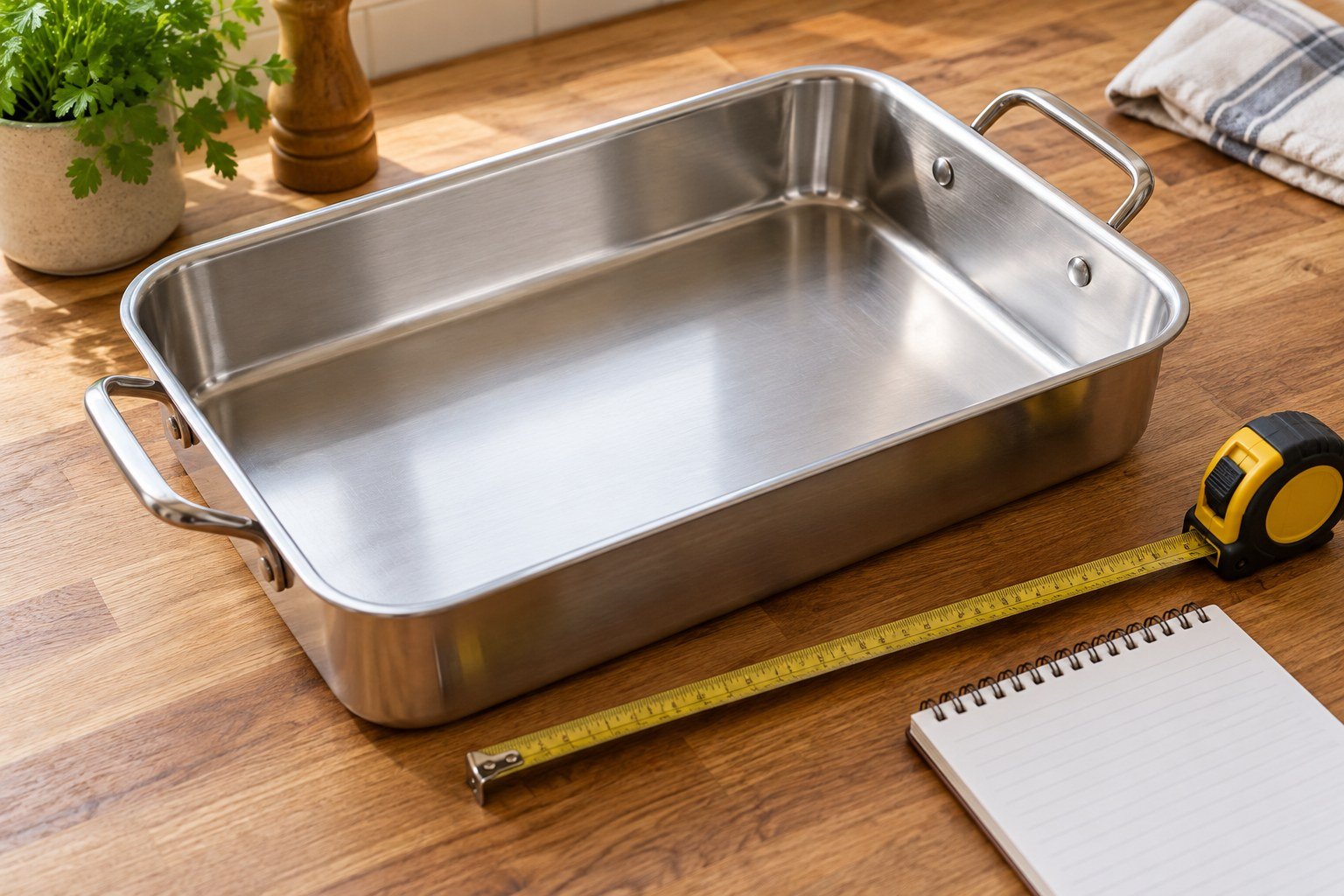
Record the usable interior length and width for your roasting pan size, the outer handle-to-handle footprint, and the total height with rack and food. Those are three different buying decisions. The interior roasting pan size determines whether dinner fits; the second determines whether the pan enters the oven; the third determines where the oven shelf must sit.
For example, Cuisinart’s current 16-inch Chef’s Classic model 7117-16URP1 lists overall dimensions of 20.7 × 12 × 4.9 inches. Its product name therefore cannot stand in for a 16-inch oven-depth measurement. Check which dimension includes handles and whether the stated height includes the rack before comparing models.
Put a tape measure across the cold pan you already own. If it has performed well for a previous turkey, save its usable measurements and the bird’s weight as a reference. If it failed, record the exact failure—overhanging legs, cramped handles, or excessive height—rather than simply writing “too small.”
2. Test the complete footprint in a cold oven
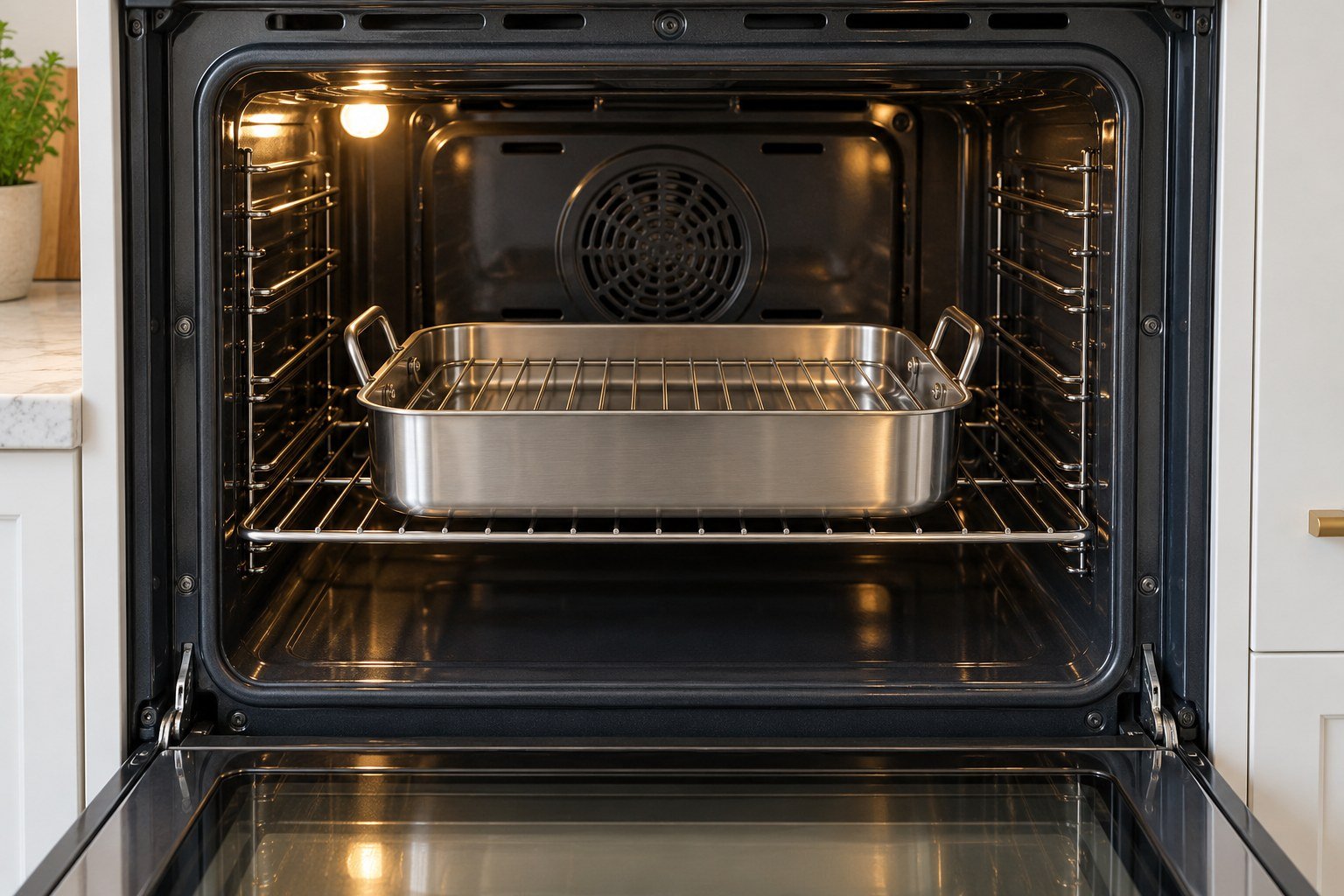
Measure at the intended shelf position, with the rack in place. Shelf supports, the back fan housing, and the closed door can reduce usable space. An oven’s advertised width describes the appliance, not the rectangular opening available to your chosen roasting pan size.
Cut a paper or cardboard template to the pan’s published outer dimensions and test it only in a cold, switched-off oven. Include handles in the outline. Remove the template immediately afterward; it is a measuring aid, never something to leave inside for preheating. A physical trial exposes awkward angles that a single width measurement misses.
GE’s poultry-size guidance calls for at least one inch of air space around the food on every side, including above and below. Follow your own appliance manual where it gives specific clearances. A pan that just wedges onto a shelf has not passed a practical fit check.
Do a second check with oven mitts before the oven is hot. Can you grasp both handles without pressing your knuckles against the cavity? Can the shelf move as the manual allows without tipping the pan? The right roasting pan size includes the room needed to remove dinner, not merely insert empty cookware.
3. Count the rack and bird when checking height
Measure from the oven shelf to the top of the loaded bird, not just to the pan rim. A high V-rack may cradle poultry securely but uses some of your vertical clearance. A low flat rack leaves a different arrangement beneath the food. Compare those layouts with the rack supplied with the actual model.
For conventional whole-turkey roasting, the CDC recommends a pan 2 to 2½ inches deep. Deep walls can be useful for containing liquid, but extra wall height is not automatically extra cooking value. Follow a tested recipe designed for your cooking method instead of assuming the deepest vessel is best.
Check that a replacement rack sits steadily on the base, clears the handles, and supports the bird without sliding. Do not balance a large turkey on a cooling rack of unknown oven rating. The roasting pan size and rack geometry must work together; matching their nominal lengths alone is not enough.
The Tramontina Prima 16.5-inch deep stainless roasting pan is worth considering if you specifically want a V-rack and basting grill. Its deeper layout makes rack height and oven clearance particularly important; choose it for that configuration rather than assuming “16.5-inch” guarantees your turkey fits.
4. Match the base to your gravy method
Oven compatibility does not establish stovetop compatibility. Before planning gravy across two burners, check the exact roaster’s instructions and your hob manual. A wide rectangular base may bridge zones awkwardly, and induction requires both a suitable magnetic construction and a shape the cooktop can recognize.
This catches buyers of familiar brands. All-Clad’s roaster comparison lists its D3 large flared roaster as stovetop compatible excluding induction, while its stainless oval model includes induction. “Stainless steel” and a recognizable logo do not settle that question. Our stainless steel cookware guide explains the broader material tradeoffs.
If the manufacturer does not approve burner use, transfer the drippings to a suitable saucepan and make gravy there. You can still choose a roaster for good oven handling. Do not pay for a larger roasting pan size solely to span two burners when your actual plan is to finish the sauce separately.
The Cuisinart Chef’s Classic 16-inch roaster with rack, 7117-16URP1 is a straightforward stainless option for occasional family roasts. Consider it when you want an uncoated pan and removable steel rack, but compare its 20.7-inch published overall length with your oven before ordering.
A roasting pan size comparison also needs the model code. Avoid confusing that Chef’s Classic with the MultiClad Pro MCP117-16BR. Cuisinart currently marks the latter discontinued, even though older reviews still recommend it. Similar product names can conceal different construction, dimensions, and availability.
5. Avoid buying empty space you will not use
A much larger base spreads a small roast’s drippings across more exposed metal. That can make the liquid reduce quickly and leave patches that darken before the meat is ready. This is a reason to match roasting pan size to the meal, not a claim that one extra inch always burns gravy.
Imagine two households: one roasts a whole turkey once a year; the other cooks a small chicken most Sundays. The first may justify a dedicated large pan. The second may get better use from an existing oven-safe skillet or smaller roaster. Compare roasting pan size with everyday portions before deciding that a holiday-sized pan should become the default.
When drippings are drying out, follow your recipe’s instructions for adding liquid carefully; do not suddenly flood hot fat. Monitor the exposed areas during cooking. A larger roasting pan size changes what happens around the meat, so copying a timing chart without checking the pan can miss the part that is burning first.
Spatchcocking also changes the calculation: the bird becomes flatter but wider. A whole-bird weight rating no longer tells you enough about its footprint. Choose a tested spatchcock recipe and check the pan it specifies. For smaller roasting jobs, our cookware buying guides can help you compare equipment you may already own.
6. Check the weakest temperature limit
Look up the oven rating for the pan, rack, lid, and any removable parts separately. Use the lowest applicable limit. A stainless pan can be suitable for a temperature that its coated rack cannot tolerate; the word “stainless” in the listing does not describe every surface in the box.
All-Clad’s category guidance, for example, lists stainless roasters up to 600°F and nonstick racks up to 375°F. Those figures illustrate why the exact accessory matters; they are not instructions to cook every turkey at either setting. Read the current manual for the model you actually receive, particularly if your recipe starts with a hot blast.
If you prefer uncoated cookware, inspect the rack as closely as the pan. A stainless body paired with a coated rack is a mixed-material purchase. Our PFAS-free cookware label guide explains why claims such as “PFOA-free” need more context before you use them as a buying shortcut.
The right roasting pan size does not determine doneness. USDA specifies 165°F throughout a whole turkey, checked in the innermost thigh and wing and the thickest breast with a food thermometer. Pan fit and browned skin cannot replace those measurements.
7. Rehearse lifting, cleanup, and storage
Add the pan’s empty weight to the food before thinking about handling. As a simple planning example, a 6-pound pan carrying a 20-pound turkey already totals 26 pounds, before drippings or vegetables. That is arithmetic, not a measured product-test result. Choose a roasting pan size and load you can control with both hands.
Prepare a stable, heatproof landing area beside the oven. Keep the path clear, use dry mitts, and avoid twisting while holding a heavy pan. If the planned load feels beyond your ability, change the meal format before cooking—smaller birds or portions may be more manageable when prepared according to appropriate recipes.
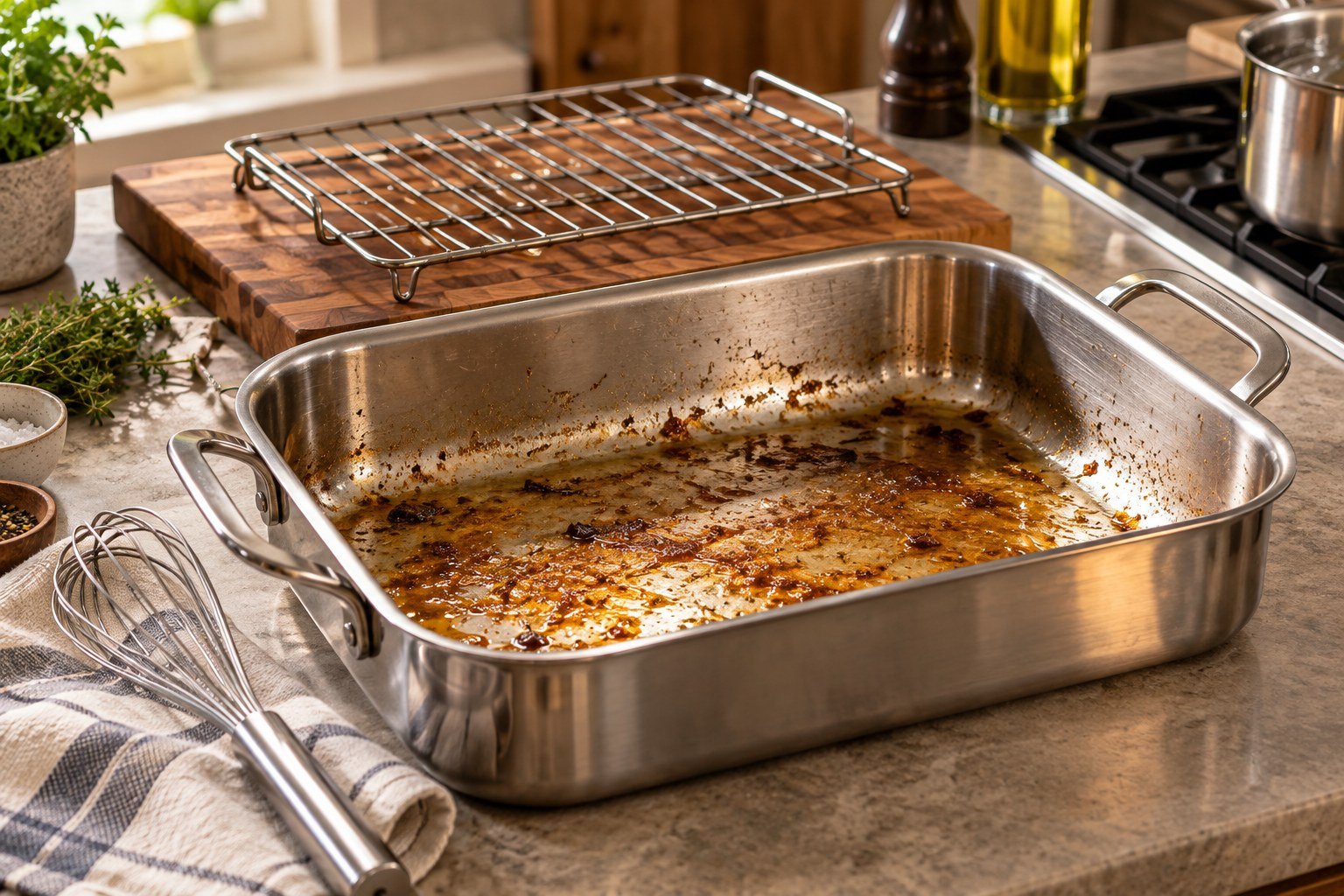
Cleanup is another roasting pan size test. Will the pan sit in the sink without straining its handles against the sides? Can you reach the corners with a nonabrasive sponge? Let it cool before washing and follow the maker’s care instructions; an awkward sink fit is a recurring cost that a holiday photograph never shows.
For gravy preparation, the OXO Good Grips Good Gravy 4-cup fat separator is useful when you want to drain settled juices from beneath the fat. Its strainer and bottom-release mechanism reduce the need to maneuver a heavy roaster repeatedly; check the fill limit and handle hot liquid carefully.
Finally, check roasting pan size against the cupboard with the rack stored inside the pan. Upright handles that improve lifting can make stacking awkward. If this will be your least-used cookware, borrowing a correctly sized pan may be more sensible than storing an oversized purchase all year. Our starter cookware guide helps put occasional equipment behind daily essentials.
Before checkout, photograph your measurements and keep them with the model number. Ask the seller to clarify any listing that mixes interior and overall dimensions instead of guessing which figure includes the handles. Check the return window before a holiday purchase, so there is time to try the empty pan in the cold oven. Keep its packaging until that trial is complete, and retain the manual with its temperature limits for later reference. A roasting pan size mistake is easier to resolve before the first cooking session than while a prepared turkey waits on the counter.
Watch how roasting equipment works together
America’s Test Kitchen’s “The Best Equipment You Need For Roasting” provides a visual companion for comparing pans and supporting tools. Use its demonstrations to assess handling and design, then verify current model specifications independently: older video recommendations may refer to products that have changed or been discontinued.
Frequently asked questions
What roasting pan size do I need for a 20-pound turkey?
Start around 16 × 13 inches, then check the individual manufacturer’s capacity, usable interior, rack, and outer footprint. A weight band is only a shopping starting point; turkey shape and oven clearance can change the answer.
Will a 16-inch roasting pan fit in a small oven?
Not necessarily. The name may exclude handles. Compare the full outer dimensions with the usable oven shelf and closed-door clearance, then check loaded height and the appliance manual’s airflow requirements.
Can a roasting pan be too big for a turkey?
Yes. A very large base exposes more drippings to heat and can let them reduce quickly. Match the pan to the bird and monitor the liquid according to your recipe rather than choosing the largest pan available.
How deep should a turkey roasting pan be?
For conventional roasting, CDC guidance specifies 2 to 2½ inches. Some commercial roasters are deeper. Choose a tested method, consider rack height, and verify that the complete loaded arrangement fits your oven.
Do I need a rack in my roasting pan?
A suitable oven-safe rack lifts the bird above the pan base and drippings. Check that it sits securely and supports the food. Do not substitute an unknown cooling rack without confirming its oven rating and fit.
Can every stainless steel roasting pan go on induction?
No. Check the exact model’s manufacturer instructions and your cooktop’s requirements. A steel-looking surface does not establish a compatible magnetic base or suitable footprint. Transfer drippings to an approved saucepan if burner use is not permitted.
Before you buy: write down the bird’s approximate footprint, the oven’s usable space, the pan’s overall dimensions, and the rack’s rating. The best roasting pan size is the smallest suitable option that passes every check—not the biggest number on the shelf.
Leave a Reply