Walk into a store in Maine today and try to buy a classic Teflon pan. You might not find one. That’s not a glitch — it’s the 2026 PFAS cookware ban. On January 1, 2026, a wave of new state rules took effect that ban the sale of cookware made with PFAS “forever chemicals.” Five states now enforce a PFAS cookware ban, and this is only the beginning.
If you’ve heard scary chemical claims before and rolled your eyes, I get it. You’ve been burned by health panic that turned out to be nothing. So let’s skip the fear and look at what’s actually true. Everything below comes from state laws, environmental regulators, and the cookware companies’ own moves — not a wellness blog.
Is Nonstick Cookware Safe? What the Industry Argues
I want to earn your trust here, so I’ll start with the part most articles hide. The cookware industry has a real argument.
The coating on your nonstick pan is made from a fluoropolymer called PTFE. Industry experts say PTFE is inert. It doesn’t bind to human cells. One trade group spokesman put it bluntly: the medical industry has used fluoropolymers inside the human body for decades with no toxicity.
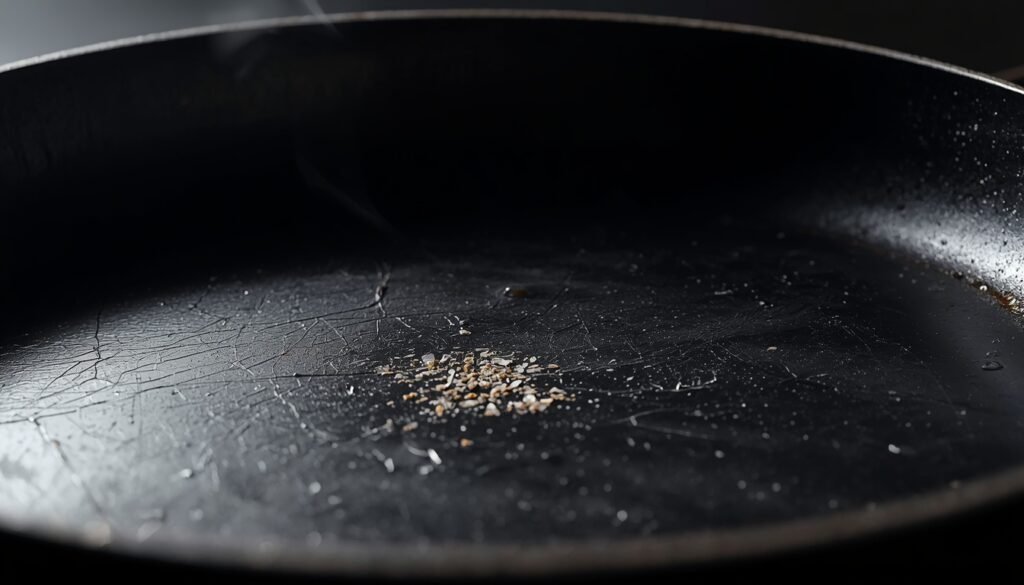
That’s a fair point. I’m not going to pretend it isn’t.
But here’s the thing. That argument answers the wrong question. And once you see why, the whole picture changes.
Why PFAS “Forever Chemicals” Get Banned (It’s Not Your Stovetop)
The bans don’t target the pan while you cook eggs. They target the whole life of the chemical.
PFAS get made in factories. They get into water and soil. They end up in the pan. Then the pan gets thrown away. Every step leaks these chemicals into the world. And they never leave.
That’s why people call them “forever chemicals.” They don’t break down naturally. They build up in water, soil, and even our bodies.
So even if your specific pan is safe on your stove, the system that makes it isn’t. The ban attacks the pipeline, not just the product. That’s a smarter target than critics admit.
PFAS Health Risks: What the Science Actually Shows
Let’s talk about the harm. Not vague fear — specific, documented links.
Health regulators tie PFAS exposure to real conditions. The EPA links these chemicals to cancer, thyroid and other hormonal effects, and developmental problems in children. Maine’s environmental department listed the risks even more plainly: low birth weights, weakened immune systems, and cancer.
Now, a skeptic will say “linked” isn’t “proven.” Fair. But look at who’s convinced. A top pediatrician and epidemiologist at Boston College — a scientist who directs a global health program and co-led a major commission on plastics — reviewed this. He called Maine’s law the most ambitious chemical-policy intervention in the United States in decades. That’s not a wellness blogger. That’s a researcher staking his name on it. When a state environmental agency and a Boston College epidemiologist land in the same place, that’s not fringe — that’s a consensus forming.
Which States Have Banned PFAS Cookware in 2026
As of 2026, five U.S. states ban the sale of cookware with intentionally added PFAS: Minnesota (effective January 2025), followed by Colorado, Maine, Connecticut, and Vermont (all effective January 1, 2026). These laws prohibit selling nonstick cookware coated with PTFE, the most common “forever chemical” coating.
And this isn’t a fringe idea from one crunchy town. Look at the scale. In 2026 alone, nearly 100 state PFAS bills were introduced across 17 states, with 280 more carried over from 2025. That’s not a trend. That’s a stampede.
Minnesota led with a ban effective January 2025. Colorado, Maine, Connecticut, and Vermont followed on January 1, 2026. These are real laws. They make it illegal to sell cookware that has PFAS added on purpose. That includes the PTFE coating on most nonstick pans. When this many states move at once, something real is happening.
Why Cookware Brands Are Going PFAS-Free
Here’s the part that should end the debate for any skeptic. If PFAS were harmless, companies would fight to keep selling them. Instead, they’re quietly walking away.
Big retailers moved first. REI required all cookware vendors to be PFAS-free by fall 2024. Target and Walmart started broader PFAS phase-out programs too.
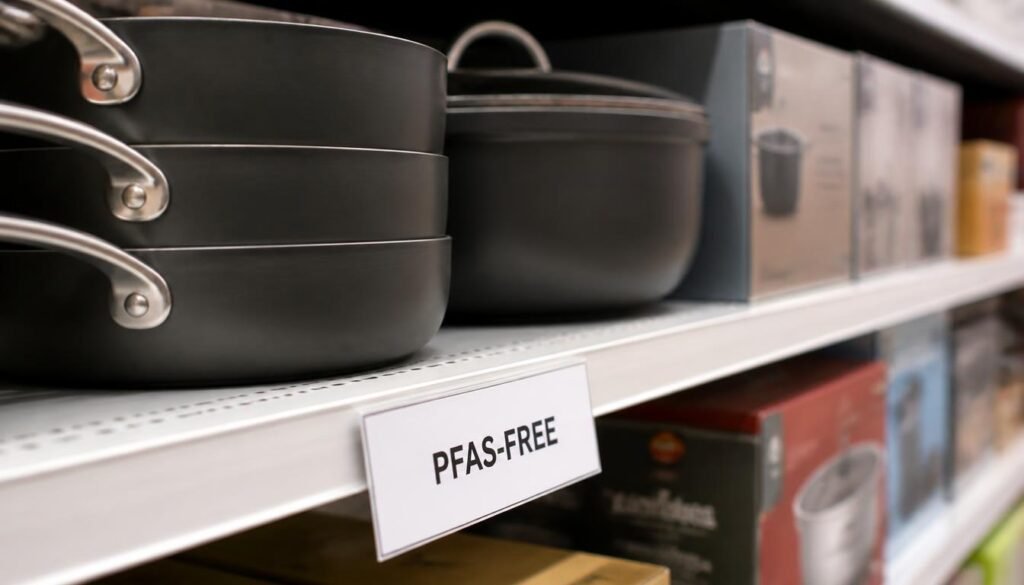
Major brands are pulling products from banned states. All-Clad, Scanpan, and Zojirushi now refuse to ship certain nonstick lines to Maine addresses as of January 1, 2026.
Think about the logic. Making state-specific pans is expensive. So when Maine bans a category, most manufacturers reformulate to PFAS-free and sell that version everywhere. PFAS-free used to be the fancy option. Now it’s just the standard.
The companies aren’t waiting to be forced. They’re already leaving PFAS behind. That tells you where the smart money thinks this ends.
Europe’s PFAS Ban: France, Tefal, and the Cookware Loophole
Want more proof this isn’t American panic? Look across the ocean.
France banned PFAS in cosmetics and textiles starting January 1, 2026. But here’s the revealing part about cookware. It was in the original draft. It got removed after heavy industry lobbying — most notably from the company that makes Tefal.
Read that again. Cookware wasn’t judged safe. It got carved out by lobbyists. As one analysis put it, cookware was not deemed “safe” — it was temporarily carved out. Environmental groups called that a major failure.
The wider EU ban is still coming. And experts don’t think nonstick pans will stay exempt for long. So the “it’s safe” story doesn’t even hold up abroad. The exemptions came from lobbying, not science.
How to Buy PFAS-Free Cookware: A Smart Shopper’s Guide
Okay. Enough about policy. Let’s make this useful for your kitchen.
Watch: a quick primer on what “forever chemicals” in cookware actually are — and the safer surfaces to reach for instead.
Here’s the good news first. You don’t have to throw anything away. The 2026 PFAS cookware ban applies to the sale of new cookware, not to owning what you have. Your current pans are fine to keep.
But if you’re buying new, the rules now guide you. Here’s how to shop smart:
- Look for clear labels. Seek out “PFAS-Free” or “PTFE-Free” on the box.
- Don’t trust marketing blindly. “PFAS-free” can mean different things by brand and state. Labels need reading, not blind faith.
- Replace damaged nonstick. If your nonstick pans are scratched or degraded, replacing them is smart for health reasons anyway — and it’s worth checking your current pans against this year’s cookware recalls while you’re at it.
I’ve stood in a cookware aisle holding a pan that said “PFOA-free” in big letters, trying to work out whether that also meant PFAS-free. It doesn’t always. That gap is exactly what some brands count on. If you’d rather skip the guesswork, popular PFAS-free lines like Caraway and Our Place spell it out on the box.
PFAS-Free Cookware That Never Needs Reformulating
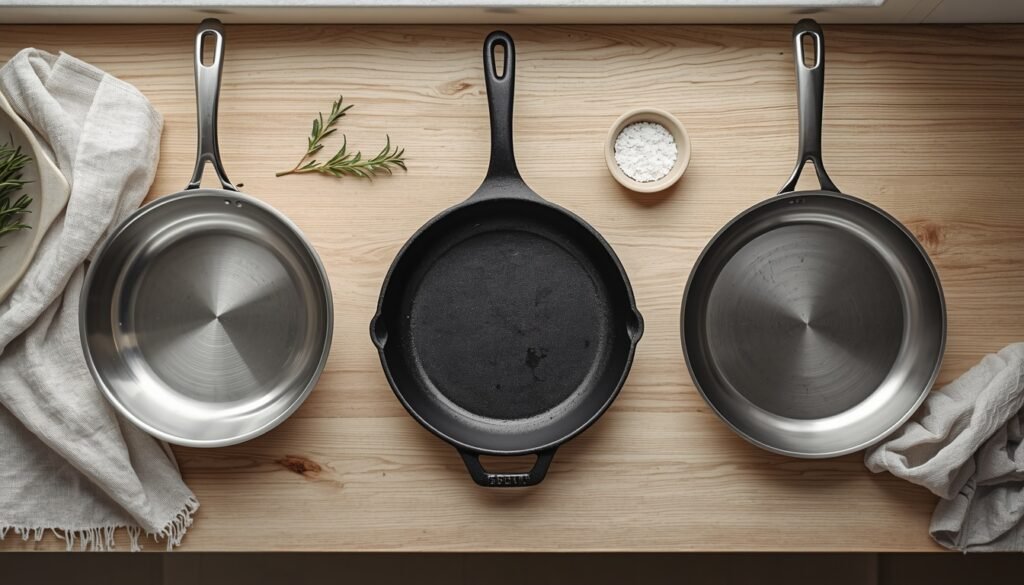
If you want cookware that never gets caught in the next chemical scare, go simple. Uncoated cookware — stainless steel, cast iron, and pure titanium — is PFAS-free by physics, not formulation. It never needs reformulating. A plain steel pan you buy today will still be safe in ten years. No coating to scratch. No chemical to worry about.
The Best PFAS-Free Cookware to Buy Right Now
Some links below are affiliate links. If you buy through them, we may earn a small commission at no extra cost to you — it helps keep this site running.
Every pick here is uncoated or genuinely PFAS-free, so none of it is touched by the 2026 PFAS cookware ban. Match the material to how you actually cook:
- Best all-rounder — stainless steel: Tramontina Tri-Ply Clad Stainless Steel Set — oven-safe, induction-ready, and PFAS-free by construction. The workhorse that sears, simmers, and deglazes for decades.
- Best forever pan — cast iron: Lodge Cast Iron Skillet — the cheapest “buy it once” option there is. Naturally nonstick once seasoned, and it will outlive every coated pan in your kitchen.
- Best nonstick feel without PFAS — ceramic: Caraway Ceramic Nonstick Fry Pan — if you want eggs to slide, this is the PFAS-free, PTFE-free way to get it. Treat it gently; ceramic coatings wear faster than steel or iron.
- Best lightweight option — titanium: Pure Titanium Frying Pan — light, tough, and inert. Confirm the listing says solid or uncoated titanium, not a “titanium-reinforced” nonstick, which can still contain PTFE.
The Bottom Line on the 2026 PFAS Cookware Ban
Here’s what I’d bet on. The 2026 PFAS cookware ban isn’t a health fad that fizzles by spring. Five states already pulled these pans off shelves. Roughly a hundred more bills are moving. The brands themselves are quietly reformulating. And every “it’s perfectly safe” line still traces back to a lobbyist, not a lab.
You don’t have to gut your kitchen. But the next pan you buy? Buy it with your eyes open.
Check the label before you pay — if it doesn’t clearly say PFAS-free, put it back on the shelf. And when your old nonstick finally gives out, replace it with stainless steel, cast iron, or titanium, and you’ll never have to think about this again.
Frequently Asked Questions
Can I still use the nonstick cookware I already own? Yes. The 2026 PFAS cookware ban restricts the sale of new cookware with intentionally added PFAS — not ownership or use. Your current pans are legal to keep. If a nonstick pan is scratched or flaking, though, replacing it is smart for health reasons anyway.
Which states have banned PFAS cookware in 2026? Five states. Minnesota’s ban took effect in January 2025, and Colorado, Maine, Connecticut, and Vermont followed on January 1, 2026. Each prohibits selling cookware with intentionally added PFAS, including standard PTFE nonstick coatings.
Is PTFE (Teflon) a PFAS? Yes. PTFE is a fluoropolymer in the PFAS family, and it’s the coating most nonstick pans rely on. That’s why “forever chemical” cookware bans sweep in the majority of conventional nonstick products.
Does “PFOA-free” mean “PFAS-free”? No — and this trips up a lot of shoppers. A pan can be PFOA-free and still use PTFE or other PFAS. Look specifically for “PFAS-free” or “PTFE-free” on the label, not just “PFOA-free.”
What cookware is guaranteed PFAS-free? Uncoated materials: stainless steel, cast iron, and pure titanium are PFAS-free by physics, not formulation. Some ceramic-coated pans are PFAS-free too, but you have to read the label — “ceramic” alone doesn’t guarantee it.
Will more places ban PFAS cookware? Almost certainly. Nearly 100 state PFAS bills were introduced in 2026 across 17 states, with 280 more carried over from 2025, and a broader EU restriction is still coming. PFAS-free is becoming the default, not the exception.
Leave a Reply