HexClad vs Nonstick Pans: Performance, Durability & Value – Which One Should You Buy?
Is the cookware you’re using secretly holding back your cooking results?
Choosing the right skillet can feel overwhelming. You want effortless food release, even heating, and a piece that lasts. This guide cuts through the noise.
We compare a popular hybrid design with standard coated options. Our goal is to show you which investment makes sense for your kitchen. For a focused look at traditional options, explore our review of the best nonstick pans.
The hybrid promises the sear of stainless steel and the release of a nonstick surface. Traditional coated pans are affordable and easy. But which one truly delivers over time?
We analyzed heat distribution, material safety, and long-term durability. Real-world testing over many months informs our findings.
Whether you sear steaks or flip pancakes, the right choice matters. Let’s find your perfect match.
Table of Contents
Key Takeaways
- Hybrid cookware combines multiple cooking surface benefits into one piece.
- Traditional coated skillets offer superior initial food release and ease of use.
- Durability and scratch resistance vary greatly between these two categories.
- Superior heat distribution is critical for consistent cooking performance.
- Long-term value depends heavily on your specific cooking habits and care.
- Material safety and composition are important health considerations.
- Your budget should align with the expected lifespan of the product.
Introduction: Setting the Stage for the Review
Selecting the right cooking surface can make or break your culinary results. Every kitchen enthusiast must balance multiple factors. Performance, durability, budget, and safety all matter.
Review Objectives and Consumer Priorities
This review cuts through marketing claims. We provide data-driven insights from extensive testing. Our goal is to help you make an informed choice.
Consumer priorities vary significantly. Traditional options focus on ease and low cost. Hybrid designs emphasize versatility and longevity.
| Priority Category | Traditional Nonstick Focus | Hybrid Pan Focus |
|---|---|---|
| Ease of Cleaning | High priority | Moderate priority |
| Food Release | Critical for users | Important but different approach |
| Affordability | Primary concern | Secondary to durability |
| Durability | Expected to be lower | Top priority for buyers |
| Versatility | Limited to specific tasks | Key selling point |
| Utensil Use | Plastic/silicone only | Metal utensils often allowed |
Our testing involved real-world cooking over months. Taste of Home testers used skillets for over a year. WIRED conducted focused evaluations on specific foods.
We examine everyday tasks and demanding applications. This helps determine which pan type excels in different scenarios. The right choice depends on your specific needs.
Product Overview & Key Features
At the heart of every great meal lies a well-constructed pan, built from layers of purpose-driven materials. The core components determine heat control, longevity, and cooking performance.
Highlights of HexClad and Nonstick Pans
The hybrid model uses a 3-ply stainless steel body. It sandwiches an aluminum core for even heating. A proprietary ceramic coating fills the laser-etched valleys.
Traditional options often have a simple aluminum body. A PTFE or ceramic coating is applied to the smooth surface. This makes them lighter and less expensive.
The materials used create a clear durability divide. Stainless steel construction is inherently tougher than most aluminum cookware.
| Feature | Hybrid Model | Traditional Option |
|---|---|---|
| Primary Material | 3-Ply Stainless Steel | Aluminum |
| Heat Core | Aluminum Core | Single Layer |
| Cooking Surface | Ceramic-Coated Hexagonal Pattern | Smooth PTFE or Ceramic |
| Oven Safe | Up to 500°F | Typically 350°F – 500°F |
| Induction Compatible | Yes | Often No (Unless Stated) |
| Warranty | Lifetime (Excludes Coating Wear) | Limited (Often 1-5 Years) |
Innovative Design Elements and Warranty Insights
The unique hexagonal design aims to protect the nonstick valleys. Raised steel ridges take utensil scratches. This allows careful metal tool use.
Features like stay-cool handles and glass lids are standard. Full induction compatibility adds versatility. These elements match high-end cookware sets.
The lifetime warranty has a key limitation. It covers manufacturer defects in the steel body. Normal coating degradation is not included. This is common, as noted in reviews of leading nonstick pans.
Performance Comparison: Heat Distribution and Cooking Efficiency
Real-world cooking tests separate marketing hype from genuine culinary performance. We examine how two popular types manage heat and handle everyday tasks.
Real-World Testing and Consumer Feedback
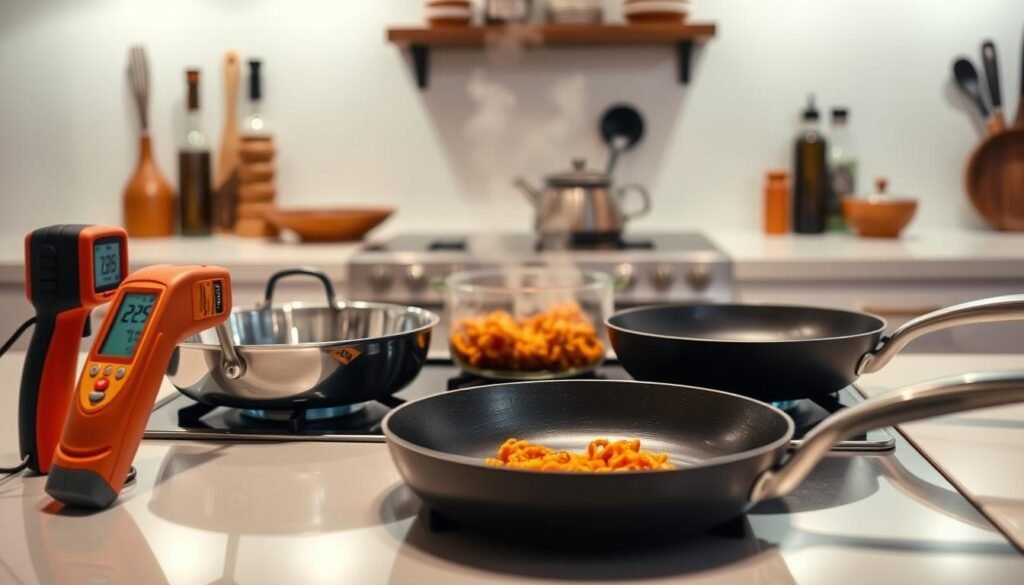
Independent testing shows the hybrid design heats evenly and quickly. It reaches temperature far faster than traditional cast iron.
For browning proteins, results are excellent. Chicken skin becomes uniformly crisp without hot spots.
However, testers note a key limitation. The surface isn’t *really* nonstick. Food can stick to the stainless steel ridges, so cooking eggs still requires oil or butter.
Comparisons Against Standard Industry Benchmarks
This creates a performance gap. It can’t handle extreme high heat for searing. Nor can it develop fond for sauces like pure stainless steel.
A detailed performance analysis against other premium brands highlights these trade-offs.
Traditional coated options excel at food release with little fat. But they fail completely with high heat or metal utensils.
Build & Materials: Construction, Durability, and Warranty Analysis
You can judge a pan’s longevity by examining its core materials and protective design. The physical build determines how many years of service you’ll get.
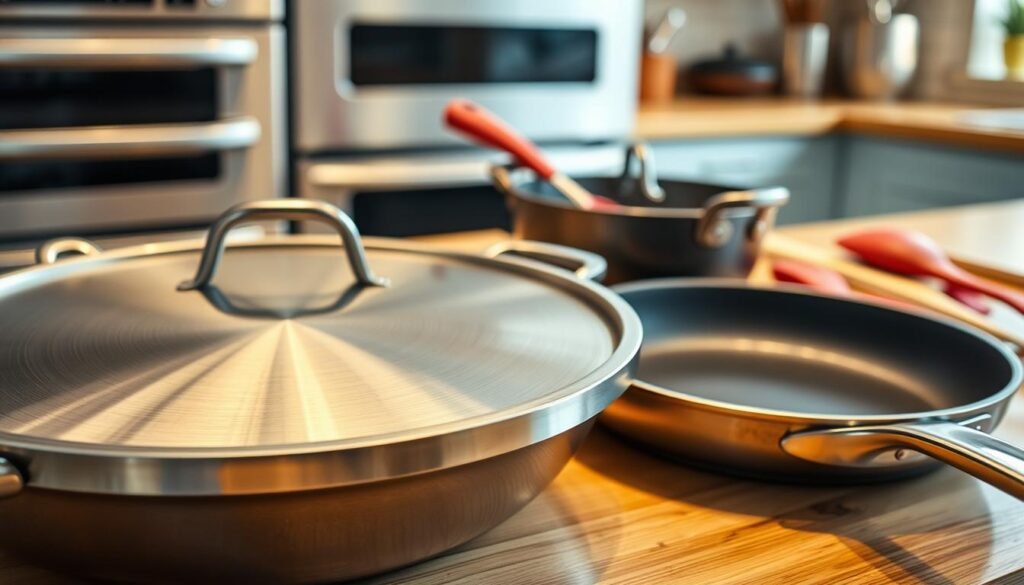
Superior cookware uses a 3-ply stainless steel body with an aluminum core. This sandwich provides even heating and resists warping. A laser-etched hexagonal lattice of stainless steel protects the ceramic coating in the valleys.
3-Ply Stainless Steel, Aluminum Core, and Lattice Design
This design aims to let you use metal tools. The raised ridges take the scratches. After 15 months of testing, such pans can still look brand new.
Only slight wear on the pattern and minor discoloration appear. The robust materials offer much better durability than simple aluminum cookware.
Lifetime Warranty and Long-Term Use Considerations
Be cautious with the lifetime warranty. It covers defects in the steel body, not coating wear. All nonstick surfaces degrade over time.
Aggressive dishwasher detergents speed up this process. A class action lawsuit against another brand highlighted issues with dishwasher safety claims. Expect to replace any pan with a coated surface every few years.
Sustainability, Safety & Toxin-Free Technologies
Modern kitchens demand more than just performance. They require peace of mind about the materials touching your food. The chemical makeup of your cookware coating is now a critical buying factor.
PTFE-Free and PFAS-Free Coatings vs Traditional Nonstick Options
Many brands now promote safer ceramic coatings. One hybrid brand uses a TERRABOND ceramic coating marketed as PFAS-free and PTFE-free. This positions it as a healthier choice.
Traditional pans often rely on PTFE coating. These can contain related PFAS chemicals. Legal disclosures confirm this for some major brands.
A lawsuit challenged the “nontoxic” marketing of these hybrid products. The company denied wrongdoing and settled. The court did not rule on the claims’ merit. For an independent analysis of its non-toxic claims, review this resource.
Neither type provides third-party test results. Consumers must trust manufacturer claims. All nonstick surfaces degrade, especially in the dishwasher.
For the absolute safest use, consider uncoated materials. No nonstick pan offers a perfect, permanent solution.
Price, Value, and Long-Term Investment Benefits
The true cost of a frying pan isn’t just its price tag. You must weigh the initial price against its expected lifespan and performance.
Cost Analysis and Comparison with Competing Brands
This hybrid brand sits in a unique price tier. A 12-inch model costs around $180.
That’s comparable to high-end stainless steel cookware, not budget aluminum pans.
| Brand & Type | Approx. Price (10-inch) | Position |
|---|---|---|
| Traditional Nonstick Pan | $30 – $50 | Budget |
| Caraway Ceramic | $115 | Mid-Range |
| Our Place Always Pan | $135 | Mid-Range |
| Hybrid Model | $169 | Premium |
| All-Clad PTFE-Free | $200 | Ultra-Premium |
Calculate cost per year. If it lasts five years at $180, that’s $36 annually.
Replacing a $30 nonstick pan every two years costs $15 per year. Pure steel can last decades for even better cost efficiency.
The lifetime warranty often excludes the nonstick coating. This limits its practical value for most users.
Your best cookware value depends on your cooking style and willingness to use oil.
HexClad vs Nonstick Pans: In-Depth User and Chef Experiences
Chef testimonials offer powerful marketing, but extended testing by everyday cooks tells a more nuanced story. The gap between professional hype and home kitchen reality defines this category.
Celebrity endorsements provide instant credibility. Gordon Ramsay famously called one line “the Rolls Royce of pans.” Chef Richard Sandoval praised the hybrid technology for combining ease with searing power.
Pros, Cons, and Professional Chefs’ Insights
These quotes highlight the design‘s potential. Sandoval’s team uses metal tools on high-BTU burners with success. This suggests robust durability for residential use.
However, professional environments differ from home cooking. Chefs have technique and tolerate a learning curve. Home editors found this curve steep.
User Testimonials from Extended Product Testing
Long-term testing reveals a split. A Taste of Home deputy editor called a hybrid her favorite after 15 months. She valued it over heavy cast iron and delicate ceramic.
Contrast this with a WIRED editor’s experience. Food stuck to the ridges, and the handle design caused a burn. This highlights the compromise of a hybrid surface.
For daily tasks like eggs, success depends on proper preheating and using oil. After nine months, testers noted pattern wear but minimal performance loss.
The consensus? This cookware suits frequent cooks who value versatility. It’s a strong choice for those seeking a multi-purpose frying pan, especially when paired with the best induction cookware for a complete setup.
Design, Usability & Ergonomics: From Handles to Induction Compatibility
A pan’s design dictates not just what you can cook, but how comfortably and efficiently you can cook it. The feel in your hand and its performance on your stove define the daily experience.
Ease of Use and Practical Kitchen Applications
The ergonomic handle is a focal point. Its bulbous center aims for a secure, cool grip. Yet, experiences vary widely.
Some testers praise the easy lift without wrist strain. Others find the shape awkward. A notable review mentioned the thinner metal near the pan can conduct enough heat to cause burns.
Induction compatibility is a major advantage. The stainless steel construction works seamlessly with modern cooktops. Many traditional aluminum pans simply cannot.
This cookware is oven-safe to 500°F. That allows for versatile techniques like starting a frittata on the stove and finishing it in the oven. Note that lids often have a lower temperature limit.
While marketed as dishwasher safe, hand washing is strongly recommended. Aggressive detergents accelerate coating breakdown. This is true for any nonstick surface.
The substantial weight feels reassuringly durable. It aids heat retention. However, it’s heavier than typical aluminum pans and may challenge some users.
A key design benefit is metal utensil compatibility. The raised hexagonal lattice protects the coating. You can use stainless steel spatulas with care, unlike with traditional nonstick options.
For practical kitchen applications, this hybrid excels at multi-step meals. Think sautéing vegetables then baking, or browning chicken before deglazing. It reduces the need to switch pans.
Cooking eggs requires a slight technique shift. Always preheat the pan for a minute or two. Use a bit of oil or butter for reliable release. The surface offers “nonstick-enough” performance rather than effortless slide.
Conclusion
No single piece of cookware is universally perfect, but one can be perfect for you. The HexClad vs Nonstick Pans decision boils down to your daily routine and budget.
Choose the hybrid model if you cook often and need versatility. You value durability, metal utensil use, and induction compatibility. It’s a strong multi-tasker for a busy kitchen.
Traditional coated pans are the smarter pick for simpler tasks. They excel at eggs and fish with less fuss and a lower upfront cost. This is great for occasional use.
For the ultimate long-term value and safety, consider uncoated stainless steel or cast iron. They require technique but last decades. Your perfect pan matches how you love to cook.