Ceramic vs PTFE Nonstick Pans: A Complete Comparison Guide (2026)
What if the “healthier” nonstick option in your kitchen actually wears out twice as fast? Choosing the right cookware is a critical decision for any home chef.
This guide cuts through the marketing hype. We provide the facts you need to make a smart investment for your cooking needs.
Not all nonstick surfaces are created equal. The performance, safety, and lifespan of your pans depend heavily on the coating technology.
We break down the core differences between ceramic and PTFE nonstick cookware. You’ll learn about durability, heat tolerance, and real-world value.
By the end, you’ll know exactly which type of pan fits your style and budget. Let’s find your perfect kitchen partner.
Table of Contents
Key Takeaways
- Two main nonstick technologies dominate the market, each with distinct pros and cons.
- Performance differences impact how you cook, clean, and replace your items.
- Heat tolerance is a major factor for searing, baking, and overall safety.
- Long-term value depends on more than just the initial purchase price.
- Proper care and maintenance can significantly extend the life of your cookware.
- Your personal cooking habits are the ultimate deciding factor.
Introduction to Ceramic vs PTFE Nonstick Cookware
The modern kitchen offers two primary paths to effortless food release. Each is built on distinct scientific principles.
Traditional options use a polytetrafluoroethylene layer over a metal core. The newer alternative employs a silica-based finish fused at high heat.
Purpose of the Comparison
This analysis cuts through marketing claims. Our goal is to give you actionable data.
You will learn which coating aligns with your routine, methods, and budget. We focus on real-world performance, not just specs.
What Home Cooks Need to Know
First, understand that “ceramic” often means a mineral layer, not solid clay. Second, modern synthetic coatings are more durable and safer than older versions.
True value involves longevity, care needs, and total cost. Your decision should balance immediate performance with long-term satisfaction.
| Feature | PTFE-Based Coating | Ceramic-Based Coating |
|---|---|---|
| Primary Material | Polytetrafluoroethylene polymer | Inorganic silica (sand-based) |
| Base Construction | Metal core (aluminum or steel) | Metal core with applied finish |
| Key Distinction | Synthetic, slick surface | Mineral-derived, fired layer |
What is Traditional PTFE Nonstick Cookware?
For decades, a slick synthetic surface has been the go-to solution for sticky kitchen dilemmas. This traditional option is built on polytetrafluoroethylene (PTFE) polymer technology.
It involves a metal base, usually aluminum, coated with this specialized layer.
Composition and Technology
The classic nonstick cookware features multiple bonded layers. Premium versions use reinforced materials and textured patterns for longevity.
Advanced technology, like some aerospace-grade finishes, creates a harder coating. This can make the surface last over a hundred times longer than basic versions.
Pros and Cons of PTFE Coatings
The primary advantage is effortless food release. Eggs and fish slide out with little to no oil, making cleanup simple.
These cookware items are versatile and affordable. They work well for sautéing, searing, and everyday tasks.
A key limitation is heat sensitivity. High temperatures can damage the coating and are not recommended.
Modern products have addressed old safety concerns. Today’s quality nonstick cookware is PFOA-free and complies with FDA standards.
What is Ceramic Cookware?
A newer entrant to the market uses a mineral-based layer for slick performance. This cookware features an aluminum core with a specialized finish.
The term “ceramic” describes this silicon-based coating, not solid clay construction.
How Ceramic Coatings Are Made
These ceramic coatings start as inorganic silica. Manufacturers apply this material to a metal base.
Next, they fire it at extreme heat. This process creates a hard, glass-like surface.
Advantages and Limitations
| Advantages | Limitations |
|---|---|
| PTFE-Free Alternative: Appeals to those avoiding synthetic polymers. | Shorter Lifespan: Nonstick properties often diminish within a year. |
| Higher Heat Tolerance: Safely handles more cooking techniques. | Careful Handling Required: Avoid metal utensils and abrasive cleaners. |
| Aesthetic Variety: Available in many attractive colors and finishes. | Prone to Chipping: Can crack from drops or thermal shock. |
This type of pan delivers excellent initial performance. However, its nonstick capability decreases with regular use.
Proper care is essential for longevity. Always use gentle tools and avoid sudden temperature changes.
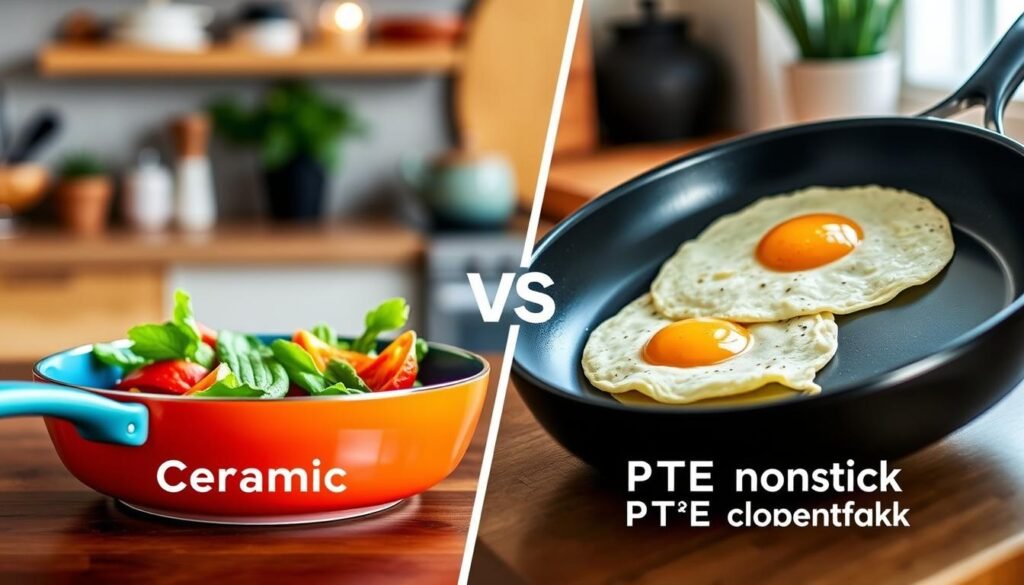
Ceramic vs PTFE Nonstick Pans
Your daily cooking results hinge on a critical choice between two distinct technologies. This comparison goes deeper than just a slick surface.
It’s about how each option behaves over months of regular use. The right pick saves you time, money, and frustration.
Key Points to Consider
The core difference is in the materials. One uses a synthetic polymer, while the other relies on a silica-based mineral layer.
This composition drives everything from longevity to heat tolerance. Understanding this helps you set realistic expectations.
Performance consistency is the major divider. Quality polymer-coated items maintain their food-release ability for years.
The mineral-based option often starts strong but fades. Its nonstick capability can diminish within a year of frequent cooking.
Think about delicate tasks like cooking eggs. A degraded mineral surface may require extra oil, while a well-maintained synthetic one continues to perform cleanly.
Heat handling is another factor. The mineral coating generally withstands higher temperatures, which is useful for searing.
For most standard stovetop tasks, both provide sufficient heat capability. The real question is longevity versus immediate results.
Your decision should weigh initial slickness against sustained reliability. For extended usability and predictable results, many find polymer-based cookware offers better value.
Those avoiding specific synthetic materials or needing higher heat may prefer the mineral alternative. For a deeper dive into this choice, consider picking the lesser non-stick evil for your.
Nonstick Performance and Durability Considerations
Durability is the true test of any kitchen tool, separating fads from fixtures. How long your cookware maintains its slick release defines its real worth.
This is where the two main options diverge most sharply. Your choice impacts your budget and cooking consistency over time.
Longevity of Coatings
Modern, high-quality traditional nonstick items are built to last. Premium polymer-based cookware with reinforced layers can deliver reliable performance for multiple years.
Advanced surface protection, like raised patterns, shields the cooking surface from utensil wear. This extends the functional lifespan significantly.
In contrast, even top-tier ceramic nonstick coatings typically wear faster. Their nonstick properties often diminish within about a year of regular use.
This means you’ll likely replace a mineral-based pan much sooner.
Resistance to Scratches and Wear
The structural makeup of each coating dictates its toughness. Polymer-based surfaces offer molecular flexibility, resisting daily stresses from utensils and heat cycles.
They handle the expansion and contraction of heating and cooling well.
The mineral-based alternative is inherently more rigid and brittle. It is prone to chipping from impacts and cracking from sudden temperature changes.
Scratch resistance varies, with reinforced traditional nonstick surfaces generally showing wear more slowly than their ceramic nonstick counterparts.
For a deeper analysis on this critical choice, consider the insights on picking the lesser non-stick evil for your kitchen.
Heat, Safety, and High-Temperature Tolerance
Before you crank up the burner, understanding your pan’s thermal limits protects your meal and your health. This is where safety and performance intersect.
Exceeding recommended temperature ranges can damage coatings and create concerns. Managing heat correctly is essential for any cooking surface.
Handling High Heat in the Kitchen
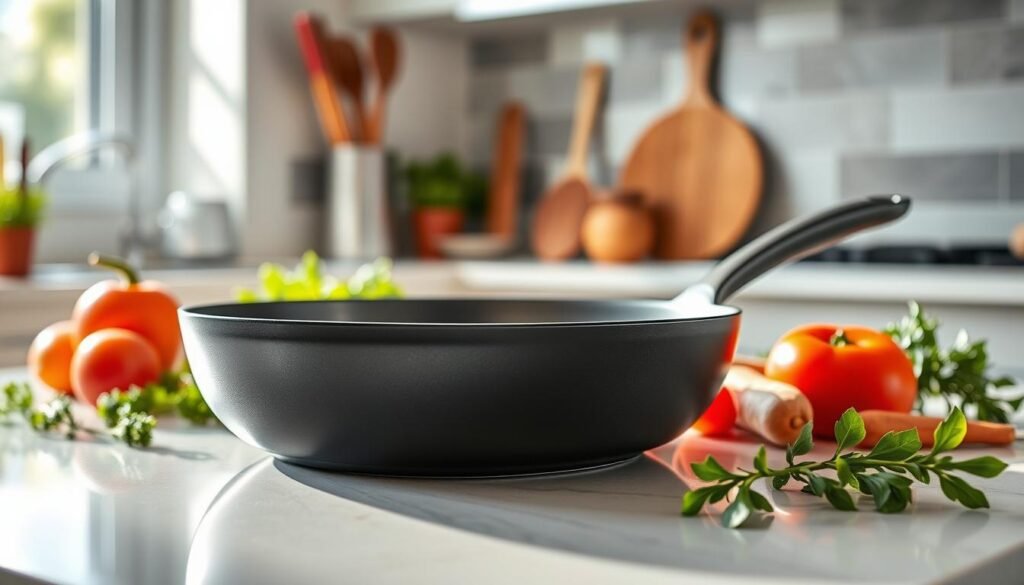
Polymer-based coatings have specific high heat limits. Extreme temperatures can degrade them over time.
Modern versions from quality brands withstand more heat than older ones. They safely handle standard stovetop cooking temperatures.
Mineral-based alternatives generally tolerate higher high temperatures. This allows for more searing and roasting techniques.
Safe Cooking and Coating Safety
Today’s quality polymer cookware is PFOA-free. This addresses past health worries.
When used within guidelines, these items are safe for daily use. Overheating can potentially release fumes, so temperature management is key.
The mineral-based option contains no PTFE or PFOA. It is a non-toxic choice for health-conscious cooks.
For most home kitchens, the practical safety difference is small. Both types are secure when used properly.
| Consideration | Polymer-Based Coating | Mineral-Based Coating |
|---|---|---|
| Max Safe Temperature | Typically ~500°F | Often ~550°F+ |
| Health Profile | PFOA-Free, modern formulations | PTFE & PFOA-Free, inorganic |
| Risk at High Heat | Coating degradation, potential fumes | More heat-resistant, fewer fumes |
| Best For | Medium-heat everyday cooking | Higher-heat searing & sautéing |
Your cooking style determines which thermal profile fits best. For a curated list of best nonstick pans that excel in both categories, explore trusted recommendations.
Design, Aesthetics, and Kitchen Adaptability
In today’s open-concept homes, the items on your stove are as much a part of your decor as your backsplash. This visibility makes the style of your cookware a key consideration.
Your choice contributes to the overall feel of your kitchen. It can express personal taste just like choosing cabinet hardware or lighting.
Color Options and Overall Style
Mineral-based ceramic pans excel in visual appeal. Manufacturers offer extensive palettes with vibrant blues, soft greens, and warm terracottas.
This allows you to coordinate your pans with small appliances or wall colors. The glossy finish conveys a modern, clean look.
Traditional nonstick pans typically feature classic blacks, grays, or stainless metallics. While less colorful, this offers timeless versatility.
These items blend seamlessly into any kitchen design scheme. Their understated look prioritizes function over flash.
| Feature | Mineral-Based (Ceramic) Cookware | Polymer-Based (Traditional) Cookware |
|---|---|---|
| Style & Color Options | Wide range of vibrant and subtle colors | Classic neutrals (black, gray, metallic) |
| Finish & Aesthetic | Glossy, smooth, modern appearance | Often matte or semi-gloss, traditional look |
| Kitchen Adaptability | Makes a bold design statement | Offers timeless, versatile compatibility |
While aesthetics matter, they shouldn’t be the sole deciding factor. The visual joy of colorful cookware is real, but balance it with performance needs for a satisfying long-term choice.
Maintenance, Care, and Cleaning Tips
Cleaning and care routines can make or break your nonstick investment. Proper maintenance ensures your pan delivers value for years. It protects the slick surface that makes cooking enjoyable.
Proper Cleaning Techniques
When new, both types clean easily. Warm, soapy water and a soft sponge remove food residue quickly. Avoid abrasive cleaners and scouring pads.
For ceramic nonstick surfaces, handwashing is essential. Even dishwasher-safe labels can be misleading. Harsh detergents may degrade the finish.
Traditional nonstick items often maintain easy cleaning longer. Their reinforced surface resists wear. Handwashing is still the best care practice for longevity.
- Always use a soft sponge or cloth.
- Never use metal utensils on any nonstick surface.
- Dry thoroughly before storage to prevent damage.
Best Practices for Long-Term Use
Avoid metal utensils at all costs. They scratch both coatings. Opt for silicone, wood, or nylon tools instead.
Proper care includes storing pans with protective layers. This prevents scratches when stacked. Also, avoid extreme temperature changes.
Traditional nonstick cookware is generally more forgiving of minor care lapses. For comprehensive guidance on selecting and maintaining your kitchen tools, explore our trusted home cookware resource.
Price, Value, and Long-Term Investment
The true cost of your kitchen tools isn’t just the price tag at the store. Real value emerges over time through dependable performance.
Both mineral-based and traditional options span wide price ranges. Entry-level pieces start under $30, while premium sets exceed $100.
Initial affordability can be misleading. A nonstick pan costing $60 but lasting three years offers a lower annual cost than a $40 alternative needing yearly replacement.
This cost-per-year calculation reveals the smarter long-term investment. Quality cookware delivers extended years of reliable service.
It offsets a higher upfront price through reduced replacement frequency. For budget-conscious cooks, accessible traditional sets often provide superior value.
Premium mineral-based ceramic cookware commands similar prices but typically lacks equivalent longevity. For a detailed analysis on whether ceramic cookware vs nonstick Teflon is worth the price, explore industry insights.
Invest in durable nonstick cookware for daily use. Consider specialized pieces only where their specific heat tolerance provides a clear advantage.
Consumer Insights and Trusted Brands
Selecting a trusted brand is a reliable shortcut to finding cookware that balances durability, safety, and ease of use. Consumer feedback highlights which manufacturers deliver consistent results.
These insights help you avoid disappointing purchases. They point to brands that invest in real innovation.
Expert Recommendations
Experts consistently stress the importance of the base metal. A responsive aluminum core heats quickly and evenly.
Stainless steel offers rugged durability and works on induction cooktops. For a premium option, hard-anodized aluminum resists scratches exceptionally well.
For specific tasks like cooking eggs, a well-seasoned cast iron skillet provides a natural, slick surface. It requires minimal oil for delicate foods.
Always use silicone or wooden utensils to protect any non-stick surface.
| Brand | Key Technology | Base Material | Best For |
|---|---|---|---|
| Circulon | ScratchDefense Coating (130x longer life) | Hard-anodized aluminum | Everyday durability & safety |
| Le Creuset | Enameled Cast Iron | Cast iron | Superior heat retention, minimal sticking |
| GreenPan | PTFE-Free Mineral Coating | Aluminum | PTFE-free cooking & attractive design |
| Staub | Ceramic Enamel (safe to 572°F) | Cast iron or ceramic | High-heat baking & roasting |
Top Brand Highlights
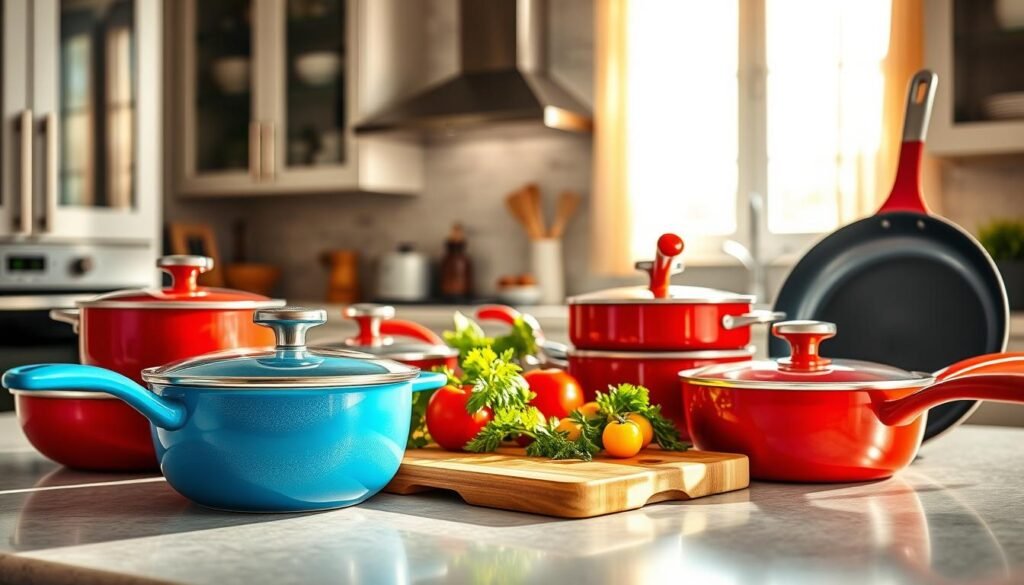
Circulon sets a high bar with its aerospace-grade coating. Le Creuset offers legendary longevity with its enameled finish.
In the ceramic cookware segment, GreenPan and Our Place provide popular PTFE-free choices. For a versatile collection, explore our guide to the best cookware sets.
Remember, a reputable brand often backs its products with strong warranties. This confidence reflects in the cooking performance of their nonstick pans.
Conclusion
Making a smart purchase means looking beyond the initial allure to lasting performance. Your choice between these two main cookware types hinges on personal cooking habits and maintenance willingness.
For most home chefs, traditional nonstick cookware delivers practical, everyday value. Its reliable surface and extended lifespan justify the investment over time.
Modern versions have addressed past health and safety concerns. They offer peace of mind for daily use.
The mineral-based alternative suits specific needs, like high-heat searing. Yet its nonstick properties often fade faster, leading to more frequent replacement.
Calculate total cost, not just price. Invest in reputable brands for cookware that performs safely and makes cooking a joy.