Calphalon vs Tramontina Pans: Which Cookware Set Is Right for Your Kitchen?
What if the most recommended cookware set isn’t the best choice for your specific kitchen? Choosing the right pots and pans is a crucial investment for any home chef.
This definitive guide cuts through the noise to compare two leading brands. Both offer quality construction, but they cater to different budgets, cooking styles, and priorities.
In professional testing, the Calphalon Premier Set scored an impressive 87, earning “Best Overall.” The Tramontina ceramic set scored 74, winning “Best Bang for the Buck.” One features durable hard-anodized aluminum, while the other uses a ceramic nonstick surface.
We’ll break down their performance across everyday cooking tasks. You’ll get a clear look at heat distribution, coating durability, oven safety, and real-world value.
Our goal is to provide actionable, unbiased guidance. By the end, you’ll know exactly which collection fits your culinary needs and makes the most sense for your home.
Table of Contents
Key Takeaways
- This is a detailed, side-by-side analysis of two top-performing cookware lines available in the U.S.
- Both brands are high-quality but designed for different user needs and price points.
- The comparison is based on professional testing scores and key performance data.
- We examine critical factors like construction materials, heat conduction, and nonstick coating longevity.
- You will receive clear purchasing advice to match the right set to your cooking habits.
- The guide covers multiple pieces and sets from each brand for a complete picture.
Introduction to the Cookware Comparison
With so many options on the market, pinpointing which brand truly delivers on its promises requires a deep dive. This review cuts through the marketing to give you the facts.
It is designed for people deciding where to invest their money for reliable, everyday kitchen tools.
Purpose of the Review
Our goal is to provide a clear, data-driven comparison. We focus on performance, durability, and overall value.
The analysis is built on professional lab tests and verified user reviews from top cookware brands. This ensures you get balanced insights, not just opinions.
“Our testing involved cooking steaks, eggs, vegetables, and sauces to simulate actual home kitchen conditions,” stated the lab report.
Experts evaluated 12 products across five key areas. The results are summarized below:
| Performance Metric | Calphalon Premier Score | Tramontina Ceramic Score |
|---|---|---|
| Cooking Performance | 92 | 78 |
| Maintenance & Clean Up | 88 | 80 |
| Ease of Use | 90 | 82 |
| Quality of Construction | 85 | 70 |
| Storage & Features | 80 | 60 |
User Intent and What to Expect
You will find detailed breakdowns of construction materials and heat distribution tests. We cover maintenance needs and long-term durability assessments.
This guide answers common questions about price differences and coating longevity. We also look at which cookware suits specific cooking styles.
Both nonstick and stainless steel options are included. This helps you identify the best cookware for your particular kitchen needs.
Brand Histories and Company Backgrounds
Every great brand has a story that shapes its approach to manufacturing and design. Knowing these origins helps you understand the quality and philosophy behind the products.
The Story Behind Tramontina
This brand began over 110 years ago in 1911. It started as a small family blacksmith shop in Brazil.
Founder Valentin Tramontina and his wife Elisa built it from the ground up. Today, it operates ten factories across Brazil and more abroad.
The company makes much more than kitchen tools. It produces agricultural equipment, appliances, and furniture.
This diverse experience contributes to its metalworking expertise. It maintains high standards across all its categories.
Calphalon’s Origins and Innovations
This American brand launched in 1963. Founder Ronald M. Kasperzak revolutionized the industry.
He invented hard-anodized aluminum cookware. This process made pots and pans far more durable.
It also reduced corrosion compared to traditional aluminum. This focus on innovation defined the company’s path.
For six decades, it has specialized in premium cookware. Its legacy is built on specific technological advances.
| Aspect | Tramontina | Calphalon |
|---|---|---|
| Founding Year | 1911 | 1963 |
| Founder | Valentin Tramontina | Ronald M. Kasperzak |
| Core Philosophy | Diversified manufacturing with quality across categories | Focused innovation in durable cookware |
Overview of Cookware Collections
Selecting the perfect cookware involves navigating a wide array of collections, each with distinct materials and purposes. Both brands organize their offerings into multiple lines. This segmentation helps buyers find the right match for their kitchen and budget.
Variety of Materials and Finishes
The material choices are extensive. You can find classic aluminum nonstick, durable hard-anodized aluminum, and premium tri-ply stainless steel.
Cast iron and enameled cast iron options are also available. These different materials create unique cooking surfaces and heat properties.
Different Product Lines and Target Audiences
One brand offers five main collections. These range from a simple Professional line to colorful Style sets.
The other features seven distinct series. They span from budget-conscious models to premium Elite collaborations.
Serious home cooks often gravitate towards the professional-grade and signature lines. Everyday users and those watching costs find great value in the classic and everyday collections.
Unique features like stackable designs and specialized nonstick coatings further define each product line.
Construction and Material Quality
The foundation of any great cookware lies in its construction and the materials used. This determines heat response, longevity, and overall performance.
Hard-Anodized Aluminum vs. Other Materials
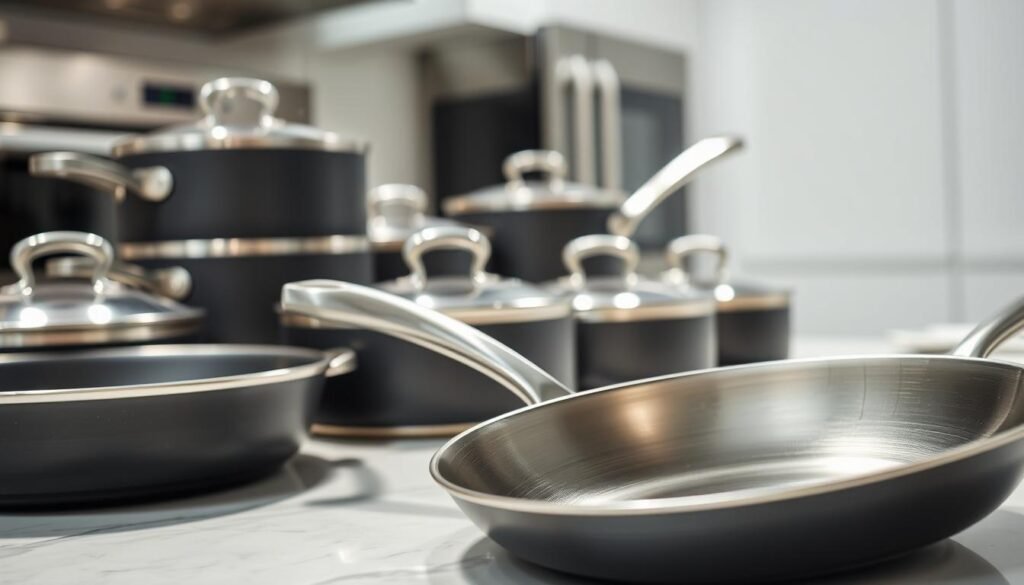
One brand pioneered thick hard-anodized aluminum. This process creates a surface more durable and corrosion-resistant than standard aluminum.
The other offers broader material variety. This includes standard aluminum, tri-ply steel, and cast iron.
Their stainless steel options feature an aluminum core for excellent heat conduction. This layered material design ensures even cooking.
Durability and Build Construction
Build robustness comes from thickness and weight. One fry pan weighs 4.4 lbs with 4.5mm walls, while another is 3.2 lbs with 3.2mm thickness.
Thicker aluminum resists warping from thermal shock. This directly impacts long-term durability.
Professional testing reflects this. One set scored 8.0 for construction quality, and another scored 7.0. The difference highlights the importance of material choice and build precision.
Design, Features, and Ergonomics
How a pan feels in your hand and stores in your cabinet can define your daily cooking experience. Ergonomic features and smart design directly impact safety and convenience.
Handle and Rivet Designs
The handle is your main point of contact. One brand uses a long, straight steel handle with a removable silicone grip.
The other offers a rounded, ergonomic shape. Its design aims to keep heat from transferring to your hand.
Rivet construction also differs. One set has three large, exposed aluminum rivets that can trap food.
The other uses two smaller, coated rivets that are easier to clean. During testing, one handle became quite hot, while the other stayed cool.
A potential issue for gas stove users is a handle-heavy design. The long steel handle can cause an empty pan to tip backward.
Lid Integration and Stackability
Both brands include tempered glass lids for visibility. One brand’s lid handles are secured with screws that may loosen with use.
The other integrates lids more securely. Its standout feature is space-saving stackability.
Uniquely designed lids allow the entire set to nest into two compact stacks. This earned a top score for storage features in professional evaluations.
The other set scored lower in this category, offering standard storage.
| Design Feature | Set A | Set B |
|---|---|---|
| Handle Length & Style | Rounded, ergonomic | Straight, 9.75-inch |
| Rivet Count & Cleanability | Two coated, semi-flush | Three exposed |
| Lid Security | Integrated design | Screw-attached |
| Stackability | Excellent, space-saving | Standard |
| Handle Heat During Use | Can get hot | Stays cool with coating |
Heat Distribution and Cooking Performance
Heat distribution is the unsung hero behind perfectly seared steaks and evenly simmered sauces. This section breaks down lab tests and real-world results to show how each set handles temperature.
Even Heating and Cold Spot Analysis
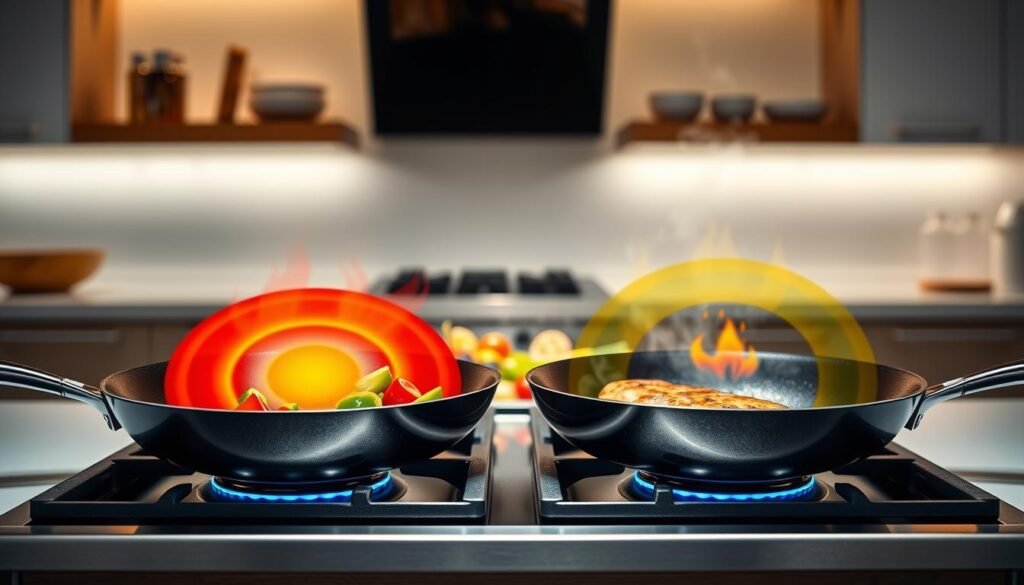
Boiling water tests revealed distinct patterns. One brand’s water boiled in 2 minutes 52 seconds with uniform bubbles, indicating excellent heat distribution.
The other reached a boil slightly faster at 2 minutes 40 seconds. However, it showed a noticeable cold spot in the center during the test.
For medium cooking heat near 350°F, the difference was more pronounced. The faster-heating pan took just 92 seconds, while the other required 142 seconds.
This 50-second gap highlights a key performance trait. One heats quickly and is very reactive. The other provides slower, more stable warmth.
| Heat Distribution Metric | Tramontina Professional | Calphalon Premier |
|---|---|---|
| Time to Full Water Boil | 2 min 52 sec | 2 min 40 sec |
| Time to Reach ~350°F | 92 seconds | 142 seconds |
| Cooking Performance Score | 8.0 | 9.0 |
Real Cooking Test Results
In actual cooking tests, the scores told a compelling story. The higher-scoring set earned a 9.0 for its performance.
It seared steaks perfectly and simmered sauces with impressive ease. Despite the water test cold spot, no practical issues emerged during meal preparation.
The other set, with its faster heat, scored a solid 8.0. Its thin construction makes it very responsive.
This means mistakes can happen quickly if you’re not attentive. The thicker, slower-heating option offers more forgiveness for distracted cooking.
Both demonstrated even heat distribution with eggs, chicken, and vegetables. For consistent results without constant monitoring, many prefer the stable best stainless steel cookware approach.
Calphalon vs Tramontina Pans: In-Depth Feature Comparison
The true test of any nonstick pan lies in how its surface holds up over months of daily cooking. This section drills into coating technologies and heat performance data.
Nonstick Coatings and Safety for Metal Utensils
One brand uses mineral-reinforced or water-based coatings marketed as metal utensil-safe. The other offers PTFE and ceramic mineral-based options.
A critical difference is metal tool compatibility. Select lines from one manufacturer claim this feature, while all nonstick options from the other require nylon or wooden tools.
It’s wise to note that using metal on any nonstick surface can eventually cause scratches.
Heat Conduction Tests and Data Insights
Initial test results were excellent for both. Eggs slid out effortlessly from each fry pan in the first month.
By month three, one began showing light sticking in the center unless oil was added. The other maintained a clean release.
After four to five months, the difference was clear. One pan required oil and showed visible wear, while the other’s surface remained slick.
The thinner construction heats faster but seems to correlate with quicker coating degradation. The thicker, slower-heating build supports longer nonstick longevity.
For a complete breakdown of these performance traits, see our detailed Tramontina vs Calphalon comparison.
Health-conscious cooks should note one brand’s ceramic option is free of certain materials, while the other’s premier nonstick contains PTFE. When evaluating the best cookware sets, coating durability is a top value factor.
Oven-Safe Temperature and Compatibility Considerations
Oven compatibility is a critical feature that separates versatile cookware from basic stovetop-only tools. This factor directly impacts your cooking methods and recipe options.
Temperature Limits and Induction Compatibility
A major difference exists between the primary nonstick sets. One is rated safe to 450°F, while the other is limited to 350°F.
This 100-degree gap matters in real heat. Finishing thick chicken breasts or a frittata started on the stove often requires a hotter oven.
The limitation stems from handle construction. Silicone grips cap the safe time inside the oven, while stainless steel handles allow higher tolerance.
The American brand offers a range across its lines. Budget sets handle 400°F, mid-tier ones like Premier go to 450°F, and premium Signature withstands 500°F.
| Collection / Material | Max Oven-Safe Temperature |
|---|---|
| Calphalon Signature Nonstick | 500°F |
| Calphalon Premier & Classic Nonstick | 450°F |
| Calphalon Simply & Select Nonstick | 400°F |
| Tramontina Stainless Steel | 500°F |
| Tramontina Nonstick (Ceramic) | 350°F |
For stove type compatibility, the ceramic set works on all cooktops, including induction. The Premier hard-anodized set is not induction-ready.
A key rule applies to both: only magnetic-base pieces (stainless steel, cast iron) work on induction. This difference in oven heat and cooktop compatibility is a deciding factor. It saves you time and expands your culinary range.
Pricing, Value, and Warranty Insights
Understanding the true cost of cookware goes far beyond the initial price tag.
You must weigh the upfront investment against long-term performance and durability.
Cost Considerations for Quality and Performance
The price gap is dramatic. One ceramic set lists for $115, while the premier hard-anodized set costs $749.
This premium price buys thicker construction and a more durable coating. It also provides a higher oven-safe limit.
| Set & Key Metric | List Price | Value Proposition |
|---|---|---|
| Tramontina 14-Pc Ceramic | $115 | Best Bang for the Buck |
| Calphalon Premier Set | $749 | Best Overall Quality |
| Cuisinart MultiClad Pro | $380 | Strong Mid-Range Alternative |
Individual pieces reflect this difference. A professional 10-inch fry pan costs $30-$40.
The calphalon premier version is $50-$53. The higher price aims for a longer lifespan.
Note the “Lifetime Warranty” fine print. It does not cover coating wear or sticking.
These issues are considered normal use over the years. The calphalon premier cost secures better build quality, not free replacements.
Determining best value depends on your priorities. Budget cooks get tremendous value now.
Serious home chefs may find the calphalon premier price justified for fewer replacements.
User Reviews and Real-World Testing Experiences
User experiences over months of cooking reveal insights no single test can capture. These reviews from home chefs provide the ultimate verdict on daily performance.

Feedback from Home Chefs and Experts
Ease of use scores tell a clear story. One set earned a 9.0 for its ergonomic design, though handles got hot. The other scored 8.0 with stay-cool handles praised for long sessions.
Maintenance scores were 8.0 versus 7.0. Users noted large exposed rivets on one set trap food, requiring extra scrubbing over time.
One expert review captured a key advantage.
“On tired nights and rushed mornings, I want the pan that doesn’t punish me for being human,”
a tester noted, choosing the more forgiving option.
Long-Term Performance and Durability
Chicken cooking tests showed distinct results. One finished in 5-6 minutes but risked uneven browning if rushed. The other took 6-7 minutes for consistent, perfect searing with low sticking risk.
The testing team believed the robustly built set could handle daily home use for many years. For the other, users accepted they might replace it sooner but appreciated its excellent price.
This trade-off defines real-world value. One offers premium feel and lasting durability. The other provides solid performance when treated gently, a great choice for budget-conscious cooks.
Care, Maintenance, and Longevity
Proper maintenance is the secret ingredient that transforms a good pan into a long-lasting kitchen companion. Following a few simple rules can dramatically extend the usable life of your investment.
Cleaning and Seasoning Tips
Ignore the “dishwasher-safe” label for nonstick pieces. The heat and detergent degrade the coating. Hand washing is the best practice for both brands.
Cleaning difficulty varies. One brand’s large, exposed rivets trap food and turn dark. The other’s smaller, coated rivets wipe clean easily.
| Maintenance Factor | Tramontina | Calphalon |
|---|---|---|
| Rivet Cleanability | Difficult, traps residue | Easy, coated & semi-flush |
| Reaction to Thermal Shock | Vulnerable to warping | Resistant, thicker build |
| Recommended Cleaning | Cool completely, then hand wash | Hand wash preferred |
When the nonstick surface starts to feel grabby, a quick re-seasoning helps. Rub a single drop of oil into the cold pan with a paper towel before heating. This can buy you weeks of better performance.
Guidelines for Extending Cookware Lifespan
Avoid metal utensils, even if the coating is marketed as safe. Let pans cool completely before cleaning. Never rinse a hot pan under cold water.
This thermal shock can warp thinner constructions. One brand showed warping in tests after such use.
All nonstick coatings wear down over time. Careful use and proper cleaning slow this process. They maximize the surface life and protect your investment.
Expert Tips for Choosing the Right Cookware for Your Kitchen
Selecting the ideal set is less about a universal ‘best’ and more about matching capabilities to your needs. This section distills our analysis into actionable advice. Use the following framework to identify which collection aligns with your routine.
Key Decision Factors
First, define your priorities. Choose the professional ceramic set if you prioritize value, cook fast, and are okay replacing it sooner.
Opt for the premier set if you cook daily, finish dishes in the oven, and want forgiveness when tired. You’ll get fewer replacements over time.
Evaluate these critical factors:
- Oven-Safe Temperature: A 100°F difference exists. One set limits you to 350°F, the other allows 450°F.
- Induction Compatibility: The ceramic set works on all stoves. The premier hard-anodized set does not.
- Storage & Design: One offers a unique stackable design. The other has a handle-heavy build that can tip on gas grates.
- Cooking Style: Fast, reactive heat suits attentive cooks. Slow, stable heat forgives mistakes.
- Budget Reality: The price gap is significant. Weigh the initial cost against expected longevity.
Your kitchen setup matters. People with induction cooktops have a clear compatibility choice.
Handle preference is personal. Some like long, cool-touch designs. Others prefer ergonomic shapes, even if they get hot.
The expert bottom line? The professional line is a good fry pan. The premier set is a better pan to live with for people who cook daily.
Conclusion
Our comprehensive testing reveals a distinct winner for daily home chefs and a top value pick for budget-conscious cooks. Both brands deliver quality cookware but serve different kitchen priorities.
The Calphalon Premier set is the overall winner. It offers superior durability, a higher oven-safe limit, and forgiving heat stability. This makes it ideal for frequent cooking and finishing meals in the oven.
For immediate affordability, the other brand provides best value. Its nonstick surface performs well, heats fast, and is lightweight. It’s a great choice if you treat it gently.
The core difference? One is a good fry pan. The other is a better pan to live with daily. As testers noted, on tired nights, you want the product that doesn’t punish mistakes.
Assess your cooking habits, oven use, and budget. For more options, see our guide to the best cookware set. Choose the set that matches your home kitchen needs.