Best Ceramic Cookware Set Under $200 (2026 Buyer’s Guide)
What if you could get restaurant-quality results in your home kitchen without exposing your family to harmful chemicals? This is the promise of modern ceramic cookware, but does it hold up under a tight budget?
Our 2026 ceramic cookware guide is dedicated to finding complete sets that deliver genuine value for under $200. We cut through the marketing to show you what really works.
More home cooks are choosing these pans for a healthy, non-stick cooking surface. You want tools that perform well and are easy to clean, day after day.
We tested multiple brands against key factors like heating, durability, and real user feedback. This helps you find the right kitchen partner for your stovetop and cooking style.
Table of Contents
Key Takeaways
- Finding a high-performing, non-toxic cookware set under $200 is very possible in 2026.
- Ceramic-coated options offer excellent non-stick performance without harmful chemicals like PFOA or PTFE.
- Key evaluation points include even heating, coating durability, ease of cleaning, and warranty coverage.
- The under-$200 price range offers a sweet spot for quality without premium costs.
- Compatibility with your stove type (induction, gas, electric) is a crucial buying factor.
- User reviews from long-term daily use reveal the true durability of the non-stick surface.
- Several brands provide professional-rated performance and value within this budget.
Introduction to Ceramic Cookware
At its core, ceramic cookware replaces traditional chemical coatings with a naturally slick surface derived from sand. This represents a major shift for health-focused kitchens. You now have two main choices.
One type has a metal base with a ceramic layer on top. The other is made entirely from ceramic material. Knowing the difference helps you shop smart.
What Sets Ceramic Apart
The key is the silicon-based coating. It comes from minerals, not synthetic polymers. This avoids harmful chemicals like PFOA and PTFE.
Many people choose it because they worry about old non-stick pans. Scratches or high heat can release unwanted substances. Ceramic options offer peace of mind.
| Feature | Ceramic-Coated Cookware | Pure Ceramic Cookware |
|---|---|---|
| Base Material | Aluminum or stainless steel core | Solid ceramic throughout |
| Induction Compatibility | Yes, if base is magnetic steel | No |
| Heat Distribution | Excellent, from metal core | Can be less even |
| Typical Use | Everyday frying pans and saucepans | Oven-to-table baking dishes |
| Durability Focus | Coating longevity | Resistance to chipping |
Emerging Trends in Kitchenware
New hybrid designs are popular. They mix great heat spread from metal with a safe, non-stick ceramic top. This creates versatile pans.
Sets now include thoughtful extras. Look for interchangeable lids and built-in storage. Reinforced rims help prevent chips.
Brands are more open about safety tests. They prove their products are free from lead, cadmium, and PFAS. Complete systems with matching pieces are now common.
Understanding the Benefits of Ceramic Coating
The shift to ceramic-coated pans brings two major wins to your stovetop: safety and superior cooking results. This layer is more than just a non-stick convenience.
Non-Toxic and Eco-Friendly Advantages
A primary advantage is freedom from PFAS, the “forever chemicals” found in old non-stick cooking surfaces. Quality brands prove their coating is free of PFOA, PTFE, lead, and cadmium through third-party testing.
You get peace of mind, especially when preparing meals for kids. From an environmental view, this ceramic coating is made without the harsh chemicals that pollute water.
Enhanced Cooking Performance
The hard, glass-like surface doesn’t react with acidic food like tomatoes or wine. Your sauces keep their true flavor.
It also spreads heat evenly, reducing hot spots that burn your food. You need minimal oil for a perfect sear.
These pans handle higher oven temperatures safely. This makes them versatile for many recipes. The coating helps food cook consistently inside and out.
Key Features to Look for in Ceramic Cookware
To get the most from your investment, focus on the construction details that separate quality pans from short-lived ones. The right features turn a simple cooking tool into a reliable kitchen partner.
Durability and Heat Retention
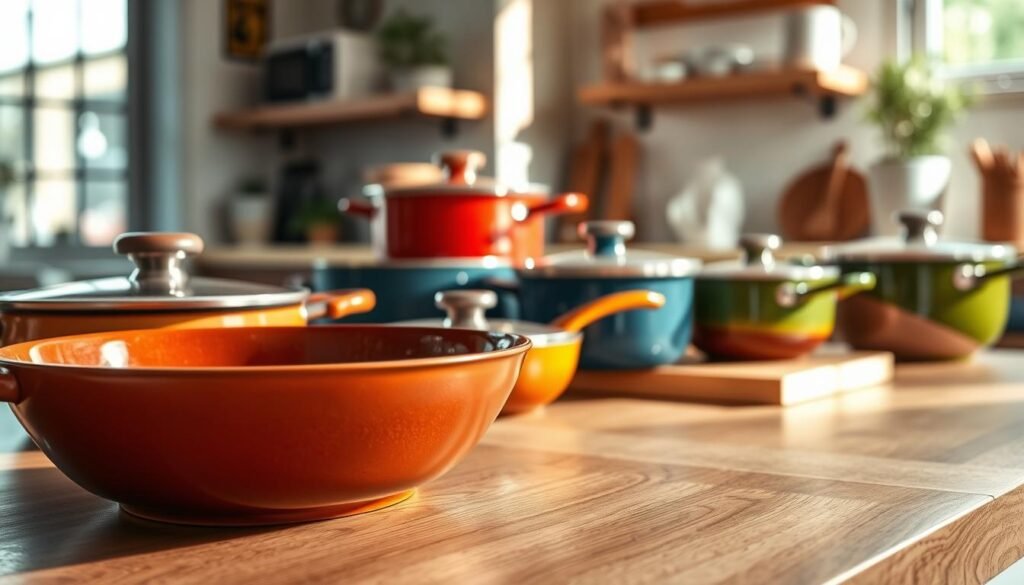
Durability in this type of cookware starts with its core. A 5-ply design, with an aluminum center layered between stainless steel, resists warping far better than thin, single-layer pans.
This multi-layer build also improves heat retention. Your pan holds a steady temperature even when you add cooler ingredients. Look for reinforced steel rims around the edge to shield the ceramic coating from chips.
Secure, riveted handles that stay cool are a must for safety. A heavier weight often signals a more robust design built to last.
Temperature Control and Even Heating
Superior temperature management is a hallmark of good ceramic cookware. The coating and base material work together to spread heat uniformly.
This eliminates frustrating hot spots that can burn your food. You get consistent results with less need to adjust the burner. Check the oven-safe rating, which can range from 200°F to 550°F based on the stainless steel or aluminum construction.
A smooth, glass-like surface ensures even contact and easy food release. This makes everyday cooking simpler and more predictable.
Criteria for Selecting the Best Ceramic Cookware Under $200
Your budget unlocks professional-grade tools if you prioritize core engineering over superficial features. The right choice balances upfront price with long-term value and daily performance.
Budget and Value Considerations
The $200 mark is a strategic threshold. Here, you access complete sets with serious construction, not just basic bundles. Look for a versatile collection of pans and pots you’ll actually use.
Evaluate the cost per piece. A set with multiple frying pan sizes, a saucepan, and a large pot offers more utility. Consider warranty length and the brand’s reputation for customer service as part of the real price.
Practical extras add value. Interchangeable lids and induction compatibility make your kitchen essentials more efficient.
Materials and Coating Quality
Core materials dictate heat spread and durability. Multi-ply stainless steel with an aluminum core resists warping and cooks evenly.
This is superior to thin, coated aluminum pans. The coating itself must be applied in layers and properly cured.
Always verify third-party testing for safety. Reputable brands provide documentation proving their coating is free from PFAS, lead, and other toxins. This is non-negotiable for healthy cookware.
Review of Top-Rated Options: Made In CeramiClad
Made In entered the ceramic-coated market with a clear mission: build the most resilient pans under $200. Their CeramiClad collection, launched after extensive development, achieves this goal with engineering that rivals professional cookware sets.
Innovative 5-Ply Design Benefits
The standout feature is a robust 5-ply design. It sandwiches an aluminum core between layers of stainless steel. This construction makes pots and pans incredibly warp-resistant.
Heat spreads evenly and retains well. This eliminates hot spots that cause uneven cooking. Your food prepares consistently every time.
Oven and Stovetop Compatibility
This cookware works on all stovetops, including induction. The entire set is oven-safe to 550°F. You can start a sear on the burner and finish it in the oven.
The collection includes multiple fry pan sizes, a skillet, a saucepan, and a large pot. Lids are interchangeable, saving cabinet space. A revised design features exposed stainless steel rims.
This smart update prevents the coating from chipping when lids are used. The non-stick surface shows excellent durability in daily use, even with metal utensils.
Handles stay cool, and rivets are flush for easy cleaning. Made In provides third-party testing results, proving the coating is free from toxins. This transparency adds to the set’s strong performance review.
Review of Top-Rated Options: Alva Maestro Collection
The Alva Maestro collection delivers professional-grade performance without the premium price tag. This set from a respected Belgian manufacturer combines sustainable practices with robust construction.
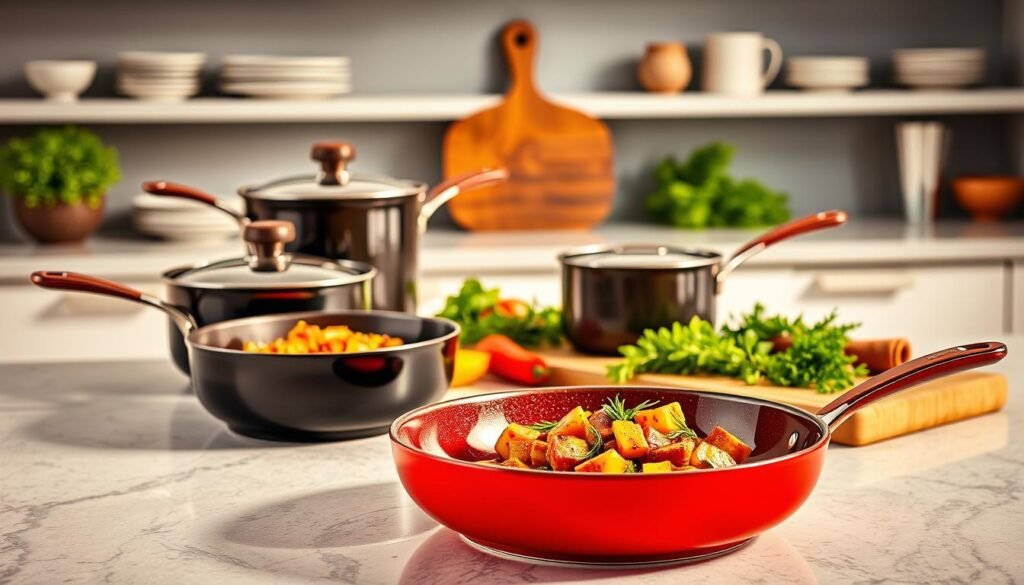
You get three frying pans and a skillet, all featuring a genuine non-stick coating. The company uses some recycled metal and eco-friendly packaging.
Consistent Heating Performance
A 3-ply stainless steel base ensures these pans heat up fast and spread warmth evenly. This eliminates hot spots for predictable cooking every time.
Straight sides maximize the usable surface area. You can prepare larger quantities of food without overcrowding the pan.
The stay-cool handles live up to their name, remaining comfortable even at high heat. This is a practical safety feature for extended frying sessions.
Independent testing confirms the coating is free from PFAS and heavy metals. Our long-term review found the surface outlasts trendier alternatives.
This cookware works on all stovetops, including induction. Note the oven-safe limit is 200°F. Hand-washing is recommended to preserve the design.
Review of Top-Rated Options: Caraway Cookware Set
A relative newcomer, Caraway distinguishes itself by making non-toxic ceramic-coated pots and pans that are as beautiful as they are functional. It carved out a niche by focusing on health, style, and smart kitchen organization.
Design Aesthetics and Built-In Storage
The set’s minimalist design comes in nearly a dozen colors. It includes essential pieces: a 10.5-inch fry pan, a 3-quart saucepan, a 4.5-quart sauté pan, and a 6.5-quart Dutch oven.
Thoughtful touches add value. The Dutch oven and saucepan share a lid, saving cabinet space. Every purchase includes a unique storage system to keep your pans organized.
Third-Party Testing for Toxin-Free Assurance
Transparency is key. Caraway immediately provides documents proving its coating is free from PFAS, lead, cadmium, and other harmful chemicals. This builds trust for health-conscious cooking.
The cookware uses a ceramic-coated aluminum body with a steel base. This makes it lightweight, oven-safe, and compatible with all cooktops, including induction. For a more in-depth look, see this detailed review.
Its commitment extends to packaging, which uses no single-use plastic. You get recycled cardboard and reusable cork trivets. Note that long-term use may lead to some coating discoloration.
Review of Top-Rated Options: Xtrema® Cookware Set
For those seeking the ultimate in chemical-free cooking, Xtrema offers a pure ceramic solution unlike any coated alternative. This set is built entirely from solid ceramic material.
It contains no metal core, synthetic layers, glues, or dyes. This approach appeals to buyers wanting the most natural surface possible for preparing food.
Pure Ceramic Advantages and Eco-Safe Aspects
The cookware is FDA-approved and meets California’s strict Proposition 65 standards. It is certified free from over 800 problematic compounds.
This includes all PFAS, PFOA, PTFE, and leachable heavy metals. Xtrema inspects every shipment for these chemicals to ensure safety.
Manufacturing uses renewable raw materials and green practices. However, the pieces are made in China despite American design.
Pure ceramic retains heat exceptionally well. You can cook food effectively on lower temperatures.
The material helps food cook evenly from the inside out. Always warm pans slowly and keep heat low to moderate.
Add oil after the pan is warmed. The smooth, non-porous glaze provides a naturally slick surface.
It is not technically non-stick like a coating. Proper technique with adequate fat gives good release.
Cleaning is remarkably easy. You can safely use abrasive cleaners like steel wool or baking soda.
This won’t scratch the surface, unlike coated pans that require gentle care. For a detailed performance review, see this staff-tested analysis.
The collection includes a skillet, frying pan, sauce pan, tea pot, and wok. This offers variety for different styles.
Substantial drawbacks exist. The pieces are very heavy, making them difficult to handle.
Real-world testing shows poor heat conduction, leading to uneven cooking. It also doesn’t work with induction cooktops.
These practical issues may give buyers pause when comparing to other sets.
Review of Top-Rated Options: CorningWare® Cookware Set
When a laboratory accident in 1953 led to a revolutionary new material, it unknowingly birthed a kitchen legacy that endures today. This cookware represents the original vision for a safe, inert cooking surface.
Its story began with scientist Donald Stookey’s creation of Pyroceram. This white glass-ceramic could handle extreme temperature swings without damage.
Legacy, Reliability, and Ease of Use
The non-porous Pyroceram doesn’t react with acidic food. It won’t change the flavor of tomato sauce or wine reductions like a metal pot can.
Nothing leaches into your food. This makes it one of the safest choices you can find. The smooth surface cleans up easily by hand or in the dishwasher.
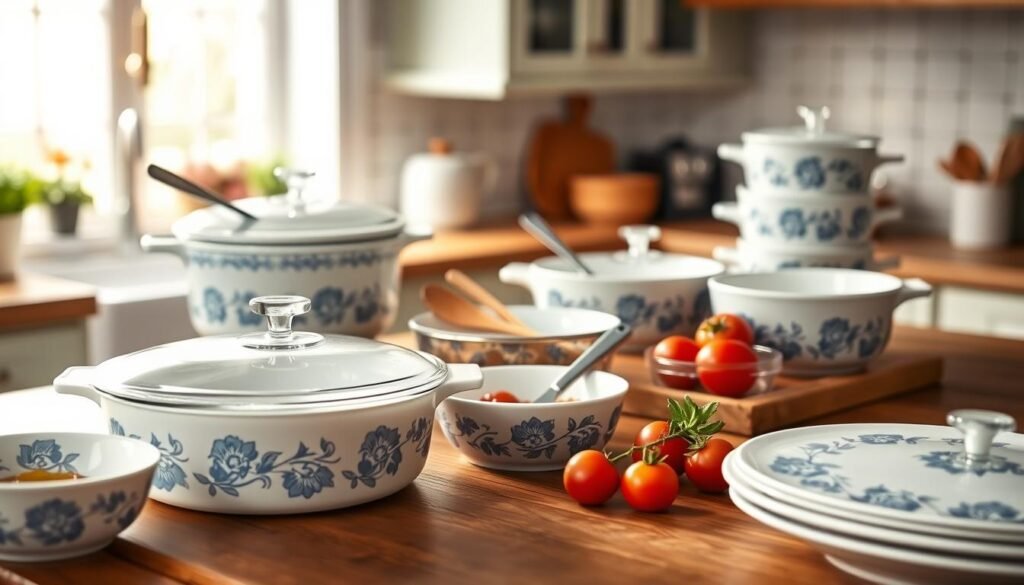
Classic pieces with the blue cornflower pattern are vintage collectibles. Finding them second-hand is a supremely eco-friendly choice. Newer lines made after 2008 work on the stovetop.
| Feature | Vintage Pyroceram (pre-2000) | Modern Stovetop Lines (post-2008) |
|---|---|---|
| Material & Origin | Original Pyroceram, made in USA | Updated ceramic formulas, various origins |
| Thermal Shock Resistance | Excellent, up to 840°F | High, but check manufacturer specs |
| Stovetop Compatibility | No, for oven and serving only | Yes, including induction for some |
| Primary Appeal | Collectibility, purity, and proven history | Convenience and full kitchen versatility |
This cookware excels at multi-tasking. You can cook, serve, and store food in the same dish. It simplifies things and reduces cleanup after a meal.
Our review finds it a unique and reliable option. Proper care ensures these pieces last for generations, making them a pan for life.
Review of Top-Rated Options: Emile Henry Ceramic Cookware
Emile Henry’s HR cookware line redefines resilience, allowing seamless transitions from freezer to oven without fear of cracking. This French manufacturer brings generations of expertise to pure ceramic pieces.
The Flame range offers a stovetop-suitable option. It serves as a modern alternative to vintage classics.
Resistance to Thermal Shock and Long-Lasting Design
The HR (High Resistance) series withstands extreme temperature swings. You can move a dish directly from the freezer to a hot oven.
These items resist oven heat up to 480°F. They are also dishwasher and microwave safe. This versatility suits modern cooking routines.
The signature ruffled tart dish showcases thoughtful design. Its shape helps baked goods release easily without greasing.
The collection includes specialty pieces like bread cloches and tagines. These pans work on induction with a disk.
The hard glaze resists scratching from metal utensils. Some fine crazing may appear over time. This is normal and does not affect performance.
The non-reactive interior won’t alter flavors of acidic food like tomato sauce. With proper care, this cookware can last a lifetime.
| Feature | Emile Henry Pure Ceramic | Typical Ceramic-Coated Cookware |
|---|---|---|
| Core Material | Solid ceramic throughout | Metal base with ceramic layer |
| Thermal Shock Resistance | Excellent (HR series) | Limited |
| Utensil Compatibility | Metal utensils safe | Use silicone or wood |
| Induction Compatibility | With induction disk | Often built-in |
| Oven-Safe Limit | Up to 480°F | Varies, often higher |
Our review finds this cookware excels in durability and even heating. It handles a wide temperature range for versatile cooking.
The smooth surface ensures easy food release. You can prepare various foods without sticking. This pan is a premium investment for any kitchen.
Incorporating Ceramic Cookware into Your Kitchen
Mastering your new kitchen tools begins with understanding how they respond to heat differently than traditional pans. A few simple technique adjustments will maximize their performance and lifespan.
Practical Cooking Tips and Techniques
Always preheat your pans slowly over low to medium heat. Ceramic retains warmth exceptionally well. You can achieve great results at lower temperature settings.
Add oil or butter after the pan is warm. This helps the fat spread evenly for better food release. It prevents sticking during the initial contact.
Choose your utensils wisely. For coated cookware, use silicone, wood, or nylon. Pure ceramic pieces can often handle metal tools.
Check the oven-safe rating before baking. Limits vary widely by construction. Avoid sudden temperature changes with pure ceramic to prevent cracks.
| Care Aspect | Ceramic-Coated Pans | Pure Ceramic Pieces |
|---|---|---|
| Recommended Utensils | Silicone, Wood, Nylon | Metal utensils often safe |
| Dishwasher Safe? | Usually not recommended | Typically yes |
| Thermal Shock Risk | Lower risk | High risk – avoid extremes |
| Cleaning | Hand wash gently | More durable for scrubbing |
Their excellent heat retention means you can often reduce burner settings. This saves energy while cooking your meals evenly.
When adding these items to your kitchen, start with one versatile frying pan. Learn how it performs before investing in a full set.
What to Consider When Buying Cookware Made Outside China
Manufacturing location is a critical, yet often overlooked, factor. It influences everything from a pan’s price to its performance over years.
This decision affects quality control consistency and intellectual property protection. It’s more than simple nationalism for your kitchen.
Domestic vs. Imported: Pros and Cons
Many brands produce in China to keep costs low. This includes Caraway, Calphalon, and GreenPan.
Others, like Made In and Fissler, make items in the USA and Germany. This often supports better long-term quality control.
“Where something is built dictates how it’s built, impacting durability from day one.”
| Origin | Typical Price | Quality Consistency | IP Risk | Example Brands |
|---|---|---|---|---|
| USA / Europe | Higher | Generally High | Low | Made In, Fissler, Alva |
| China | Lower | Can Vary | Higher | Caraway, T-Fal, Xtrema* |
*American-designed but manufactured in China.
Your final choice balances immediate price against long-term value and supply chain ethics.
Best Ceramic Cookware: A Buyer’s Perspective
Your perspective on what makes a great set evolves after you’ve used it through hundreds of breakfasts and dinners. The “best” option balances its initial price against how many years its non-stick surface lasts.
Evaluating Value for Money
Made In CeramiClad earns the top recommendation. Our testing considered variety, real cooking performance, and durability. After nearly a year of daily use, its 12-inch fry pan looks almost new.
The Alva Maestro collection shows superior value. Its coating outlasts more expensive competitors. It provides easier food release than seasoned cast iron.
User reviews reveal concerns with other options. Some beautifully designed sets show discoloration and scratching after a time. This raises questions about their long-term value.
User Reviews and Performance Testing
Real-world testing over months is crucial. It should assess how pans handle high-heat searing and low-temperature cooking. Ease of cleanup after sticky sauces matters too.
Our testing methodology focuses on voting with dollars to fight climate change.
The most eco-friendly choice is a set that lasts for years. This avoids repeated replacement. Always check warranty coverage and customer service responsiveness.
Finally, weigh professional reviews against verified user experiences. Long-term performance often differs from first impressions in your kitchen.
Maintenance and Care for Ceramic Cookware
Proper maintenance is the simplest way to ensure your pans perform like new for years. The right care routine protects your investment and keeps your cooking surface slick.
Cleaning Tips for Longevity
Always hand wash ceramic-coated pots and pans. Dishwasher detergents and heat can damage the coating over time.
Let your cookware cool before washing. Sudden temperature changes can cause thermal shock. Use warm, soapy water and a soft sponge for daily cleaning.
For stuck-on food, make a paste with baking soda and water. Apply it, let it sit, then gently scrub. This method cleans without harming the surface.
Preventing Coating Damage
Use silicone, wood, or nylon utensils. Metal tools can scratch even durable coatings. This simple habit greatly extends the life of your pan.
Add cooking oil after the surface is warm. Avoid plunging a hot dish into cold water. Store pieces with soft cloths between them to prevent chips.
| Care Aspect | Ceramic-Coated Cookware | Pure Ceramic Cookware |
|---|---|---|
| Washing Method | Hand wash recommended | Dishwasher safe |
| Utensil Safety | Silicone, wood, nylon only | Metal utensils often safe |
| Abrasive Cleaners | Avoid (can scratch coating) | Safe to use (e.g., steel wool) |
| Thermal Shock Risk | Avoid extreme changes | High risk – warm slowly |
Avoid aerosol cooking sprays. They leave a sticky residue. For storage, a thin layer of oil helps maintain the non-stick quality.
Conclusion
In the search for safe and efficient cookware, the under-$200 category has become a hub of innovation. You now have access to non-toxic surfaces that avoid harmful chemicals while delivering reliable performance.
Our testing shows Made In CeramiClad leads in durability with its 5-ply design. Alva Maestro offers exceptional value for the price. Your final choice should match your cooking habits and stovetop type.
Remember to use moderate heat and proper utensils. With care, these pans can serve your kitchen for years. In 2026, you can invest with confidence in tools that blend safety, quality, and value.